A Look Inside the NYPD Surveillance System
New York, NY —
After the Times Square attempted car bombing, the world focused on a man who was captured on videotape changing his shirt near where the bomb rigged Pathfinder was left. We never learned his identity, but the entire Times Square incident has prompted city officials to redouble efforts to expand to midtown a New York Police Department video surveillance system already well established in the city's financial district.
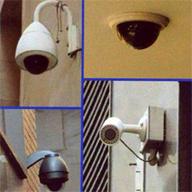
Right now, odds are pretty good that if you are in a public space south of Canal between the East River and the Hudson River, you are being watched. Hundreds of surveillance cameras send live feeds to an undisclosed location.
Jessica Tisch is the NYPD's Director of Policy and Planning for Counter-Terrorism. The Lower Manhattan Security Coordination Center, where Tisch works, feels like a cross between a movie theater and NASA's mission control.
"We call this system the Domain Awareness System, and it gives us ultimate domain awareness," Tisch says.
Under the a set of privacy guidelines defined by the NYPD in 2009, the police have pledged only to monitor public areas "where no legally protected expectation of privacy exists." Domain is a government-funded public/private partnership between the NYPD and commercial concerns like the New York Stock Exchange.
Gary Jones, a retired cop who works for the New York Stock Exchange monitoring their video feed at the center, explains how the Domain software helps him monitor hours of live video. He points out an entrance way to a secured area of the Exchange.
"With video analytics," he says, "it draws an imaginary line through where this gate opening is and if anybody passes through that line it will send out an alert."
The artificial intelligence flags irregularities -- any behavior or situation that might catch the eye of a cop on the beat or a security guard.
The zone Jones covers includes the steps of the iconic Federal Hall on Wall Street, a spot that draws a constant stream of humanity.
"There will be hundreds, maybe thousands of people out here just walking around -- visitors, people who work in the area," Jones says.
He says a dramatic change in street conditions can come without notice.
"These events can sometimes just pop up at any given time you can have protestors," he notes.
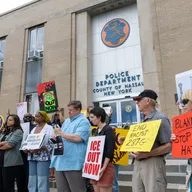
Video surveillance did not exist when the Bill of Rights was written. The NYCLU protested the NYPD's expansion of surveillance after 9/11. But the Department says it's acting well within the powers granted to it by the City Charter. Tisch says concerns over preserving the public's privacy are hard wired into how Domain is used.
"We only retain videotape data for 30 days unless it is needed for an investigative process," she says. "And to retain beyond 30 days requires several layers of authorization from top personnel at the NYPD."
The NYPD's Domain system is often compared to London's so-called Ring of Steel. Tisch says the London system has a half-million cameras but is not networked like the NYPD's.
"The implications of centralizing the system are that, for example, we can run video analytics on every single camera and so if we are doing a video canvas and we know we are looking for a guy on a bike we can type into our video analytics program 'guy on a bike,'" Tisch says. "It will search every camera on our network."
Three years ago, the New York Civil Liberties Union filed a Freedom of Information request with the NYPD for details about Domain. Donna Lieberman, the executive director of the NYCLU, says the public is at a real disadvantage when it comes to knowing when they are being covertly watched.
"Our electronic privacy laws haven't been updated since 1986," she says. "Quite frankly, policy has not caught up to technology or to the reality of our lives."
She argues that ubiquitous public and private surveillance comes with a price.
"In New York in particular, the notion of being able to go about your business anonymously is really very core to New York 's identity," she says. "That's why so many famous people and movie stars and celebrities are comfortable making their home here."
And what does she say to the popular retort that if you are not doing something wrong you shouldn't balk at surveillance that's for the collective public safety?
"That is such an attractive argument. If you've got nothing to hide then what are you hiding? When I go to the doctor, I have nothing to hide and I expect my privacy. If I go into a gay bar, I have nothing to hide, and I expect my privacy."
View the NYPD's Public Security Privacy Guidelines: Public Security Privacy GuidelinesNear Wall Street, Gayle Penn, a paralegal, says she was working in the city on 9/11. She gets some peace of mind from knowing she is under surveillance.
"We live in a different time and age, you know, post 9/11, and everything is different. You just have to adjust to it. If it means your safety, then I am all for it," she says.
Wall Street Consultant Joe Walker says, as a regular business traveler, he know it is impossible to not come under consistent surveillance. He says the public is making a trade-off.
"Yeah, you're giving up your personal privacy in relative anonymity around the streets of your community. But the question is, do you to some extent give up some of that right for the right to move in relative known status around the streets, with less danger of being taken out, whether it is by street criminal or a terrorist."
By 2013, NYPD Commissioner Ray Kelly says Domain will be expanded to include midtown from 30th to 60th Streets from river to river. No public hearings are planned. Last year, when the NYPD solicited public comment on its proposed privacy guidelines for its video surveillance, only 13 New Yorkers weighed in.
View NYPD's Ring of Steel in a larger map

WNYC is funded by sponsors and member donations