Early Start for Reading
New York, NY —
As educators wrestle with how to improve literacy, a persistent challenge is the gap in reading scores between low-income and middle class students. Studies have shown that children from poor families don’t get the same early start as students from wealthier or more educated households, who read to them at an early age. As WNYC’s Beth Fertig reports, a new literacy curriculum being piloted in New York City shows signs of promise in closing that gap.
TEACHER: So the word for today is am, watch me.
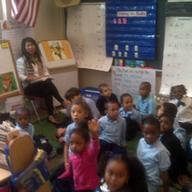
It’s a common sight to see first graders sitting on a rug learning phonics, or the sounds of the letters.
STUDENTS: Am, am.
At PS 30 in the Bronx, about 20 children are blending the letters A and M as modeled by their teacher.
Unlike other schools, where kids may practice phonics and then move onto a separate, unrelated reading lesson, PS 30 incorporates phonics into everything the children read. If the students are reading fairy tales, for example, the stories will include words the students have already learned how to sound out through phonics. First grade teacher Sandy Wong points to a list of words on the classroom wall.
WONG: They’re exposing the kids to a lot of rich vocabulary. Like stingy, startled, bounce. And they’re actually using it in the classroom. So that shows me it’s not just me reading a story to them, they’re actually using them. It’s something that’s part of their daily lives, you know?
PS 30 is among a handful of city schools using the Core Knowledge Early Literacy Program. It’s the creation of E.D. Hirsch, an academic who’s questioned why so many students enter school at a disadvantage.
HIRSCH: What is the difference between kids from low income neighborhoods and kids from high income well educated families and so on? The answer is knowledge and vocabulary. And so the schools need to teach them the most enabling knowledge and vocabulary in the most time productive way.
Hirsch has written many books including one in the 1980s called “Cultural Literacy.” Its assertion that students need the same background, or core knowledge, to succeed in school led to a debate about what that means in a multi cultural society. He went on to design a grade by grade curriculum where students work on their reading skills while studying science, arts, and civics.
His new Early Literacy program is for grades K through 2. It includes units on farm animals, kings and queens and taking care of the earth. It’s being piloted in ten schools in New York City, including PS 30. Chancellor Joel Klein says the results with kindergarteners are promising. They scored higher on tests of early reading skills than kindergarteners in comparable schools – which all had high concentrations of poor and minority students.
KLEIN: The really, the dominant gains or perhaps the only gains to speak of were in the Core Knowledge group. So it does move people across the spectrum and that’s something you look for.
Seven other districts across the country are also piloting the early literacy program.
At PS 30 in Mott Haven, Principal Roxan Marks said she was eager to try something new because her school has struggled to raise its reading scores. Just forty percent are meeting state standards –an increase from previous years. Marks says she’s seen real progress among her kindergarten students in the Core Knowledge pilot. Their reading levels are determined by books whose difficulty is rated with letters of the alphabet.
MARKS: These kids were on or above grade level. And to see a kindergartener coming out with an H, F level, that’s sort of first grade the end of first grade. So we’re hopeful it will turn our school around.
For that to happen, though, children will need to keep performing at or above grade level. Students in the Core Knowledge pilot will continue using the curriculum through second grade and the city will study whether it makes a difference. For WNYC I’m Beth Fertig.

WNYC is funded by sponsors and member donations