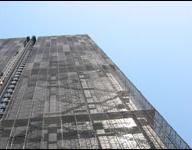
Deconstruction Zone: Two Contaminated Buildings Waiting to Come Down at Ground Zero
New York, NY —
While there's been national discussion about what is -- or is not -- being built at the World Trade Center site, there's been less attention paid to two buildings devastated in the attacks almost five years ago... that are still standing. WNYC's Bob Hennelly reports on the process of taking them down.
REPORTER: These days the crowds of tourists are getting larger and larger at Ground Zero. For most it is their first encounter of the iconic site. There is that emotional moment when they grasp the scale of the site that just isn’t captured on TV.
Then there are invariably questions about the Deutsche Bank building. It hovers over Ground Zero like a shrouded 42 story tall sentry. On September 11th the Trade Center’s South Tower tore a massive gash into the building that left it open to a hurricane of toxic ash and debris.
STEVENS: Here it is covered in this black kind of material. It is almost like it is there as a very large grave stone in a way.
REPORTER: For twenty-six year old tourist Chris Stevens the ruin was a focal point.
STEVENS: There is something very depressing about it being there. I guess it still serves a purpose and a reminder of what has happened... it’s hard to know where you draw the line between looking back and moving on.
REPORTER: That contradiction is evident as you survey the site. The debris from seven buildings were painstakingly sorted and cleared in record time. The groundwork for a new train station and all the underground utilities are underway to support what comes next.
Yet, on the northern periphery of Ground Zero is Fiterman Hall, a much less well know remnant of the attacks. The 14 story academic building owned by the City University of New York was badly damaged. Fiterman Hall and Deutsche Bank are supposed to be demolished in the next 12 months.
Before they can be taken down they must be decontaminated. Each morning at 130 Liberty Street dozens of workers file in to start their day at the Deutsche Bank. Charles Makesh oversees the Lower Manhattan Construction Command Center. He says the scale of the decontamination and deconstruction project is unprecedented. MAKESH: People are in tyvek suits, they have respirators on and they have personal protection equipment…
REPORTER: After months of often bitter debate involving the local community, elected officials and the US Environmental Protection Agency it was decided the clean-up would be conducted as an asbestos abatement.
MAKESH: There’s the containment and decontamination chambers that are used so it is treated as if it were an asbestos job. You don’t have the release into the environment nor do you have the work force exposed to it. Those are the conditions under which this building is being taken down and that is some of the reason it is so time consuming and as expensive as it will be.
REPORTER: Expensive? The public is already in pretty deep. In 2004 the state’s LMDC bought the building for 90 million dollars. Initially the budget for the clean up and deconstruction costs were estimated at 45 million. The official estimate is now 160 million. But, Makesh says there is no choice— it’s a contaminated site that needs to come down. Above ground the 2/4 of an acre site will be transformed into a public park. Underground Makesh says it will be the access point for all vehicles in and out of the entire complex.
MAKESH: Like the world trade center site it functions from below….The life blood of all the buildings basically is dependent on being able to get the material and supplies in and the waste out.
REPORTER: But the slow process of decontamination and the eventual razing of the building has been delayed further by the discovery over the past several months of over 760 human remain. The fragments were found primarily on the Deutesche Bank building roof. Mike Haberman is an LMDC’s Vice President who defends the pace of the work done by explaining that they only had access to the building after LMDC purchased it in 2004.
HABERMAN: It was sort of ironic because we were being criticized for finding the remains you know. We were actually pleased that when we took control of the building we put in place a very thorough process to find the remains.
REPORTER: The New York City Medical Examiner maintains a daily presence at the building in the hopes of finding a trace of any one of the 1,151 victims for whom no remains were found.
While the professionals involved in the deconstruction of the Deutsche bank project have complete confidence in the process, community members remain uneasy. They have been skeptical of government pronouncements ever since former EPA administrator Christie Todd Whitman declared the air at ground Zero “safe” to breathe.
Community activists have had mobilized to get city, state and Federal agencies responsible for environmental quality to step up to the plate on their behalf.
REPORTER: At this LMDC public hearings dozen of irate community members protested what they contended was a lack of transparency on plans for the demolition of the Deutsche bank. Mary Perillo who has lived in the neighborhood for over 20 years was at that explosive public hearing.
PERILLO: We were really really worried that this would be taken down and we would completely be re-dusted.
REPORTER: Long before the recent media focus on the health effects of first responders from inhaling World Trade Center dust Perillo and her neighbors were keeping up on every bit of the latest scientific research on what bureaucrats called the “potential contaminants of concern”
PERILLO: They could be dioxin, they could be mercury, we know it is fiber glass, we know it is all kind of things. Point zero three microns or less can puncture your lungs. It’s nasty….When I first a refugee out of the building I stayed in a hotel for a little while with some OSHA people who said I am not telling you this bit you need a PIOO professional respirator to go there.
REPORTER: For Perillo “there” was her eighth story apartment at 125 Cedar Street. It has the distinction of being located in the residential building closest to the activity at Ground Zero. She is just across the street from the Deutsche Bank decontamination site.
PERILLO: I’ve called the EPA and said ‘Hi-I am looking out my window and there are guys wearing tyvek suits and P100 respirators. I don’t understand why their in Tyvek suits over there and I am looking into my pot of pasta over here.
REPORTER: On the northern edge of Ground Zero in the shadows of Larry Silverstein’s gleaming new number Seven World Trade office tower, sits the 12 story CUNY college building that appears bombed out. Barbara Bowen is President of CUNY’s largest labor union.
BOWEN: We are in front of Fiterman Hall which is a building completely shrouded now in scaffolding and nets…the building until September 11th housed classrooms and other spaces for Manhattan Community College…There has not been enough attention to this building and the loss that it meant. It meant that classrooms were created out of hallways and closets…
REPORTER: Community Board One member Kathy McVeigh Hughes says CUNY has been a bad neighbor in the years since the attack.
McVeigh: It’s five years and it is an eye sore. It is a constant reminder and it is something that should have been dealt with several years ago.
REPORTER: Officials say that by the Fall of 2009 CUNY students will have a brand new state of the art facility that will cost $187 million dollars. College officials concede it took years to get their insurance settlement and to raise the money to rebuild.
Winning local public confidence from a neighborhood that has been through so much has been a major challenge for officials. Word that the Lower Manhattan Development Corporation will soon go out of business is not helping. Community activists have locked horns with the Pataki creation but they say it gave them a place to plug in.
Hughes, a civil engineer by training, heads the Community Board Number One’s World Trade Center task force.
HUGHES: A lot of unknowns are out there now with LMDC being dissolved. We don’t even know what their time frame is for going out of business…..Who will be overseeing the demolition of Deutsche bank?....So who will the community go to when they have questions and for the accountability. Also after the building is taken down who is going to own that property and get the proceeds from that sale?
REPORTER: LMDC officials don’t pretend to have answers to Hughes’s questions. They only say it will all be worked out in the next few months. The pace of development just outside the foot print of Ground Zero has the potential to make the community that lives here 24-7 feel besieged. Perhaps the enduring legacy of September 11th is that this very neighborhood—the scene of so much loss and pain is now the fastest growing residential neighborhood in the city bustling with baby carriages. Ruins and all. For WNYC I am Bob Hennelly

WNYC is funded by sponsors and member donations