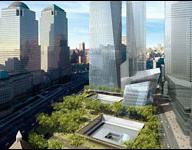
As Groundbreaking Begins, Politics Still Surround WTC Memorial
New York, NY —
The wait appears to be over. Groundbreaking on the World Trade Center memorial takes place this Monday. The memorial is due to be completed by 2009. WNYC's Arun Venugopal looks into the politics that have surrounded - and still surround the memorial - as well as the vision behind it.
REPORTER: Just over two years ago when Governor Pataki got on stage and praised architect Michael Arad for coming up with the final design for the World Trade Center memorial, known as Reflecting Absence.
PATAKI: Michael Arad has done just an extraordinary job. And Michael, congratulations to you (applause and Whooo!)
PATAKI: We're proud of you.
REPORTER: It was a triumphant moment. The memorial was the centerpiece of the rebuilding effort, a means of channeling grief through the creative process.
But already onlookers were getting a little restless. The politics and infighting behind the scenes at Ground Zero were being exposed, and in time, the Master Plan would be dramatically altered.
Would the vision of Michael Arad – a relative unknown - hold up to the pressure?
Well, that depends on whom you ask.
DYKSTRA: That's the western end of Fulton Street.
The office of the World Trade Center Memorial Foundation is located 20 stories above street level. From her window, Gretchen Dykstra, the President and CEO of the group, has a birds eye view of Ground Zero.
DYKSTRA: The footprints which you can see, because of the snow. See the footprints of the towers? Outlined with the orange cones. That represents - each of the voids is one-acre big.
REPORTER: The Memorial Foundation takes pride in having shepherded Arad's design concept through the process. But what Dykstra refers to as the Moral Center of the site - the two sunken voids, with water cascading down the inside walls - is a long way from becoming a reality: several years, in fact. The next six months mostly involve preconstruction. That's when the construction manager and his crew - having done their initial surveys and excavation - will determine a maximum price for the whole job.
DYKSTRA: They'll come by the end of August, beginning of September, and tell us, exactly in their opinion, the cost and we then start signing on all the subcontractors.
Michael Arad was just 32 when his design was chosen. Not long after 9/11, he saw a cake in the window of a bakery, below his apartment. It had a silk-screened image of the twin towers emblazoned on it. As kitschy as the cake was, it got him thinking. Soon he found himself consumed with the idea of two square voids, into which water flowed.
ARAD: Visitors would come up to the very edge of this enormous reflecting pool and stand next to this band of names which would surround each pool. They would be standing right behind a curtain of water... I wanted visitors to feel sheltered in the space, but I wanted also the space to feel very open to the city.
But there are those who think Arad's symbolism is all wrong, namely a group of family members who are totally opposed to the design. To that end, they've brought in Reverend Bill Minson.
MINSON: We're going to take these letters now, having placed our faith in God, and go do what these families have been trying to do for a very long time.
This week, Minson delivered a petition by hand to the LMDC, with 9/11 family members and camera crews in tow. Hoping to disrupt the groundbreaking, they've threatened a round-the-clock vigil and hunger strike until a different memorial design is proposed, one that isn't below ground.
The families admit their vigil is an act of desperation. But their larger point is that, as family members and advisors to the memorial, they haven't been taken seriously. Rosaleen Tallon.
TALLIN: there's been a charade of a public process. That's it in a nutshell. You ask any family member and they'll say the same thing.
Stefan Pryor, the president of the Lower Manhattan Development Corporation, disputes that. In a letter sent to families earlier this week, he listed all the ways the memorial design had incorporated suggestions from family members. Mayor Bloomberg chimed in with his support for the LMDC.
BLOOMBERG: They're about to start construction. And you will never please everybody. I have some reservations and some things I like, some things I don't. I'm sure you and everybody else has the same thing. But we have to pull together and finally do something.
Rick Bell is with the American Institute of Architects. He thinks that the process of arriving at a final memorial has been fairly open and democratic.
BELL: As someone who did participate in the drafting of the memorial program… I think a lot of the effort and energy that went into the effort to include a lot of different thoughts in what the memorial should be about, those were reflected in what the foundation's current design is.
But he does think the LMDC needs to be more forthcoming about certain issues, including how people will cue up and enter the memorial. And this, more than anything symbolic or aesthetic, may be one of the major sticking points of the memorial. How will it handle crowds?
Family members, even those who like the Arad design, ask the same question, especially since the LMDC announced it would reduce the number of entrance and exit ramps from 4 to 2. One to go down into the memorial and another to come back up. Anthony Gardner is on the Family Advisory Council to the LMDC - his brother Harvey died in the attacks.
GARDNER: Back in 2004, Kevin Rampe, then president of the LMDC, was floating a figure of 10 million visitors to the site. 25 thousand per day. LMDC is building a design based on half that at this point.
The LMDC has now adjusted these figures down. But the issue is not just about whether people will have to wait for hours to enter the underground memorial. It's also whether, in the event of an emergency or Ground Zero security threat, people will be able to evacuate.
There are other points of tension, too. Many family members are outraged that the voids are smaller than the actual footprints. Others are pushing for a different naming system, one which would give first responders more emphasis. Michael Arad has engaged with the criticisms while trying not to get sucked in.
ARAD: I find some elements of it frustrating but I also think a project like this - I never had expectations it would be easy.
He also has a lot on his plate. Not just the big decisions, such as how the voids and the underground museum should interact. But small ones, such as what font to use for the names of victims, and how to make sure the waterfalls land just right. Far from the mausoleum that some critics imagine, Arad is aiming for something transcendent, at once private and connecting with the city beyond.
Like Arad, the LMDC and the Memorial Foundation have managed to grin and bear it. But just barely. Even as officials answer questions, there's always a watchful press aide nearby, making sure the wrong thing isn't said, or occasionally, flashing a sheet of paper with - presumably - the right thing to say.
But Anne Papageorge, who's helping coordinate the memorial's construction, thinks the politics and noise will recede. And that ultimately it will be about a single visitor who stands before the names of the dead, the sound and mist of a waterfall filling the air.
PAPAGEORGE - It'll begin to change and decompress the visitors from the busy city, from the taxicabs and streets and honking noises to this more contemplative space, and then get you ready for this experience, of descent, confronting death and then ascending back to life.
For WNYC, I'm Arun Venugopal.

WNYC is funded by sponsors and member donations