The Token's Swan Song?
New York, NY —
The Metropolitan Transportation Authority is holding public hearings for the next two weeks on whether to raise subway and bus fares for the first time since 1995. Blaming a one billion dollar deficit the agency is also proposing to shut down 177 token booths. And as WNYC's Richard Hake reports, the token itself may become a thing of the past.
At the Chambers Street station in lower Manhattan most riders swipe their MetroCards. So in order to make the subway and bus system more cost efficient the MTA is considering eliminating the token. Many riders, like Sapora Gotlieb from Manhattan, say they won't miss them.
Gotlieb: The subway token was a nice um little icon when it existed, but I love the MetroCard. It's so much easier. I don't have any any nostalgia for the token.
But you would think that the token would hold some kind of sentimental feel for New Yorkers. Some straphangers, like this man from Nassau County, agree.
Man: It was very convenient to have subway tokens. It was very convenient to be able to hold them and just put them in and not worry about the cards and being on line or getting them in the machine. It's a part of New York that should just stay with us.
Edith Parker looks back to when the brass token was first introduced in 1953.
Parker: And I remember when tokens were uh I have a small one at home. Gosh I remember when the subway was a nickel. So what can I tell you.
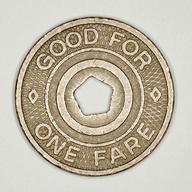
Since you couldn't put two coins into the turnstile the first token with it's Y cutout was brought in when the fare was raised from a dime to 15 cents. Kathleen Holsur is a public historian at the New York Historical Society. She says the words Good for one Fare which are inscribed on the tokens mean much more than a ride to work.
Holsur: Having our own token is like printing our own money. It's a coin of the realm. It's like being a City-State where it's something only you use and everybody recognizes. And the token was so recognizable that you could walk into stores and use it and you could trade it with other people. It was really recognized as a coin.
In order to raise fares and stop people from hoarding and using slugs in the turnstiles, the transit authority issued five regular and two commemorative tokens over the years. There was the small y cutout and the large y cutout. That one was dropped into turnstiles through the 1970s and only saw a 20 cent fare increase over ten years. In 1980 the Y was filled in and the fare raised to 60 cents. Then, in order to fight counterfeiting, the transit authority introduced the stainless steel centered bullseye token in 1986. The last tokens were minted in 1995 and feature the pentagon center representing the five boros; they are used today.
With their elimination, no longer will you see Token Booth Clerks emptying the turnstiles with a bucket and a dust pan. This conductor whose train was pulling out of the station says transit officials don't care about history.
Conductor: They don't care, it's just the money. It pisses me off. Corporations just think about money. Bye laughs.
60 million tokens are currently in circulation. Where will they go if the MTA gets rid of them? Well, probably they'll have the same fate as the old tokens sent to a secret warehouse and then sold to the highest bidder. Some get melted down for scrap metal and others are made into jewelry. Anthony Reyes runs the gift shop at the New York Historical Society.
Reyes: We currently have cufflinks, money clips, three different types of key chains and the charm bracelet which is actually the nicest one. You get the most variations. There is a paper weight with a token under crystal glass, a ladies necklace embeded in a sterling silver fitting.
If the MTA's plan goes through and the token is taken out of service, The New York City Subway system will also lose some words closely associated with its history. The token booth and the token booth clerk will be terms of the past.
For WNYC, I'm Richard Hake.

WNYC is funded by sponsors and member donations