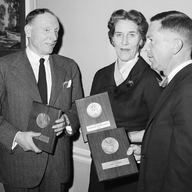
9th Annual National Book Awards
9th Annual National Book Awards. Awards honoring books by American authors published in 1957. Awardees include Robert Penn Warren for "Promises: Poems, 1954-1956," Catherine Drinker Bowen for nonfiction for "The Lion and the Throne," and John Cheever for Fiction for "The Wapshot Chronicle." Clifton Fadiman emcees, and the evening's guest speaker is Randall Jerrell.
Warren's speech discusses the role of structure and meaning in poetry, while Bowen's discusses the temptations to biographers and the perils of praise for the writer. Cheever's very brief speech discusses his amiable estrangement from his winning book, while Library of Congress Consultant on Poetry (essentially the Poet Laureate) Randall Jarrell's very long speech discusses the unhappy estrangement from art and culture of the artist and public in a society based on mass media and the profit motive. Jarrell's speech leans heavily on the work of sociologist Ernest Van den Haag.
The program begins with the emcee discussing the breadth of attendees involved in the making of books (everyone excepting lumberjacks). They are honoring the place of books in American life. He paraphrases Emerson - an institution is the lengthened shadow of a great idea. The attendees have a responsibility in the spreading of ideas. He notes the use of the term "communicators."
He notes the three principal organizations sponsoring the event: The American Book Publisher's Council, The American Book Publishers Association, and the American Book Manufacturers Institute.
He introduces the poetry board of judges: John Ciardi, William Meredith, and Adrienne Rich. Marianne Moore and Louis Undermeyer are unable to attend.
He reads the citation for the year's winner, Robert Penn Warren, for "Promises: Poems, 1954-1956." They give him a plaque and a check for $1000.
Warren jokes about writing both poetry and novels. He reflects on his good fortune. He reviews the recent history of the National Book Awards in honoring poetry. He wants to talk about poems as structure. It's more than mechanics - rhyme and meter. He relates meaning and structure in poetry. A poem is a structure of experience. A poem is a myth of man's capacity for making life meaningful. Warren thanks the audience and the sponsoring organizations.
The speaker introduces the member of the nonfiction board of judges: Agnes Rogers Allen, Whitney North Seymour, George N. Shuster. Not attending are Arthur H. Compton and Richard Hofstadter. He reads the citation for Nonfiction to Catherine Drinker Bowen for "The Lion and the Throne."
Bowen talks about starting the project eight years ago - the unlikeliest job she had ever undertaken. She knew no one who had known of Edward Coke, the subject of her biography. She jokes about being rewarded for having a bad time. Prizes are hazards for writers - she stopped work to celebrate her newest book. She jokes about the expectation of "universal truths" expected of winning writers. She jokes about the lack of attention she had received prior to the award. She talks about the temptations and hazards for biographers. She talks about Samuel Johnson's aphorism about writers tearing apart libraries for single quotes, while subtly alluding to his sexism.
Fadiman introduces the fiction board of judges: Albert Guérard, William Maxwell, Francis Steegmuller. Not attending are Van Wyck Brooks and Elizabeth Ann McMurray. Fadiman awards John Cheever the National Book Award for fiction for his novel "The Wapshot Chronicle."
Cheever is thankful for the award. He describes the "amiable coolness" he has towards his novel. He talks about the loneliness of the author. The writer depends upon the good opinion of strangers. He talks about the sickness he was under when finishing the novel. There are few inhibitions in studying humanity in writing novels. He thanks the readers.
Fadiman thanks the judges, who worked without fee, and the sponsoring organizations.
He then introduces the Library of Congress Consultant in Poetry, Randall Jarrell, the guest speaker at the ceremony. He details Jarrell's honors and credentials.
Jarrell describes the "mercenary interest" writers and publishers have in selling books, but there is more to it - there is a struggle between God and Mammon. He talks bout the drive to write for both. Cultural life would not be worth living without art made for the purpose of making art. He brings up the example of Marcel Proust's "In Search of Lost Time" "Remembrance of Things Past," particularly "Swann's Way." Swann's Way was published as a vanity book because Andre Gide's reader did not think it worth publishing.
He approves of recognizing good books for what they are. He asks if American society encouraged the reading and writing of the books honored at the National Book Awards.
He discusses the theories of sociologist Ernest Van den Haag - "professional student of society." He quotes from Van den Haag's portions of "The Fabric of Society." He talks about the growth of folklore and saga and also high culture in the past. Popular culture did not exist in the past. The Rome of Petronius tried this but only modern American technological power could achieve it. He goes into the alienation of standardized things and people. He talks about the impersonal qualities of mass production. It becomes hard to identify with anything, even one's self.
He talks about the purpose of characters in modern society - they are never an end in themselves. Mass media cannot talk about human experience than cannot be misunderstood. Art, philosophy, and literature can touch on potentially misunderstood humanity.
Art must create without repeating, for it to be art. Art is a personal, cumulative relationship, otherwise it is entertainment only.
Van den Haag asks why Brooklyn is less productive than Florence was. He talks about the market orientation in American art. He uses the example of the potential fate of Dante's Divine Comedy in modern society as popular culture ("Florence Confidential"). The artist who eschews the mass market cannot create what he would have created if the mass market wasn't there.
What is the effect on the public? All is trivialized. Each bit of mass media is weakened by the next, but cumulatively it is strong; it becomes an obstacle to personal experience. Industry has impoverished life and marginalized taste.
Popular culture distorts life by provide illusion in contrast to reality.
Distractions cannot solve boredom or the loss of experience and individuality.
The National Book Awards are a triumph of culture, though some members in the audience are enemies of the aesthetic of the other. You cannot be for God and Mammon at the same time, though that's what we all are, in part. He talks about the difficulties in attempting to be both for God and for Mammon at the same time. People are now hypocrites in their own pleasures, paraphrasing Samuel Johnson. He criticizes popular culture. America's founders would look at modern culture with despair.
He mentions a poem by Philip Larkin about a deserted, ugly, country church. In spite of not believing he liked being there. He quotes from Wordsworth about the monotony of trivial objects and stimulation and also about his poem about a prisoner who led a slave revolt ('To Toussaint L'Ouverture).
Fadiman closes the night's National Book Awards by point the way to refreshments.
A WNYC announcer closes the broadcast.
Audio courtesy of the NYC Municipal Archives WNYC Collection
WNYC archives id: 150532
Municipal archives id: LT7951