The American Flag: Symbol of Beauty or Intimidation?
On a recent morning I stood with a man in East Elmhurst, Queens, not far from LaGuardia Airport. The two of us were looking up and down the street, counting American flags.
There were at least ten on this block, and this made my companion nervous.
"Like someone's looking out their window watching me," he explained, before asking that we keep moving.
The man didn't want to give his real name, so we'll call him Nasaar. He lives nearby and normally avoids this area. Ever since Nasaar was a kid, the American flag wasn't an innocent decoration, but a coded message. This is something he learned from his Dad, a black immigrant from Ethiopia who moved to America and married a white woman in the 1960s.
"And maybe there was something about the neighborhoods he was not allowed to live or maybe felt unsafe to pass through where they had more flags. And that was his perception. So he was passing that knowledge on to me like a lot of parents do. Trying to protect me."
And I understand. A couple months ago, I asked people on Facebook how they felt about the American flag, and I was inundated with comments.
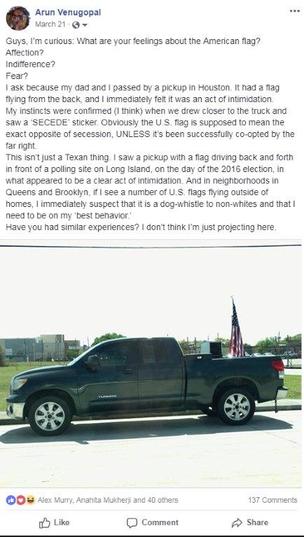
Some people said the flag is beautiful and represents the best of American ideals. And some argued that in certain contexts, say flown from the back of a big pickup truck with tinted windows, flags are intimidating, even scary.
When he and his wife were looking for a home near Philadelphia last year, Rutgers University professor Chenjerai Kumanyika said he was influenced, in part, by what flags he encountered.
"When I walked into certain neighborhoods, if I saw like a Blue Lives Matter or an American flag, that's definitely a signal of a block I wouldn't have wanted to live [in]," he said. "As opposed to the LGBT flag or a Black Lives Matter sign. Or just nothing."
Kumanyika's also a host of Uncivil, a podcast that reconsiders the Civil War, and he argued that asserting the flag, asserting America, always comes at somebody's expense.
"Because in the end of the day, nationalism is always about figuring out who's an insider and who's an outsider," he said. "At its core that's what it is. Who do we have special obligations to, and who can we put as a second-tier priority?"
The Cult of the Flag
Nationalism isn't unique to America, but the way it's embodied in the flag is. Marc Leepson, author of "Flag: An American Biography," said the feelings of near-religious adoration that many Americans have for the flag is unlike anything in the rest of the world.
"People, yes they do love their flag in Australia or Austria or Papua New Guinea," said Leepson. "But nothing like what we Americans do. The display of the flag, for instance, is everywhere you look."
Which is to say, on homes, on cars, at car dealerships, on umbrellas and bikinis. Even toilet paper.
Historians call it the 'cult of the flag,' something that emerged in the wake of the Civil War and exploded in the late 1800s. That's when Francis Bellamy wrote the Pledge of Allegiance, originally a marketing idea meant to sell flags to public schools.
New York was the first state to mandate that public school students start the day by reciting the pledge. Bellamy lived in New York and was a Christian socialist, which informed those words, 'liberty and justice for all.' At the same time, it's worth noting his racist views on immigration. He wrote that while some races should be admitted freely into the U.S., there are others "which we cannot assimilate without a lowering of our racial standard."
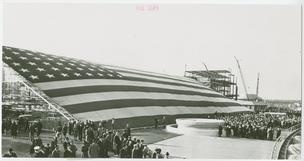
In 1940, nine years after Bellamy's death, Mayor Fiorello La Guardia was in Flushing Meadows, Queens for Old Glory Week at the World's Fair, where he was on hand for the unfurling of the 'world's largest flag.'
"It’s the flag that represents more, to more people, than any other flag," proclaimed Mayor La Guardia. "Our own Old Glory!"
And then he led the city in what is arguably the most heartfelt Pledge of all time. His voiced was piped into every public school in New York over WNYC Radio.
A Divide Over the Flag
Cultural historian Maurice Berger said a split over the flag emerged during the Vietnam war, between conservatives who saw the flag as symbolic of freedom and military might on one hand, and those on the left who decided they'd no longer pledge allegiance to it.
"I think it's during processes like that that the flag increasingly became a symbol of a kind of patriotism," said Berger. "A militaristic patriotism. A racialistic patriotism. A celebration of a white America."
After 9/11, flags were everywhere: a moment of national unity for many, but certainly not all. Some cab drivers, especially Sikhs, displayed flags from their cars so they wouldn't be attacked.
More recently, the flag has returned to the center of our nation's politics. Football fans stood in their backyards and set fire to their team paraphernalia, all because one black man, Colin Kaepernick, inspired his fellow players to take a knee over racial injustice.
"In New England, we don't kneel for the national anthem," said one Patriots fan, as his old jerseys burned on a grill behind him (5 minutes into the video), "and we don't kneel when we're supposed to be paying our respects to our flag."
Fans were egged on by President Trump, who characterized any player who chose to kneel as a 'son of a bitch' who should be thrown off the field.
For the aggrieved football fan, the basic message was 'don't mix your protest with our flag.' But progressive activist Denise Oswald said that's exactly what the American flag is for: "The right to question your government. The right to free speech. The right to assemble and organize. And to do it without fear."
Last year, she and a friend handed out flags during a Tax Day protest in Manhattan, when demonstrators were pushing for President Trump to release his tax returns.
"I would say that most people came up to us very nervous and circumspect and unsure and suspicious," said Oswald. "Most people assumed we were counter-protesters."
In other words, the American flag felt out of place to most people in this crowd: too conservative. Oswald wants to change that. She wants progressives to embrace the flag, and make it represent an inclusive America. And she's not alone.
Consider the image from last year's Women's March. Artist Shepard Fairey — known for creating a red, white and blue Barack Obama above the word HOPE — painted a portrait of a young Bangladeshi-American, a resident of Queens, in fact. She's wearing a hijab, patterned on the Stars and Stripes.
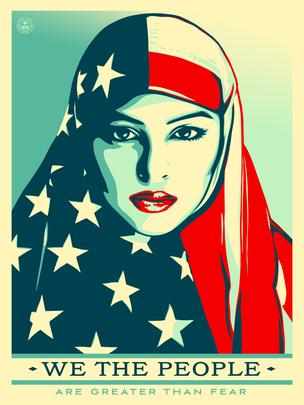
Chenjerai Kumanyika, the Rutgers scholar, said he respects the efforts of progressives to make the flag a symbol of inclusion. But he's skeptical that they can ever truly reclaim the flag. He said they're up against a lot. Namely, a vision laid out by the Founding Fathers, nearly 250 years ago.
"If we're being honest about where the founding fathers were at, if we really go and look at their writing, what they stood for, they didn't stand for me or you, Arun. To have the rights and be in the position that we're in. We've changed their words to try to mean that."
'You will see the flag'
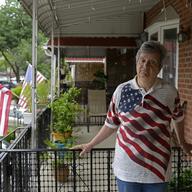
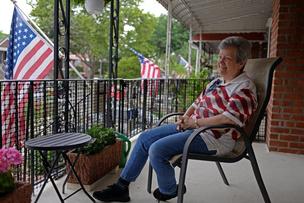
On that same Queens block with all the American flags, the one that Nasaar consciously avoids, lives Donna Raymond. She's lived in the same house for 57 years, since she was just 12.
Raymond is the reason there are so many flags in this neighborhood. She comes from a military family, and said that in the days after 9/11, she started buying flags and selling them to neighbors. She even constructs the wooden brackets.
"It's our duty to fly the flag every day," she said.
She's clearly proud of all her work with the local civic association, and her close ties to the police precinct. But she sounded wistful, because her neighbors are old and they're passing on.
However, she said she gets along with her newer neighbors, many of whom are immigrants. She said people from around the world have flocked to this country to honor the flag, and to experience freedom.
Her efforts aren't confined to her block. She also makes it a point to keep a flag flying over the park nearby.
"I got very out of sort when somebody burned the flag that I put up on the fence. And I went up and said 'You're not gonna do me in.' I put another one up! So when it gets old, I put another one up!"
For all who should pass, the message is clear.
"You will see the flag."
Archival audio from the NYC Municipal Archives via WNYC's Andy Lanset. Additional reporting from WNYC's Richard Yeh.

WNYC is funded by sponsors and member donations