Better Late Than Never: A Talk WNYC Censored in 1934
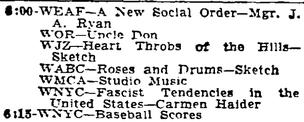
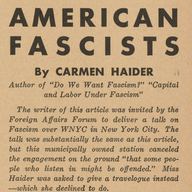
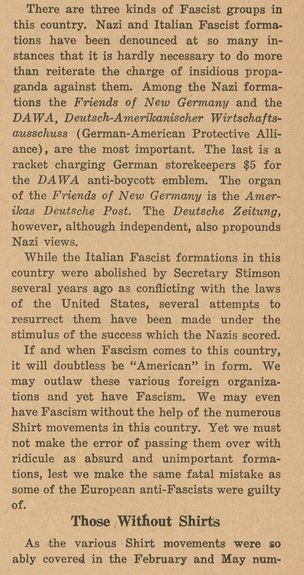
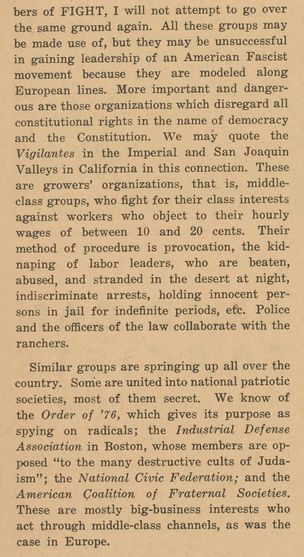
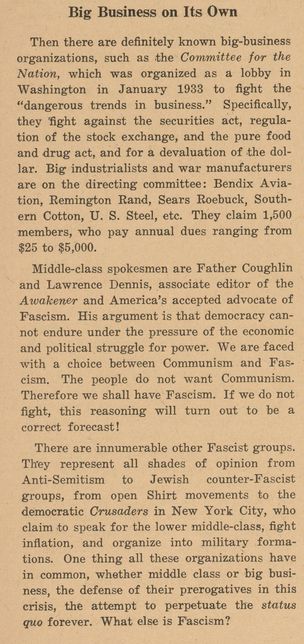
When discovering the article pictured above,[1] I was disappointed. In the course of my research of the station's history, I had seen the newspaper radio listings for May 27, 1934, and thought well of WNYC for airing this speaker at a time when fascism was gaining ground in Europe. There at 6:00 p.m., it said, "Fascist Tendencies in the United States-Carmen Haider." She had a Ph.D. from Columbia University and spent time at the Brookings Institution. Her book, Do We Want Fascism? had just been published by John Day in New York.
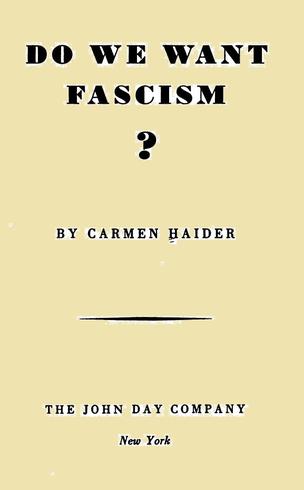
An April 29, 1934, New York Times book review had noted Haider's extensive studies in Europe, particularly Germany, where she had observed fascism's "anti-intellectualism" and "acceptance of violence as a means of gaining a desired end." As for fascism in the United States, the Times reviewer wrote: "She thinks that the only group that would gain under Fascist rule would be the industrial and banking capitalists." Although the unnamed reviewer concluded that Haider's research is "marked by much finely spun theorizing and acceptance of hypotheses as realities,"[2] it is clear that many of Haider's predictions regarding Fascism’s rise in Europe were well-grounded.
Yet, Haider never delivered her talk on WNYC; it was considered 'controversial,' potentially 'offensive,'[3] and rejected by the station's management. Since the radio listings include her talk, the cancellation must have been a last-minute decision.
Why would the station censor a seasoned academic like Haider? So far, documentation from the station's point of view is lacking; but some context may be helpful. WNYC, then owned and operated by the City of New York, was only five months into the new La Guardia administration. The mayor had campaigned on a platform that included saving taxpayer money by shutting down the station. By May 1934, WNYC was still very much on probation and hanging on tenterhooks; there was also a significant amount of friction between the station's somewhat staid, 'old guard' director/head of programming Christie R. Bohnsack[4] and Mayor La Guardia's newly appointed Assistant Program Director, Seymour N. Siegel.[5]
Fortunately, the station survived. After a blue-ribbon study of its operations and the recommendations that followed, Mayor La Guardia was convinced that holding onto (and improving) WNYC served the city's best interests --as well as his own. The decision not to air Haider's talk, then, may be the result of a cautious approach on the part of the new administrator (Siegel), but more likely, reflective of a struggle with the old one, (Bohnsack). As Siegel would write a year and a half later, "with the accession of the present Fusion Administration[6] in New York City, WNYC's censorship policies have been materially liberalized although the heritage of past years still persists to a degree."[7]
Haider's WNYC radio script, however, did not go to waste. It was adapted into an article for the July 1934 edition of Fight Against War and Fascism, a monthly tabloid publication of the American League Against War and Fascism. Although an American Communist Party initiative, the League's membership was fairly broad, including other left groups, trade unions, and African-American civic organizations. To right the wrong some 86+ years later, we now present Carmen Haider's WNYC talk (virtually) courtesy of this publication and the Tamiment Collection at NYU.
______________________________________
[1] Haider, Carmen, "American Fascists," Fight Against War and Fascism, July 1934, pgs. 13-14.
[2] The New York Times, "Do We Want Fascism?, by Carmen Haider," April 29, 1934, pg. BR10.
[3] Haider, ibid. The broadcast censoring of Haider's talk was also noted in the 1935 pamphlet, Censored! The Censors See Red: The Record of the Present Wave of Terrorism and Censorship in the American Theatre, by Richard Pack and published by the National Committee Against the Censorship of the Theatre Arts, an ACLU membership organization that included Brooks Atkinson, Bennett Cerf, Clifford Odets, Clifton Fadiman, and Fannie Brice.
The ACLU reported that following several cases of censorship of controversial material by the station brought to their attention, they suggested to Mayor La Guardia that WNYC set aside time to air uncensored discussion of public issues. The suggestion they reported was rejected. Source: "Land of the Free: The Story of the Fight for Civil Liberty 1934-1935," ACLU, June 1935, pg. 44.
[4] Christie R. Bohnsack, of whom little has been written, appears to be largely a product of early 20th Century tabloid newspapering, Tammany Hall politics, and public relations. He was originally installed at WNYC by its founder, Commissioner Grover A. Whalen. In 1946 Variety's radio editor Robert J. Landry described the station's early handling of hot topics, "the station had the reputation for being excessively timid and was far more severe in the censorship of talks than most commercial managements. WNYC would not allow the city's own Department of Health to mention the term 'social diseases'...The La Guardia administration held WNYC in more respect and proceeded to initiate a series of reforms." Taken from: Landry, Robert J., This Fascinating Radio Business, The Bobbs-Merrill Company, New York, 1946, pg. 125.
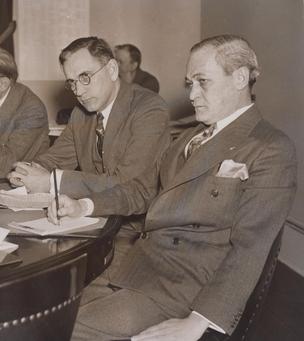
[5] One of Siegel's initiatives was getting public hearings on the air. So, it is worth noting that by mid-October of 1934, WNYC was, without hesitancy, airing the New York hearing of The House of Representatives Special Committee on Un-American Activities Authorized to Investigate Nazi Propaganda and Certain Other Propaganda Activities. The committee was led by Congressmen John W. McCormick of Massachusetts and Samuel Dickstein of New York. Six public hearings were held. The last, in New York at the Bar Association building in Manhattan. It was reportedly a raucous event with Nazi sympathizers cutting WNYC's microphone cable, and the station receiving threatening phone calls.
[6] In 1933 La Guardia, ran for Mayor as a progressive Republican on a ticket backed by reform-minded Democrats, Socialists, and independents against the Democratic and Tammany machines. Thus, his ticket was known as City Fusion Party.
[7] Siegel, Seymour N., "Censorship in Radio," Air Law Review, January 1936, Vol. 7, No. 1, (1-24) pg. 21.
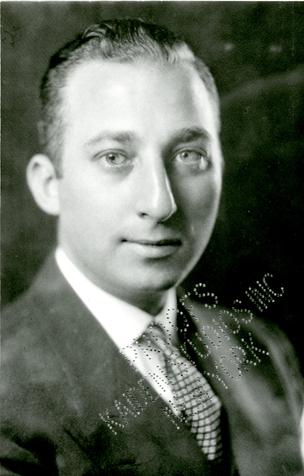
Siegel, listed in the journal as Assistant Director of Radio Broadcasting for the City of New York, opens the piece by quoting a headline in The American Journal of Public Health (December 1935): "Municipal Broadcasting Station Not Afraid." for its willingness to allow for a candid on-air discussion of syphilis and eyesight. The 24-page study called on the relatively nascent FCC to stop using the threat of license revocation as a primary part of disciplinary proceedings since it effectively had a chilling effect on free speech. Medical quacks on the air, Siegel argued, could be handled by state medical boards and the FTC and "the criminal laws of the individual states might well handle the questions of profanity, obscenity, or vulgarity." (pg. 24)
If there is to be censorship, Siegel placed his faith in the audience and a minimum of government. He concluded, "In radio, 'the program's the thing.' The severest and sternest critic of broadcasting will continue to rest at the American fireside; the silent weapon in the hands of radio listeners which allows them to cast into oblivion any program which does not meet with their approval is the surest censorship." (pg.24)

WNYC is funded by sponsors and member donations