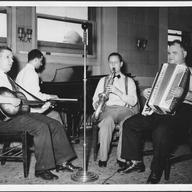
The Capitol Dance Orchestra: Blind Musicians Are WNYC Regulars
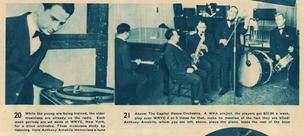
New York City's Capitol Dance Orchestra was among the most publicized of the Federal Music Project's units for the blind. Organized in August 1936, it consisted of five musicians (with an additional four slots), and it listed WNYC as its leading performance venue. Clarinet and saxophone player James Sumner told the Daily News at the time, "I made a good living before the Depression, playing at clubs and dances...I guess I can satisfy radio audiences."[1]
The group's size fluctuated over its seven-year run and included some thirty different blind or sight-impaired musicians. Most members of the group had been graduates of the New York Institute for the Education of the Blind but some, like accordion player Oscar England and banjo/guitar player Ray Dinsmore, (pictured above) went to the Indiana State School for the Blind before coming to New York. They all, however, learned their repertoire from Braille music and popular records.
"The musicians believed that the project had rescued them from oblivion and poverty and had given them equal treatment. Like most other Americans, these musicians wanted 'jobs we are equipped to handle...[The] Federal Music Project is a fair project and ours is a fair job,' said Oscar England, the unofficial leader of the group."[2] They were each paid $23.86 for their weekly WNYC broadcast.
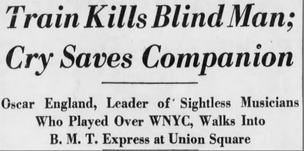
Unfortunately, Oscar England's last performance at WNYC was on December 29, 1936, when a tragic accident ended his life. After the performance, England left the broadcast studio with his bandmate James Sumners. With their white canes, the two musicians were headed home to Brooklyn by subway; while transferring from the BMT to the Broadway-Canarsie line at Union Square, a misstep tragically landed England between the platform and the train. The New York Times assigned Meyer Berger, one of its best reporters, to cover the front page story. His heartfelt piece appeared the next day. Oscar England was 34 years old, married, and a father of three.
The dog snatched at the reporters' gloves, tugged at their hats, as the couple told about Oscar England. "His wife is upstairs," the man said. "Yes, she is blind too. The children are crying, and --'Hush Brownie!'-- neighbors are with them. There's John, he's 4-years-old, the baby; Lelah Fay, she's 10, and there's Wanda, she's 15. They can all see. The children can all see." As the woman led the way to the door, again Brownie frisked before the visitors and licked their hands. Down the stairwell came the mingled sobs of the accordion player's children.[3]
By January 1943, the Federal Music Project was coming to an end. The band's last concert was on January 18th. The 'WPA unit' tallied more than 3,000 performances and was noted as one of the more popular WPA-sponsored dance bands. Towards the end, the remaining six members of the group changed their name to the Musical Bombardiers with the hope of getting paying gigs entertaining workers at defense plants.[4]
____________________________________
[1] "WPA Organizing Band of Blind to Go on Air," Daily News, September 27, 1936, pg. 151.
[2] Bindas, Kenneth J., All of This Music Belongs to the Nation: The WPA's Federal Music Project and American Society, University of Tennessee Press, 1995. pg. 39.
[3] Berger, Meyer, "Blind Musician, Groping in Subway, Miscounts Steps, Is Killed By Train," The New York Times, December 30, 1936, pg. 1.
[4] "Concert and Opera Asides," The New York Times, February 14, 1943, pg. X5.

WNYC is funded by sponsors and member donations