Chuck Schumer and the Art of Managing Democrats
Every vote matters in the Senate, so Minority Leader Chuck Schumer keeps one eye on what the Senate is working on now, and one eye on 2018.
That's because 10 members of Schumer's Democratic Caucus are up for reelection in states President Donald Trump won last year — an emerging bloc that he calls "red-state Democrats."
It’s a constant balancing act: He has to keep Democrats together, but also let some Senators distance themselves from the party line.
Eight months into his tenure as Senate Minority Leader, New York’s Schumer can claim a major victory because he kept his caucus united against GOP plans to repeal Obamacare.
But Schumer is constantly managing the two wings of his party. Progressives such as Bernie Sanders of Vermont and Elizabeth Warren of Massachusetts want to take on Trump at every opportunity. But red-state Democrats have to worry about the consequences of obstruction back home.
So Schumer has to think hard about what votes he asks his caucus to take.
“It’s absolutely in the forefront of a leader’s mind,” said Adam Jentleson, a former deputy chief of staff to Nevada Sen. Harry Reid, Schumer's mentor and predecessor as Minority Leader.
"That’s one of those areas where it’s art and not a science, because you might want to say ‘Members should only think about the merits of legislation,' " said Jentleson, now at the Center for American Progress. "But it’s impossible not to think about the politics, because you’re talking about whether your closest colleagues, the people you work with every day, keep their jobs or not. You develop strong bonds with these people you want them to stay around."
Every one of their votes is critical as Democrats challenge Republicans to govern with a slim and divided 52-48 majority.
Just look at the health-care debate. One more Republican vote and the Affordable Care Act could have been gone. Every seat lost next year also makes Schumer’s dream of becoming Majority Leader that much harder to achieve.
Democrats are working to reconnect with voters who left for Trump last fall, particularly white, rural and working class voters.
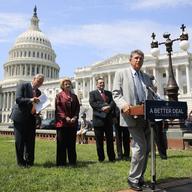
Schumer, the top Democrat in Washington, took a group of fellow travelers on a road trip last month to Virginia’s bucolic Shenandoah Valley.
Flanked by House Minority Leader Nancy Pelosi and top deputies in both houses of Congress, Schumer announced that the party would renew its focus on economic issues like job training and rising prices for food and prescription drugs.
“We are here today to tell the people of Berryville, and the working people of America, someone has your back!” Schumer told a small crowd in a local park.
The event was a clear signal that Democrats are trying to reconnect with voters who sided with Donald Trump last year. But it was also notable for the people who were not there: None of the ten Senate Democrats who are up for reelection next year in states Trump won.
Five of those Senators — Joe Donnelly of Indiana, Heidi Heitkamp of North Dakota, Joe Manchin of West Virginia, Claire McCaskill of Missouri and Jon Tester of Montana — represent states Trump won by at least 15 percentage points.
Nevada’s Dean Heller is the only Republican up for reelection next year in a state Hillary Clinton won.
But Schumer argued that both red and blue state voters respond to green — economic policies that could mean more money in their pocket.
“You will be hearing in future days from a lot of our red-state Democrats," Schumer said. "They have been very much part of this agenda.”
Jentleson praised Schumer's leadership, especially keeping his caucus united during this summer's health-care debate.
"Keeping 48 very independent-minded Senators, each of whom consider themselves a power center, together on anything is a major achievement," he said.
Whipping — the process of rounding up Senators to vote the way leadership would like — usually involves a carrot and a stick, he said. Sometimes you have to squeeze Senators, or convince close allies to help coax a vote.
But Jentleson said Schumer didn't force unity on health care with threats and backroom deals. Instead, he gave his members space to make up their minds.
Take West Virginia's Manchin, for instance. Only one other state gave Trump a higher percentage of the vote than West Virginia.
Initially, Manchin tried to work with Republicans on health care — which he said Schumer encouraged. But he said it was quickly clear the Republicans weren’t interested. So he voted against their plans.
But on other issues, Manchin has broken with Democrats.
He was one of three Democrats who voted to confirm Supreme Court Justice Neil Gorsuch, who was popular in his state. He also declined to endorse a Democratic priority list for overhauling the tax code.
Walking back to his Senate office after a recent vote, Manchin said Democrats need to change their priorities.
“The Democratic Party should not be all about just urban America," he said. "Better start taking care of rural America."
Manchin said Schumer listens, even if he doesn’t always agree.
“He considers my side, if you will," Manchin said. "A West Virginia Democrat is not a Washington Democrat. I’ve been very clear in saying that.”
In fact, Schumer added Manchin to the Democrats’ leadership team and asked him to find ways to work with Republicans.
“So he said ‘Well, that’s fine, why don’t you just be on leadership? You can speak out.’ I said ‘OK’ and that’s what I did.”
Last week Manchin joined Schumer to announce a package of policies to protect American companies from unfair foreign trade, another piece of the Democrats' economic message.
Liam Donovan, a former Senate GOP fundraiser who now works for a trade association, said Schumer has nothing to lose if Manchin or other Democrats occasionally break ranks.
“I think he’d gladly let them do whatever they needed to stay," Donovan said. "You know, remain in the chamber.”
Donovan said the first eight months have been relatively easy for Schumer because Democrats are united against Trump’s immigration and health-care policies. Donovan said Schumer, who is not known for being camera-shy, has also helped himself by keeping a lower profile than expected.
“Schumer’s done what he needs to do, but he’s avoided becoming the boogeyman that Nancy Pelosi represents,” Donovan said.
But Schumer has also been pushed by activists eager to challenge Trump. Several times Schumer has been pushed by the left — to oppose more Trump nominees, to filibuster Gorsuch and to wage procedural warfare against the health-care bill in an effort to slow down the Senate. Jentleson said Schumer acted when he needed to.
"The measure of the leader is not whether they occasionally need to be pushed or not," he said. "The measure is do they listen and do they respond?"
Donovan said that energy helps Schumer.
"The activist base of the Democratic Party is incredibly motivated right now and are holding everyone’s feet to the fire," he said. "So staying together is not really optional at this point."
Senate Democrats have raised nearly $29 million dollars for the 2018 elections so far — slightly more than Republicans. And neither side has ramped up their spending yet.
The votes will get harder soon, Donovan said. When they come back, Congress has things they have to get done — like passing spending bills and raising the debt ceiling. Tough negotiations require party discipline. And that means Schumer may have to ask red-state Democrats to stick with the team, even if people back home might not like it.

WNYC is funded by sponsors and member donations