City Immigrants Fear Being a 'Public Charge'
A proposal by the Trump Administration is causing panic among immigrants who receive public assistance. The plan is more than 400 pages long, so complicated that immigrant advocates fear thousands of New Yorkers may drop benefits they are legally entitled to receive, while many more will not qualify for green cards if they're considered at risk of ever going on public benefits.
The proposal focuses on the definition of "public charge," government-speak for someone who is not self-sufficient. U.S. Citizenship and Immigration Services can currently deny permanent residency to applicants if they're primarily dependent on the government through cash assistance.
But the Trump Administration is proposing to make it harder for someone to obtain a green card if they also receive Medicaid, food stamps or public housing. The proposal was released in late September, and community-based organizations say many of their clients are confused.
"It's causing mass fear within the community," said Mohammad Razvi, executive director of the Council of Peoples Organization in Midwood, Brooklyn. The nonprofit helps low-income immigrants, many from South Asia and Eastern Europe, apply for government benefits and learn English.
Razvi said staff attorneys are working to clear up the confusion. About 90 percent of his clients already have green cards, but many mistakenly believe they cannot become citizens if they continue getting food stamps or Medicaid.
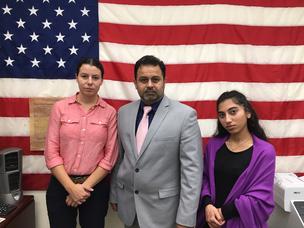
This was evident during a recent visit to an English class. Rubina Safdar, who came from Pakistan about five years ago, said she feared her food stamps could prevent her from becoming a citizen.
"I have breast cancer, that is why I need food stamps," she said, adding that she used to work but the radiation treatments have made that too difficult.
The website DocumentedNY reported that enrollment figures for the Special Supplemental Nutrition Program for Women, Infants, and Children (WIC) dropped in New York City after reports that President Donald Trump was considering a change in the public charge rule. But WIC was left out of the final proposal in September, which focused on food stamps, Medicaid, institutionalization and public housing. Those receiving several other benefits including emergency Medicaid and the Child Health Insurance Program would not be affected if they apply for green cards.
With rare exceptions, immigrants aren't even able to access food stamps or Medicaid unless they already have a green card. New York City estimates about 75,000 immigrants who don't have green cards are eligible for Medicaid under a law particular to New York State. These are mostly DACA recipients who came to the U.S. as children. If the proposal goes into effect, they would have to drop their benefits within 60 days to apply for a green card without any negative consequences.
But far more immigrants would be affected by another aspect of the new proposal. Those who don't take public benefits, but are considered at risk of becoming a public charge, could be denied a green card based on age, health conditions and English proficiency.
Income would also be a major factor. To get the highest rating, a green card applicant would need to make 250 percent of the federal poverty limit, or $63,000 a year for a family of four.
New York City estimates these criteria could prevent 400,000 local immigrants from getting green cards. The New American Economy, a bipartisan coalition of more than 500 business leaders and mayors that's pressing for immigration reform, views the proposal as way too restrictive.
"The majority of people this applies to are workers," said Jeremy Robbins, the coalition's executive director. The organization's own study found 7.5 million people — many of whom work in the service sector and construction — would be ineligible for green cards because they don't make enough money.
But supporters said Trump's new public charge proposal is fair. Jessica Vaughan directs policy studies at the Center for Immigration Studies, a group that wants to limit immigration.
"If there are people who can’t pass this test at this point in time, there are other applicants who can," she noted. "And it’s in the national interest to choose, where at all possible, those immigrants who can support themselves or who will be supported by family members."
She predicts few immigrants will be harmed, while the government estimates it could save $1.5 billion annually from the rule. The federal budget for food stamps, alone, is about $70 billion and Medicaid is about $350 billion.
Critics say a lot of those savings would be generated by needless fear. New York City estimates it could lose $400 million annually if just 20 percent of immigrants mistakenly think they have to cancel food stamps and other forms of assistance and don’t spend the money in local shops. The Fiscal Policy Institute is predicting even more losses due to this "chilling effect."
"We also know, of course, there would be additional strain on individuals not seeking healthcare and needing emergency care in hospitals," said Bitta Mostofi, commissioner of the Mayor's Office of Immigrant Affairs. "And so there are a myriad things that would result if individuals unilaterally disenrolled from benefits that they are eligible for."
The city is conducting outreach to help immigrant communities understand the proposal, and to submit public comments. The federal government is accepting those comments through December 10, and the rule could go into effect early next year.

WNYC is funded by sponsors and member donations