Hillary Clinton Wins New York Primary
In the end, Bernie Sanders couldn’t make it here.
Fueled by African-American, Latino, and older voters, Clinton, in her fourth electoral go-round in New York, was once again crowned favorite daughter.
Clinton won the state by a comfortable double-digit margin, nearly matching her margin of victory over Barack Obama eight years ago. Of the 247 Democratic delegates at stake in New York, Clinton picked up at least 129 while Sanders gained at least 98.
The count widens Clinton's overall delegate lead. She won in all five boroughs, in all the city's suburbs, and in Buffalo, Rochester, and Syracuse. She won the decisive "battle for Brooklyn," including Park Slope, Gowanus, Crown Heights, and Sanders' old neighborhood of Flatbush. And according to a WNYC analysis, Clinton won 98 percent of election districts that are majority African-American.
But Sanders won a huge swatch along I-87 corridor, including the Catskills and the Adirondacks, and the Southern Tier, which is home to Binghampton, Ithaca, and Cornell University.
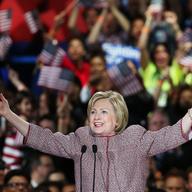
Still, it was Clinton's night, and she, Bill, and Chelsea triumphantly took the stage at the Sheraton Hotel to the song "Empire State of Mind" by Alicia Keys and Jay Z.
"You know, we started this race not far from here on Roosevelt Island," Clinton said. "Pledging to build on the progressive tradition that's done so much for America, from Franklin Roosevelt to Barack Obama. And tonight, a little less than a year later, the race for the nomination is in the home stretch and victory is in sight."
Women, in particular, lined up behind Clinton, enthused by casting decisive votes for a candidate who could be the nation’s first woman president, 96 years after women were granted the right to vote. And New York voters, who have a history with Clinton from her eight years as Senator, seemed inclined to put the primary to bed. “I definitely wanted … to pick the Democratic candidate that could best challenge the Republican candidate, whoever that may be,” 36-year-old Debby D’Angelo said after voting in Washington Heights on Tuesday.
Sanders found strength among young voters, rural voters, progressive New Yorkers and a huge wave of discontent among New York City residents confronted by rising rents and dwindling pay.
But at the end of the day he could not pry open the tight lid of New York’s Democratic machine, which discourages independents and voters who do not register long before the primary date.
Sanders also found near-unanimous opposition from New York’s elected officials, from Gov. Andrew Cuomo to Mayor Bill de Blasio, who can’t agree on anything, but did concur in their support of Clinton.
“I think that [Clinton’s] policies and Bernie Sanders’ policies are similar but I think that she is better prepared to effect the changes that we need to make,” said D’Angelo.
Sanders put up a tough fight, organizing massive rallies fueled by the energy that spawned the Occupy Wall Street movement five years ago, and outspending Clinton two-to-one on television advertising. Though Sanders has criticized Clinton’s fundraising in this campaign, he has pulled in a far larger haul, powered by $27 donations, surpassing 5 million individual donors -- the largest of any political candidate in history.
But at the end of the day, Sanders could not match Clinton’s New York history, know-how and organization. She made sure to connect with every constituency, playing dominoes in East Harlem, professing her love of hot sauce on an African-American radio station, drinking bubble tea in Chinatown, stopping by an LGBT phone bank and wrapping up her last day of campaigning at an “Irish Americans for Clinton” event with her husband, former President Bill Clinton.
Bill Clinton almost upended the campaign when, at a stop in Pennsylvania, he berated a member of Black Lives Matter who was protesting the 1994 crime bill. The bill has roused serious ire among activists because it’s seen to have contributed to high levels of incarceration among blacks and Latinos. During last week’s debate, Sanders said “superpredator” — a term uttered by Hillary Clinton in the 1990’s in reference to the crime bill — is considered a “racist term.” And it did give pause to progressive voters -- black and white, alike.
But the Clintons stumped in more than a dozen black churches between the two of them during the two weeks before the New York primary, and Clinton’s deep ties with New York’s African-American community generated an emotional passion that the Sanders camp might have underestimated.
At its outset, his campaign miscalculated the affection some New Yorkers feel for Clinton. Sanders' top aide, Tad Devine, vowed that Sanders would “campaign like a Brooklynite,” and he did indeed. Sanders and his team clobbered Clinton on her Iraq war vote, her Wall Street contributions, and her refusal to call for a ban on fracking, all unpopular positions among the Democratic primary electorate in New York, which leans left.
Sanders relentlessly hammered Clinton at rallies and in their televised debate from the Brooklyn Navy Yard. At one point in the campaign, he called Clinton “unqualified,” referring to her judgment on Iraq and other issues. One rally warm-up speaker referred to Clinton as a “corporate whore.” The comments drew ire, particularly among women, and Sanders quickly walked them back.
On her final day of campaigning, Clinton held a women’s rally with Planned Parenthood chief Cecile Richards and former Arizona Congresswoman Gabby Giffords, who was shot in the head in an incident of mass gun violence in her home state.
“Speaking is hard for me,” Giffords said on the eve of the New York primary. "But come January, I’d like to say the words ‘Madame President.'”
The Associated Press contributed to this report.

WNYC is funded by sponsors and member donations