As Senator, Clinton Made New York Love Her. Now She Has To Do It Again.
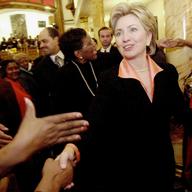
When it became clear that the New York primary might be decisive, Hillary Clinton came straight to Harlem. "It is wonderful to be back home in New York!" Clinton said to rousing applause at the Apollo Theater.
She really did look happy to be among us. It's funny, though, that this is now home for her. Because her move to Chappaqua from Arkansas via the White House was the main criticism of her when she ran for U.S. Senate here in 2000.
"What has my opponent done for New York?" spat out then-Congressman Rick Lazio at a campaign rally shortly after he got in the race. "For eight years where has my opponent been for New York? Can anybody point to one single thing she has done for New York State? One thing?"
The Clintons faced deep suspicion for moving to Westchester, the center of political gravity at that time. It was widely expected that the race that year would be over the hearts and minds of the “soccer moms”: independent, suburban, white women voters.
Everything seemed calculated. Clinton had to spend a lot of time that campaign struggling to establish her New York bona fides.
"Carl, as Judith said, is from Elmira," Clinton said at a 1999 gathering of Democrats. "There are a number of people here from Elmira. I have been to Elmira." By the time the campaign was over, she had been not only to Elmira, but also Oneonta and Watertown and Otsego — in fact, to all 62 counties of New York, staying in people's homes, sleeping on their couches. She went on to win that election by a wider margin than anybody thought she would.
As a senator, Clinton continued to spend time in those tiny counties, talking to people about rural broadband and the apple harvest and their at-home fishing rod businesses. I caught up with her once in Lake Placid, in the Adirondacks, population 2,500.
Even in this generally politically-ignored area of the state, Clinton had friends, and an uncanny ability to recall details of their lives. She spoke with one woman about her aunt's move to Saranac Lake, and to a man named Cliff about an upcoming visit to the North Country's new "Wild Center," which Cliff would be attending, along with Joanie and Aaron, all known to Clinton.
There are 20 million people in New York, and somehow Clinton seemed to be on a first-name basis with half of them by the time she finished running for Senate twice. Unlike Bernie Sanders, who sure sounds like he’s from here, Clinton, who doesn’t, has knitted herself into the life of the state.
"She is friendly and warm and neighborly, if you will," said Amy Drucker, a Westchester photographer who attended a Clinton rally at SUNY Purchase earlier this month. She's not like she seems on TV. "She and her husband, you run into around Chappaqua, they’re regulars there," Drucker said.
In the Clintons' hometown, people see her at the farmer’s market, the library, taking walks, and, especially it seems, drinking coffee. She likes it black with a shot of espresso.
At the train station, I ran into a mother-daughter pair who were visiting Chappaqua to see relatives who live there.
"They have seen her many times at various events, and not just by accident," said the woman, Carrie, who only wanted to give her first name. "Up close, it helps Clinton. Makes her more human." Carrie predicted Clinton would get "98 percent" of the Chappaqua Democratic vote. But not, her daughter said, "The two percent of newbies."
Those newbies could have a big effect, though. Since Hillary Clinton last ran for office in New York, a whole new generation of voters has come of age and many are skeptical. Mitch Elliot Kutin, a 22-year-old philosophy major from Mt. Kisco, showed up at SUNY Purchase to protest because, he charged, Clinton has flip-flopped on too many issues.
"The most blatant one is gay marriage. Her blatantly saying she’s not for it, then saying she’s for it and denying in some videos that she flopped," he said.
"Do you know that Bernie Sanders wasn’t for gay marriage until 2009?" I asked. But Kutin and his fellow protesters wouldn't hear that. "That’s not true! That’s not true! That’s not true!" three of them chimed in.
It is true, according to Sanders' campaign. He did vote against the Defense of Marriage Act, but he didn’t affirmatively say he supported gay marriage until 2009. But for most everyone under 30, who have no personal recollection of Clinton as a senator, her home court advantage evaporates.
For these younger voters, and some older ones as well, there are two other problems for Clinton that come with her having been a senator from New York. The first is her Iraq war vote. It was a mainstream New York position in 2002, but never sat well with the left wing of the party that’s now on the ascendancy.
And then, there’s the money she’s raised from Wall Street. It’s the hometown industry, and it gives generously to Clinton, as it does to her former colleague Sen. Chuck Schumer and her replacement, Sen. Kirsten Gillibrand. But for some New Yorkers, the Wall Street money adds to their suspicion Clinton can’t be trusted.
"Every time you take money from a business, you’re talking on a debt to that business," retiree Emily Boland told me at a meeting of women transitioning from work to retirement on Manhattan's Upper East Side.
So Clinton finds herself back in New York, fighting for every vote. The center of political gravity has moved from the suburbs to multi-cultural Brooklyn, home now to Clinton's national campaign headquarters and to some of the most progressive voters anywhere in the country.
Last week she was at Medgar Evers College in Crown Heights, a campus with predominantly low-income and minority communities. She told a story I’ve never heard before, about teaching at the University of Arkansas and meeting students who were single parents who had to drop out of school when they faced unexpected expenses like a car breakdown.
So, she said, she started a scholarship fund in Arkansas for college students who were single parents. After the speech, I randomly approached second-year business student, Sasha Duncan, who couldn't stop gushing. "She's awesome, she’s so empowering for women. I love it!"
Duncan is a college student, Bernie Sanders' usual constituency, so her enthusiasm was surprising.
"I’m studying business, and I got a chance to speak to her about my son," Duncan said.
Clinton had done what I’d seen her do in so many campaign stops from Lake Placid to Columbia, S.C., to here in Brooklyn: take a small fact a voter told her and weave it into her overall platform. "Why wouldn't I want to vote for her?" Duncan asked.
In 2000, Clinton had two years to put together a personal argument for New Yorkers. This time, she has to count on old friends and some new ones, like Sasha Duncan, to come to her side by primary election day on April 19.

WNYC is funded by sponsors and member donations