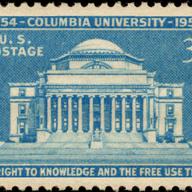
Columbia University Bicentennial, Excerpts from "Conference Four."
Various educators celebrate the Columbia University Bicentennial at "Conference Four." The theme of the conference was "education, health, [religion], and social services as they affect the citizen today."
Speakers include Dwight D. Eisenhower; Eleanor Roosevelt, Adlai Stevenson, along with university presidents, government secretaries, and educators.
The program begins with a excerpt of a speech from President Eisenhower.
at the Columbia University Bicentennial at "Conference Four."
we are told by host Roger Kennedy that the theme of the conference was "education, health, and social services as they effect the citizen today."
Eisenhower talks about importance of academic freedom and freedom of speech.
Kennedy introduces A. Whitney Griswold who talks about the struggle for intellectual freedom against ignorance, hearkening back to the middle ages. There is a fear implanted in us for self-preservation. He praises due process and liberalism as the root and branch of democracy.
Kennedy notes that other meetings took place in smaller separate venues. He introduces Irwin Griswold of Harvard Law School, who talks about academic freedom. Academic freedom requires self-examination and well as protection from outside forces - pressure groups.
Kennedy introduces Henry Steele Commager, professor of history, notes that academic freedom extends beyond professors and includes laboratories and libraries.
Kennedy notes Henry M. Wistin's call for courage. Wristin quotes Thomas Mann - "education is an optimistic and humane concept." Universities must protect the past and lead the path for the future. They must tolerate error and conservative and revolutionary. Kennedy returns to note that Wristin also spoke against stultifying forms of standardization.
Kennedy notes the panel on public schools. He introduces Willliam G. Carr of the National Education Association. He wonders what the role of the federal government should be in public education. There are two - leadership and funding. There is focal point where responsibility should be pinned for leadership that does not exist. He feels that education is woefully underfunded and that money is poorly spent elsewhere.
Kennedy speaks of the conference 4 talks on welfare and social security. He introduces Eleanor Roosevelt. She talks about the importance of freedom from want and a feeling of partnership with the government and the economy as a whole.
Kennedy introduces Oveta Culp Hobby, of the U.S. Department of Health, Education and Welfare. She uses a wheel metaphor to describe the importance of welfare and social security.
George Davidson, deputy minister of welfare in Canada, talks about the importance of welfare and helpful human service.
Marion B. Folsom, of the department of the treasury, also discusses welfare. He talks about how the federal program fortifies individual financial security.
Kennedy moots just how much social security should function and whether it should become necessary. Barbara Wooten of the University of London notes the unknown effects social security might have on freedom and enterprise. She notes economic factors. It may be good business and good humanity. She is concerned by the role of unions and other special interests - she dislikes collective bargaining.
Kennedy talks about the revival of religion spoken of at the conference. Barbara Ward Jackson talks about religion as a means to fight totalitarianism. Nationalism is the new Caesar. Communism, which thinks itself the culmination of politics, actually is redolent of older forms of political organization based on totalitarianism. Freedom and democracy should not be a religion, something that is enforced.
Adlai Stevenson provides a final summation. He praises democracy as the one of humanity's greatest accomplishments and speaks against communists. He talks about the free society that America has created. He speaks about western humanism compared with pagan worship of nations and leaders. He speaks about the importance of education, calling the university "the archive of the western mind."
Audio courtesy of the NYC Municipal Archives WNYC Collection
WNYC archives id: 150638
Municipal archives id: LT3016