Courthouse Immigration Arrest Leads to Courthouse Protest
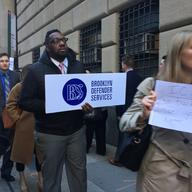
The debate over whether New York's courthouses should limit cooperation with federal immigration agents escalated Tuesday, when dozens of public defenders walked outside of Brooklyn criminal court to protest an immigrant's arrest inside the building.
Genaro Rojas-Hernandez was charged earlier this month with punching a woman in violation of a court order. He was waiting in the eighth floor hallway of the Brooklyn courthouse for a hearing on Tuesday when he was apprehended by agents from Immigration and Customs Enforcement, or ICE.
Legal Aid lawyer Jane Sampeur said she witnessed the incident. The defendant was represented by another Legal Aid attorney.
"I saw his attorney continuously saying 'I want to speak to my client, I want to speak to my client, the judge told me I can speak to my client,'" Sampeur described. "And then he was brought back into a restricted area behind the court."
Sampeur said the attorney was not able to have a private conversation with her client about his rights because of the presence of the deportation officers. When Rojas-Hernandez's attorney told the judge about what happened, the defendant was allowed to attend his routine hearing. He was then taken into custody by ICE and the agency is seeking to have him deported to his native Mexico.
News that ICE was in the Brooklyn misdemeanor courthouse on Tuesday spread quickly among public defenders through texts, emails and social media. The lawyers and their allies walked out shortly after noon for a spontaneous protest with their union.
ICE has arrested at least 39 people in city courts this year, according to the Office of Court Administration. The agency has no comparison numbers from last year. However, immigration advocates believe there has been a big increase since President Trump took office.
After WNYC reported on an attempt by ICE officers to arrest a woman in a human trafficking intervention court last spring, immigration advocates and City Council members called on the courts to limit their cooperation with ICE. They feared that defendants would be too afraid to attend their court hearings. But the Office of Court Administration insists the courts are public buildings.
Spokesman Lucian Chalfen said ICE agents went through the proper channels on Tuesday by notifying court officers that they were in the building. He said court staffers neither facilitate nor interfere with immigration arrests. He also claimed Legal Aid lawyers interfered with the arrest of Rojas-Hernandez.
"Only for the professionalism and restraint of the court officers involved, there were no injuries and the attorneys were not arrested for obstructing governmental administration," he said.
Legal Aid denied that any of its employees interfered with the arrest. “The Legal Aid Society’s attorneys have an ethical and constitutional duty to advise and represent our clients, and that’s exactly what they were trying to do,” said Tina Luongo, the attorney in charge of the organization's criminal defense practice.
Brooklyn District Attorney Eric Gonzalez also criticized ICE's decision to arrest a man accused of domestic violence in court, saying that interferes with due process. "Such actions deter victims from reporting abuse and threaten public safety," he said. "I join our public defenders in calling on ICE to reconsider their misguided policy and stop conducting enforcement raids in courthouses.”
Immigrant advocates said victims of domestic abuse often don't want their attackers deported because they depend on them for child support and other aid.
ICE spokeswoman Rachael Yong Yow said courthouse arrests are necessary because of so-called sanctuary city policies like those in New York. The city's local law enforcement agencies won't honor requests from ICE to detain people in their custody unless they've been convicted of serious crimes.
"ICE does not consider courthouses sensitive locations," said Yong Yow. "The agency complies fully with all prevailing jurisdictional court policies and makes efforts to exhaust all other avenues before effecting a courthouse arrest.”

WNYC is funded by sponsors and member donations