De Blasio Donors Face Their Own 2020 Decision
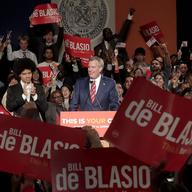
As Mayor Bill de Blasio weighs a possible 2020 Democratic campaign, he’s not the only one making big decisions. His donors are also making choices — like who to back in an increasingly crowded Democratic field.
Since last July, de Blasio has been raising money for his federal political action committee known as the Fairness PAC. The committee raised and spent more than $400,000 through the end of last year. It's paid for the mayor's trips to early battleground states like Iowa, New Hampshire and Nevada.
Federal Election Commission reports identify 118 of the committee’s donors. They come from 10 states and the District of Columbia — with three quarters of them from New York. The list includes pillars in finance, tech, and real estate development along with top-tier national Democratic donors.
While de Blasio’s fundraising faces persistent scrutiny, his ability to raise money will play a key role in whether he can launch a credible presidential campaign. WNYC reached out to Fairness PAC donors to find out whether they support the mayor joining the 2020 fray. Some declined to comment, while others said they shared the mayor’s ideology but weren’t ready to back his next steps.
Taken altogether, it all points to what may be one of the biggest hurdles facing de Blasio should he officially launch a presidential campaign: finding enough donors to support it.
In It To Win It?
Some Fairness PAC donors are de Blasio’s true ideological compatriots. Stuart Davidson, a labor lawyer based in Philadelphia, is one of them. He met the mayor in 2013 through de Blasio’s cousin, John Wilhelm, a longtime leader with Unite Here, the hospitality workers union. Davidson said they’ve cultivated a friendship over the years bonding over politics and a shared loved of Boston sports teams.
Last October, Davidson gave $1,000 to de Blasio’s Fairness PAC and at the time, he said, there was no discussion of the mayor’s possible presidential bid. “You of course have to have to be a bit of an idiot not to consider him as a possibility,” Davidson added.
He described de Blasio as a champion for causes that matter to him personally and professionally — an advocate for the rights of workers and immigrant families. But since de Blasio isn’t in the race yet, Davidson couldn’t say outright that he would support him in the crowded Democratic field.
“This is the year of mayors for me,” Davidson said praising Mayor Pete Buttigieg, while still signaling an openness to a de Blasio candidacy.
The calculation for Scott Nash, the founder of Mom’s Organic Markets, a chain of organic grocery stores, was slightly different. He and his wife Suzanne donated a combined $10,000 to de Blasio’s Fairness PAC last August.
Despite describing de Blasio in glowing terms (gracious, hard-working and curious), Nash said he’s going with the candidate he thinks is most electable and will be the best campaigner.
“Right now, I think it’s Joe Biden,” said Nash, “now that he’s entered, he’s my man.”
Big Donors, Other Priorities
Top tier Democratic donors also gave to the Fairness PAC, like James and Marilyn Simons, the third largest party donors nationwide in the 2018 election cycle according to an analysis by the Center for Responsive Politics. But it’s not clear whether de Blasio can count on more of their support.
In this cycle, FEC records show the Simons contributed to “Inslee for America,” the presidential campaign committee for Washington Governor James Inslee, who's sought to make combating climate change his signature issue.
De Blasio is also drawing increasing attention to climate change. He's drummed up media coverage of New York City’s Green New Deal, which would slash carbon emissions from city buildings, and planned a rally on Monday in front of Trump Tower.
Another prolific Democratic donor, Texas businessman Ben Barnes, donated $5,000 to the Fairness PAC, but it was specifically to support Democratic challenger Gina Ortiz Jones in a competitive House race in Texas, according to his assistant Susan Martin.
“I think that pretty much settles any questions you could possibly have,” she added, not mentioning de Blasio by name, but saying a lot by the omission.
Support Versus Commitment
Candidates need real money for a campaign — for the staff, travel, mailings and messaging. There's also a fundraising threshold for the first Democratic debate. Candidates have until June 13, which is two weeks before the debate, to qualify. A candidate needs to raise donations from at least 65,000 donors with a minimum of 200 donors in at least 20 different states.
Campaign finance experts add there’s a big difference between donating to de Blasio’s PAC and donating to his possible presidential campaign.
“It's one thing to help him explore and provide an opportunity to travel and to meet with other donors and to help move his message forward,” said Kristie Stiles, a managing director at Mercury Public Affairs who's worked for 20 years as a Democratic fundraiser on presidential, state and local campaigns. “It's another thing to say, ‘I'm committed to this,’” she added.
“Commitment” in fundraising parlance translates to taking a leadership role — helping a candidate as a fundraising chair. Some of the top Democratic fundraisers have already committed to candidates.
De Blasio could target the grassroots path and aim to fill his coffers with low-dollar donations, modeled after Sen. Bernie Sanders' 2016 run (the mayor reportedly met with Sanders' former campaign manager). But there are at least two problems for de Blasio with that approach: Sens. Sanders and Elizabeth Warren, who are already doing it better than the rest of the field.
That means if he decides to run for president, it becomes all the more important for his PAC donors to go along with him.
"Are they still going to write those checks for President?" said Stiles, "It’s definitely a bigger commitment."

WNYC is funded by sponsors and member donations