Dispatches From the Bang on a Can Summer Festival 2018: Part 4
Profile of a Composer In Five Quotes and a Laugh
By Stan Tymorek
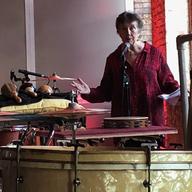
“Imagine me at Bang On a Can! They’re so cutting edge,” composer Joan Tower said to a MASS MoCA audience on Thursday night. “I’m elderly, but I guess I’m adventurous.”
Tower was being modest. She comically screwed up her face at the word “elderly,” but this year the music world is happily celebrating her 80th birthday with a number of performances dedicated to the adventurous composer. At the Bang On a Can concert of her music, her quick wit and enthusiastic encouragement of the musicians were on display.
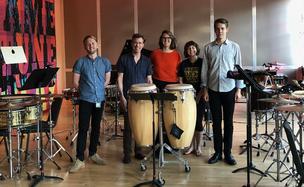
“I love percussion and percussionists. They’re the salt of the earth,” Tower said when introducing her piece DNA for five of these instrumentalists. It shows how she treats percussion instruments like people, because she said the title refers to the DNA of cymbals, drums and woods.
As she began to talk about her next composition, Sixth Fanfare for the Uncommon Woman for solo piano—part of a series of acclaimed works riffing on the title of Copland’s famous Fanfare that have been performed by dozens of groups around the world”—she looked at the program and saw the misprint “Common.” Some composers would have been outraged; Tower laughed it off.
When Piano Fellow Fei Nie finished playing the Sixth Fanfare, Tower embraced her. “I love the intimacy of music,” she told the audience. “I know a lot about her after hearing her play that piece. But she knows a lot more about me.”
Next up was another piece demonstrating Tower’s affection for percussionists. Small was written for about a dozen small percussion instruments that she wanted to fit in one, easily carried bag. “That way the musicians can pack up quickly after a performance and not miss the party,” she explained. “Percussionists have always been delayed by having to take down big instruments like marimbas.”
The final selection on the program was Noon Dance, for flutes, clarinet, violin, cello, percussion and piano. In his introduction, Nick Photinos, Bang On a Can’s Faculty cellist, recalled an earlier performance of the piece. When Photinos and the other members of the popular new music ensemble Eighth Blackbird were still in school, Noon Dance was the first sextet they played. “It meant so much to us that Joan was there,” he said. “When she came up to us after the performance, tears were in her eyes.”
Less nostalgically, Tower quipped, “I never really liked that piece.” She turned to Photinos and added, “but your ensemble’s commitment made it sound so special.”

Stan Tymorek is a freelance writer from Madison, Wisconsin, specializing in the arts.
Alicia Jane Turner: A Composer of Contradictions
By Sarah Lindmark
Composer Alicia Jane Turner has spent the last three weeks dragging her friends (and in this case an almost complete stranger) with her into the Turrell Gallery at MASS MoCA. The first stop on Turner’s impromptu gallery tour, an installation titled Afrum, was a bright white projection in the corner of a dark room that looked strangely like a 3-D object. The second stop, titled Guardian, looked at first like a flat projection, but after close inspection was actually a cavernous hole cut into the side of the gallery. The other installations in the Turrell exhibit feature disorienting washes of color in complete darkness.
The performance art she is known for in London, where she grew up and still resides today, expresses the sexuality and gender politics involved with listening. Many of her works are interactive, and she highly values being involved in every aspect of the production process. "I collaborate with lighting designers and sound designers, or I work as a sound designer on other artists’ projects,” she said while talking about her most recent performance art project titled Breathe. The intimate piece has the listener tune in to Turner’s heartbeat and breath while she experiences fear and anxiety.
Turner’s fascination with Turell’s work stems from her interdisciplinary background. “I’m really interested in putting new music into different contexts, mainly theater and performance art,” she said. She doesn’t typically write concert music, in part because her education didn’t take place at a music conservatory like many of her counterparts. “I haven’t been around a lot of really expensive instruments,” she stated matter-of-factly. The resources at Bang on a Can have allowed her to experiment with a wider variety of instruments. The piece she premiered Thursday night, titled Valves, for example, utilizes a violin, vibraphone, and a cymbal. During the concert, the violinist danced on the fine line that separates a clear, distinct tone from a distorted, crunchy, sul-ponticello sound in true Alicia Jane Turner style.
In stark contrast to her bright, welcoming personality, she’s worn exclusively black over the last five days of the Bang on a Can Summer Music Festival, and greatly admires the similarly friendly attitudes of the festival’s storied founders Julia Wolfe, Michael Gordon, and David Lang. “A lot of people writing contemporary classical music or new music are really patronizing when they talk about things and they’re really elitist,” she said. The Bang on a Can founders, however, “talk about things in a really matter-of-fact way, so that they don’t alienate people.” On the other hand, Turner loves their music because they utilize many of the same sounds and techniques that she works with in her own interdisciplinary compositions.
“I like Marilyn Manson, and I really like Arvo Pärt,” said Turner while talking about how she doesn’t quite see herself fitting in to the world of new music. Nervous about being an outsider among composers she admires for their accepting attitude, she and her work live in a beautiful world of contradictions.
Sarah Lindmark is currently working on a Master's Degree in Musicology at the University of California, Irvine.
The Celestial Music of Samn Johnson
By Maggie Molloy
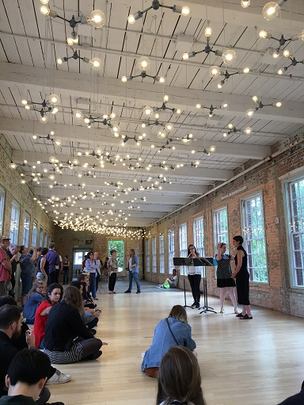
It’s 9pm on a Thursday and Samn Johnson is sitting at a picnic table outside MASS MoCA talking about the cosmos. He pushes his curly blonde hair back from his forehead as he excitedly describes a new app on his phone that allows him to map the constellations. Later tonight at an after-hours concert, one of his pieces will be performed under a different set of stars: Spencer Finch’s glimmering LED light installation Cosmic Latte.
Johnson is one of nine composer Fellows at the Bang on a Can Summer Festival, where he’s spent the past three weeks writing and rehearsing new music with performers from around the world. For the festival he has composed three new works, each one inspired in some way by time, space, or the celestial spheres.
Tonight’s premiere is an ethereal, three-minute saxophone quartet which will be performed by Dylan Ward, Luke Carbon, Ken Thomson, and Susan Summers. The piece, which is not yet titled, unfolds through broad washes of harmony that seem to hang suspended in mid-air, slowly spinning below the stars.
“There’s something very comforting about music’s ability to manipulate time,” Johnson says. A good composer, he points out, can make time move faster or slower, allowing certain moments to pause or repeat. Sometimes an hour-long piece can pass by in the blink of an eye, or a three-minute miniature can stretch on for an eternity. By altering the audience’s perception of time, he believes music can address the transitory nature of humanity.
In fact, Johnson’s music often juxtaposes different historical forms and styles as a way of circumventing the linear march of time. Blue Aurora, his string chamber work performed on Monday, employed an abstracted concerto grosso form to depict a cloudy nocturnal scene drifting in and out of focus. A gallery performance on Tuesday featured a celestial motet he wrote based on a medieval chant titled “Ave Maris Stella” (“Hail Star of the Sea”). Johnson’s rendition reversed the traditional roles of voice and accompaniment and softened the modal harmonies of the Gregorian chant, highlighting its haunting and ephemeral qualities.
“It feels like the ghosts of forgotten centuries,” he says. “I’m fascinated by this idea of trying to bring back something that’s irreparably broken.”
Maggie Molloy is a music journalist, editor, and radio host at Second Inversion. She is based in Seattle, Washington.
The marathon before the Marathon: Emily Thorner at Bang on a Can
by Lasse D. Hansen
On Thursday afternoon, Emily Thorner arrived ten minutes early to sing into a paper cup. “It’s my warm up cup,” the high-coloratura soprano explained while preparing her voice for her second rehearsal that day–this time of steel pan virtuoso Andy Akiho’s NO one To kNOW one.
The piece is one of many new works the Bang on a Can Summer Festival’s thirty young musicians, or Fellows, are performing with its Faculty this Saturday at the six-hour Marathon at MASS MoCA. It is a pulsating, fast-paced and shape-shifting piece, and with its leaping melodic lines, rap sections and punchy bass drum hits, it requires Thorner to be exactly the same.
Saturday’s marathon will mark the end of eleven different performances for the young soprano, who gives the impression of someone who is constantly in motion. “There have been a lot of times during this where I would go from one thing and then immediately after go learn something else,” she said flipping through her sheet music while recalling three weeks of Old English text, Scottish dialect, electronics, Renaissance-like timbres and scat singing. “At this point you kind of rely on your sight reading abilities, and then just put it together bit by bit: ‘Where do I have an entrance?’, ‘What’s the next interval?’, ‘How’s the rhythm?’”
She had to leave the rehearsal an hour early in order to get ready the third rehearsal of the day–this time of Iannis Xenakis’ Akanthos. The sound of the Greek “stochastic” composer’s piece–with its wordless and wide-ranging instrumental use of the voice–is located at the opposite end of the musical spectrum from the Akiho. Being located at the opposite end of the converted factory building complex as well, walking through the iconic wall art hallways gave Thorner just enough time to adjust to the appropriate frame of mind.
“It’s doesn’t always seem like there’s a place for vocalists in the new music world and I really want to change that,” she said later that Thursday. “I really want to show that we can be part of the instrumental texture too.” This interest she shared with Flute Fellow Alexis Letourneau in the first week of the festival, and they came up with the idea for a composition that would switch the classic roles, having the flutist as the soloist with the singer supporting. Subsequently they asked Composition Fellow Samn Johnson to write a piece based on the idea. After only 24 hours it was premiered this Tuesday together with Fellows Cara Search, Eli Greenhoe (both singing) and Rebecca Lawrence (bass).
“We can move fast,” Thorner concluded in a rare moment of rest. “And we do move fast.”
Lasse D. Hansen is a Copenhagen-based composer and writer, whose latest performances includes the theatrical fantasy Face the Music at the 2018 MATA Festival in New York. As a music journalist he is interested in the mysterious process of doing creative work.