Dispatches From the Bang on a Can Summer Festival 2019: Part 4
Yesterday, Friday, Aug. 2, marked the beginning of the end. The Bang On A Can Summer Festival wraps up with the first “LOUD Weekend” - 3 days and nights packed with live music. Our Media Fellows have been preparing all week, shadowing the Composition and Music Fellows as they rehearse, and following their daily recitals in and among the art works here at MASS MoCA. It’s been busy but manageable so far. Here are some of their final thoughts about this week before all hell breaks loose this weekend. - John Schaefer
Ambient Noise or Compelling Sounds? An Exploration of MASS MoCA’s Sound Installations
by Vanessa Ague
On Tuesday, Fellows at Bang on a Can’s summer festival performed two works in Spencer Finch’s “Cosmic Latte” exhibit at MASS MoCA. Voices from afar – sometimes a soaring soprano, sometimes a thundering bass – seeped into the room, mixing with the dissonant Boulez and sweet violins that were part of the actual concert.
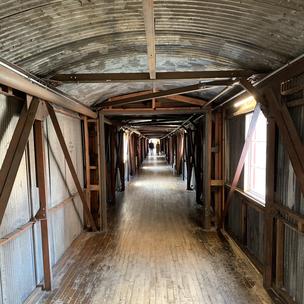
The vocal intrusions emanated from the sculptor and sound artist Julianne Swartz’s “In Harmonicity, The Tonal Walkway,” an installation that welcomes visitors to the museum every day. It’s a bridge that leads you from the entrance of the museum into the galleries that looks like an industrial tin can – an ode to MASS MoCA’s factory past. It’s also alive, breathing, making music. You can’t walk through its halls without the halls calling back to you.
The installation plays with the idea of tones eliciting different emotional reactions. It features recordings of 24 singers, from a range of voice types and ages, who each sing a different tone or scale with a variety of vowels or consonants. A soprano sings a descending chromatic scale in one corner, or a tenor hums a sustained pitch in the other. At times, each singer plainly speaks the emotion their tone elicits – sometimes their own opinions, and sometimes quotations from the work of the 19th Century British music teacher John Curwen. (His ideas inspired the installation itself.)
The result is a seamless set of interacting pitches and words. Notes reverberate like the inner workings of a factory. The piece is on an endless loop; it’s nearly impossible to define the precise start or end. It’s an immersive experience – finding stillness and listening to the pleading held tone of a bass singer does seem to evoke the meaning of the words one hears.

Then there’s the Boiler House. A relic of MASS MoCA’s past, this massive room was once used to heat the factory’s campus that the museum now inhabits. It’s currently the site of Stephen Vitiello’s sound installation “All Those Vanished Engines,” which simultaneously evokes the clanging of factory pipes and the uneasiness of a haunted house. The soundscape is rhythmic, not melodic. Built out from the natural resonance of the pipes, the sounds heard around the building range from windchimes to scratches to screeches to deep drones. Little alcoves on the first floor form sonic oases – each one features different resonances, and standing inside of them yields the feeling of solitude as the impromptu drones hum.
Ascending the staircase here is treacherous: it’s narrow and dusty. The further you ascend, the more prominent a spoken word component of the exhibit becomes – a spooky poem written by Paul Park. A conversation between a factory engineer and two visitors, the poem seems to channel an eerie past. “It’s hard to get the noises out of my mind, even after so long. It’s hard not to wake up with them, or hear them when I fall asleep. And in the time when I’m lonely here, it’s hard not to listen.” That’s how it feels to wander through the Boiler House. The sound is everywhere, unavoidable, yet nowhere.

Vanessa Ague is a violinist, avid concertgoer, and aspiring musicologist who holds a Bachelor's degree from Yale University. She currently works at National Sawdust, a nonprofit music venue in Brooklyn, NY, and studies music history and theory at Hunter College.
Pamela Z and the One Second Delay that Changed Her Voice
by Elias Gross | non-pro video from John Schaefer's phone
One evening in San Francisco in 1982, the composer Pamela Z watched the band Weather Report walk offstage and leave bassist Jaco Pastorius alone with an eight-second delay pedal. The pedal, at the feet of Pastorius, opened up new sound worlds, allowing him to effectively play a duet with himself. Z had to have her own.
At the time, Z was busking as a singer-songwriter in Boulder, Colorado, singing Joni Mitchell covers for ski bunnies and college students, and experimenting with synthesizers at home. The delay pedal offered the new possibility of manipulating sound live. The next morning, Z purchased a one-second delay pedal and played with layering vocal samples all through the night. She created a new kind of instrument, a mix of her bel canto opera training, experimental vocal techniques, and live electronic processing.
“I’m all about signal processing,” Z explained in an interview, not long after she arrived at the Bang on a Can Summer Festival this week. Signal processing allows Z to manipulate her vocals with effects like delays and pitch distortion in real time. With a MacBook, MAX/MSP software, and gesture-controlled MIDI, Z creates a composite instrument that can continually adapt to new technology. Her current set-up might sound complicated, but it used to be even trickier––before MAX/MSP, Z relied on a rat’s nest of “black spaghetti” cables and racks of effects processors heavy enough to earn overweight baggage fees at airports worldwide.
One of Z’s works being performed during the LOUD Weekend, “The Schmetterling,” was composed for the Bang on a Can All-Stars in 1998. In the piece, Z’s vocals transition from rhythmically spoken text about butterflies to sustained pitches looped atop metallic chords played by the ensemble. Gesture-controlled instruments allow Z to trigger samples of sounds from the natural world, while electric guitar slices through the textures with razor precision. Grooves blend and clash between percussion and intoned text, with the bass driving a repeated sequence of pitches that trades among the ensemble.
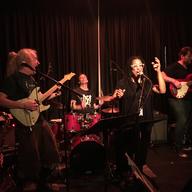
A recent recipient of the prestigious Rome Prize, Z remains curious and playful about new technologies. The first night she arrived at MASS MoCA, Z turned up at a jam session with an ocarina iPhone app. The next night, she waved a digital lighter in the air during a live karaoke session with a band comprised of Bang on a Can stalwarts. She took to the stage for a thunderous performance of the Talking Heads’ “Psycho Killer,” bringing her experimental techniques as well as her singer-songwriter roots to bear. It brought the house down.

Elias Gross is a PhD student in musicology and educator at UNC-Chapel Hill by day and a violist/ mandolinist by night.