Dispatches From the Bang on a Can Summer Festival 2019: Part 7
Power Struggles and Rebellion In “Eight Songs For A Mad King”
By Vanessa Ague
“The king is dead.”
So begins the final monologue of Sir Peter Maxwell Davies’s “Eight Songs for a Mad King,” a harrowing music-theatre work that portrays King George III’s madness, loss of power, and decline. Screams, bangs, howls, flutters, tears, courtly dances, and nearly every sound and musical style imaginable appear throughout the chaotic work. A group of Bang on a Can Fellows tackled it all at LOUD Weekend, coached by faculty member Ken Thomson and director David Eppel. Their extreme diligence helped reveal the heart of the piece: rebellion.
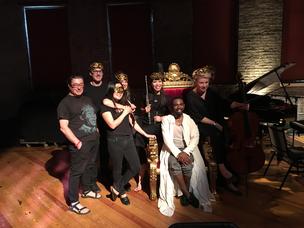
In directing the performance, Eppel felt that he needed a deep understanding of King George III’s history. He went through numerous documents – multiple films and plenty of articles – to delve into the life of the king. George III was the first of the generation of Hanover kings to speak English natively, giving him a deep sense of national pride. He also wrote obsessively – nearly everything that came to his mind. Some of these words are directly quoted in Davies’s piece. These obsessive habits eventually landed George III in a home for the mad. And when madness hit, it threatened his rule. There, he struggled with the thought that he might lose the throne.
What we see in “Eight Songs” is the king in the midst of madness, scared that his power is gone forever, tormented by thoughts of failure. He wants to rebel against the confines raised around him as a “mad man.” For Eppel, this rebellion is the key component of Davies’s work, and what makes it continually relevant to new audiences.
For Fellow Julian Otis, the vocalist, learning this piece was a wish come true. He stumbled upon it through a passion for the work of the composer and vocalist Julius Eastman, a famed interpreter of “Eight Songs” in the 1970s. The show portrays the humanity of the king, a person of power, which Otis finds deeply important. But to learn the work, he had to be immersed in it. “It is physically, mentally, vocally demanding,” Otis explained. “It’s not a piece you can do halfway.”
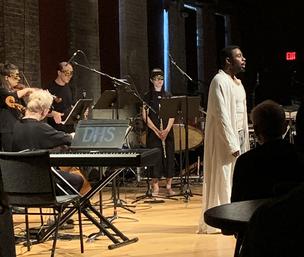
On stage, Otis must move through a variety of emotional states, seemingly at random. But in his score, Davies makes a point to mark practically each note the singer utters with directions that precisely indicate when to sing a raging glissando or to giddily laugh, making evident the way the king’s madness must be portrayed. So, learning the work meant mastering the score. Faculty member Ken Thomson remembers one section in particular, where the king sings “Blue, yellow, green is the world, like a chained man’s bruise.” At first, Otis interpreted these words loudly and angrily. But Davies indicates that they be sung quietly and in a very high pitch. Once Otis made this change, Thomson recalled that “it [gave] you chills rather than a statement of being angry.”
One particularly unsettling duet between flute and voice gets its own remarkable page in the score. The written music in this section is shaped like a birdcage. The two musicians need to master this unusual notation, which mimics what’s happening on stage: the flute slips between the vocalist’s words, like the intertwining bars of a cage. In Eppel’s staging, flutist Phoebe Bognár stepped out from behind her stand and began to play fluttering sounds as she watched Otis intently from behind. The king then immediately switched his emotional state in response, and began a disturbing, quivering conversation of nonsense words back and forth with her.
For the ensemble as a whole, one especially difficult element of learning the score was the fact that it ignores one of the basic elements of written music: meter. On one page, each ensemble member is on their own. “They’re all going at their own speed,” Thomson said. “So how do we execute that so we all end at the same time?” It posed an “interesting challenge,” and required a great deal of rehearsal time to learn the correct cues and timing.
Eppel and Otis worked together for two months before the festival began, talking frequently over the phone about their goals. Once at the festival, they went in full force to put the parts together in the couple of weeks they had. And all the work paid off in two LOUD Weekend performances to packed audiences. Emerging from stoic silence and dimmed lights, the first, dissonant blast of music made some of the audience jump on Friday evening. And then the septet of performers was off – clashing, shrieking, and more. Seeing Otis in full character after a week of preparation was eye-opening. In rehearsal, he was already performing the role at an extremely high level, switching expertly between moods and showing a strong command of his voice. But he was saving the full madness for LOUD Weekend, pulling out all the stops from over-the-top comedic dancing to harrowing cries and spine-chilling quietude.
During comedic moments, like Otis’s absolutely silly dancing during a song laden with irony, the audience laughed. They cringed and jumped during other moments, completely engrossed in his character. Towards the end of the work, there is a moment that has made the piece infamous: Davies instructs the king to take a violin from one of the performers and destroy it. Everyone watched, riveted, as Otis wrestled the instrument out of violin Fellow Isabelle Bania’s hands, stomped to an off-stage throne, and smashed the instrument to pieces.
Otis’s complete immersion in the role did cause one minor technical snafu on Friday. While writhing on the floor, his microphone stopped working. A sound technician entered the stage and fixed the problem quickly, as the instrumentalists improvised a soft loop of music underneath. No one, not even Otis, broke character.
In rehearsal, it took numerous practice runs to perfectly time the king’s slow, dragging walk onto stage. The raising of the lights needed to be timed in accordance with the walk, as the piece began in complete darkness. At the performance, the pace felt right, and dim lighting contributed to a creepy ambiance.
The work concludes with a chilling monologue accompanied by bass drum, played by Fellow Tomek Szczepaniak. Timing this took practice: the drummer had to follow the king offstage, interjecting loud blows between the king’s cries. At the performance, it was utterly haunting, leaving the audience understanding the fear of this broken, beaten down man.

Vanessa Ague is a violinist, avid concertgoer, and aspiring musicologist who holds a Bachelor's degree from Yale University. She currently works at National Sawdust, a nonprofit music venue in Brooklyn, NY, and studies music history and theory at Hunter College.