Dispatches From the Bang on a Can Summer Festival 2024: Part 2
The Bang On A Can collective, which has championed new music since 1987, decamps every summer to MASS MoCA, the vast complex of former industrial buildings in North Adams, Massachusetts that now houses one of the country's largest contemporary art museums. Since 2002, Bang On A Can has hosted Fellowship programs for emerging composers and musicians - a way of allowing a younger generation of creators and performers to essentially grow up together. This year, they have once again included a Fellowship program for aspiring music writers, and invited me and the radio host/music scholar/pianist Terrance McKnight to serve as the faculty.
This week, we are reporting back from the Berkshires with a new batch of writing fellows. You’ll get their impressions of the concerts, rehearsals, and unusual concert settings they're experiencing. It all leads up to the big event this weekend - Bang On A Can Summer Festival's LOUD Weekend at Mass MoCA -a "fully loaded eclectic super-mix of minimal, experimental and electronic music," (massmoca.org). Follow our writers, Elizabeth Derner, Jurgis Kubilius, Leona Oliveros, Maddy Briggs, and Stephanie Manning as they follow the musicians and composers who may be the next generation to change the sound of contemporary music. -John Schaefer
Todd Reynolds plays his instrument inside an instrument
By Elizabeth Derner
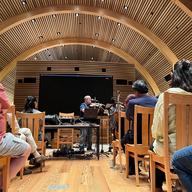
If you’ve listened to sound bounce around in headphones, picture stepping inside them. Studio 9, a wooden building with a domed roof, moves sound around the entire room through 48 speakers. It’s across the street from MASS MoCA in North Adams, Massachusetts, site of the Bang on a Can summer music festival.
Violinist Todd Reynolds, a Bang on a Can faculty member, held a recital at Studio 9 on Saturday night, but he didn’t have an ordinary recital in mind. He wanted it to be more of a community gathering.
“I really want to take them on a journey,” Reynolds said. “And I want them at the end of that journey to feel well taken care of, led on it but not forced on it and I also want them to feel like they were part of creating it. Every single person was part of creating every single person's experience.”
Audience members filled all the seats, and several stood against the back wall or sat on the floor. And with many of them also part of Bang on a Can or knowing Reynolds from the area, the environment was warm and friendly. Reynolds’ jokes, casual conversation and closeness to the audience contributed to this too. Rather than stand on a stage high above the audience, he wanted to be among them and experience the music together.
Performing at Studio 9 was new for him and Bang on a Can — the faculty had never performed a recital there, so it was a new experience for many audience members too.
At the beginning of the night, Reynolds told the audience that playing in Studio 9 was like “playing the building as an instrument.”
Reynolds loves big sound. He’s known for his experimental work with violin and electronics, inspired by Jimi Hendrix and rock bands whose sound could fill a room. He also loves sound that bounces around, so he’s been involved with Studio 9 since it was built during the pandemic. He performed there acoustically when it opened but said Saturday was the first time he got to perform in the studio “for real.”
“[Its technology is] attached to real-time music making and real-time self expression — that's what really interests me the most,” Reynolds said.
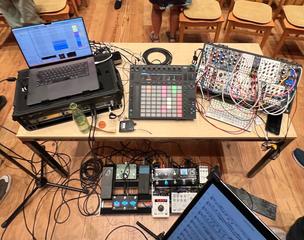
Studio 9’s rare Meyer Sound Constellation and Spacemap Go technology allow him to mix live and make sound not only fill but spin, zoom and dance around the room.
He spent three days working in the studio before his recital and said he felt at home. Using sound design software, he set up which areas he wanted the sound to come from for each piece and how it would move.
Without concert programs, the audience had no idea what music to expect, making the night feel even more like a journey.
Bassist Kebra-Seyoun Charles, cellist Nick Photinos and pianist Richard An joined Reynolds along the way as he played pieces by George Gershwin, Ray Noble, Meredith Monk, local composer Paul de Jong and Bang on a Can founders David Lang and Michael Gordon. He also played two improvised pieces influenced by Steve Reich.
Reynolds chose these pieces to incorporate community members and create an experience of contrast. Lang’s “Killer” seemed to turn the violin into an electric guitar shredding over thumping, heavy-metal-sounding electronics. “Age of the Sea” by de Jong, on the other hand, sounded meditative and nostalgic with ocean sounds and gentle cello accompaniment. For some pieces, the technology interacted with Reynolds’ violin as he played, creating distorted effects a violin can’t make on its own.
“It’s a journey of contrast in noticing and experiencing, a journey in breath, a journey in storytelling,” Reynolds said.
While the constellation speakers immersed the audience in moving sound, a video screen added another sensory experience. Films played in the background during three of the pieces, like ocean waves for “Age of the Sea,” offering another way to experience the music.
The audience responded enthusiastically to every piece. After the last, Reynolds invited them to come up and see the equipment, in a way welcoming everyone into his home.
Elizabeth Derner is a senior at the University of Missouri-Columbia studying journalism, English, and music. She enjoys playing double bass, writing articles and poetry, learning about new music, and spending time with cats.
The young composer Fellows working at the Bang On A Can Summer Music Festival were given an unusual challenge after they arrived at Mass MoCA, as media Fellow Stephanie Manning reports.
Originally from the Washington, D.C. area, Stephanie Manning trained as a bassoonist at Oberlin Conservatory while finding her way into journalism as a classical music critic. She recently completed a graduate diploma in journalism at Concordia University in Montreal. Her writing has appeared in The Montreal Gazette, Early Music America, and ClevelandClassical.com.
(Un)serious art of (un)welcoming music
By Jurgis Kubilius
“I go to a lot of new music concerts, and it's a torture being there,“ says Annija Anna Zariņa, a contemporary music composer.
Surprisingly, Annija was not the only at this year Bang on a Can Summer Festival who once had felt this. Alexey Logunov and Alex Groves, young composers just like her, taking a 3-week summer course at MASS MoCA, have also experienced this problem: That loads of contemporary music—including their own—doesn’t reach that point where one says: ‘it was hard to listen to, but worth it.’
And this was not what these three composers could fix simply by going to more new music concerts.
They said he would have a serious career as a pianist, this Russian wunderkind Alexey Logunov. But it was not what he wanted—or not how his teachers imagined it. Right after touching the piano keyboard, Alexey started composing. In teenage years, he played in a Rock band. He went on, switching paths when needed, even when discouraged by a conservative environment. And yet, despite all his effort and backing from those closest to him, Alexey realized: “There was a wall in front of me, and I just couldn’t break it.”
Annija Anna Zariņa realized that something was wrong during her, as she puts it, ‘serious’ composition studies in Latvia. Entering the contemporary stage from the world of jazz, Annija Anna, a kid of this century, found herself in a mindset where her music seemed to her ”not contemporary enough.”’ So she went for that contemporary music—making pieces where pure aesthetics is the ultimate goal. “I ended up writing music that I hated,” Annija smiles bitterly.
As for UK based Alex Groves, things started pretty well. He developed a laconic and mellow style, writing music he enjoyed, easily bringing him more commissions each year. But it proved to be a dead-end. Eventually, Alex felt trapped, as he puts it, ”not risking enough,” feeling financial insecurity if his music didn’t attract contemporary music gatekeepers. “I was trying to get people to take me seriously,” says Alex, who ended up being seen as “someone who didn't need pay, didn’t need time, space or resources.”
The magical word ‘serious’... It became a curse word for them.
But Alexey Logunov went here, to the United States. He met composer PQ Phan in Indiana, who, upon examining Alexey’s extensive knowledge of contemporary music, told him: “I see you know lots of music, but I don't hear anything of that in the sounds you make.” And he helped to change this.
Now Alexey pursues a doctoral degree and explores ways to merge his classical schooling and passion for piano and Rock. Finding himself in the right place, Alexey advances in electroacoustic music, preferring large ensembles which can create huge sound masses.
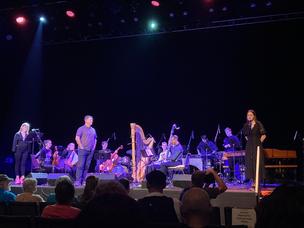
The ongoing war in Ukraine brought yet another identity crisis to Alexey. But now he dares to be himself: he stopped shortening his name, despite people often mispronouncing it. ”Making clear who I really am is what happens in my music now“, Alexey says. And you can hear it in his composition ‘Ultramarine’, premiered at the Bang on a Can Summer Festival. Inspired by visions of the ocean, the piece ends with a muted cymbal rhythm—probably a rebellious Rock soul—emerging from a mist of whistling strings.
Annija Anna Zariņa escaped the torture of ”seriousness” by starting to think more about the audience. “There is so much music that is not aware of itself,” she says, “it doesn't really demand the attention of a listener.” So now Annija makes sure that her listeners would be engaged, but would not need to work to enjoy her music.
A huge boost to this aim seems to be her demanding yet caring teachers in the Hague, the Netherlands. In her latest pieces, she challenges herself by writing sounds as well as words. In her Bang on a Can Festival premiere ‘Unsaid’, Annija Anna Zariņa wrote a part for a singer who sings a single sentence—but spelling it letter by letter. That way, Annija keeps listeners on the edge of their seats: ‘I understand there’s a sentence, it’s even spelled for me—but I cannot understand a word!’
Alex Groves, decided to throw parties on the contemporary music stage: “The pieces that I'm writing at the moment, are very different, very rhythmic, very punchy, very sort of in your face.”
The environment where Alex embraced freestyling, surprisingly, turned out to composition studies, where Alex found it much easier to experiment than in times he wrote music full-time. He later took a stable administrative job, totally unrelated to music. “Yes, it takes up lots of my time,” Alex admits, “But it gives me a very stable platform from which to take risks.”
The Bang on a Can Summer Festival audience heard the results during premiere of a piece called ‘hottt’. As Alex says, the goal here was to “bring the concert hall aesthetic to club music.” The piece serves what that its title promises: a steamy experience with bass drum kicks, crash cymbal shots, and crazy backbeat performed by classical instruments.
After years of searches, Alexey Logunov, Annija Anna Zariņa, and Alex Groves now don't escape from who they are, what they like—and especially what they don’t. As Alex Groves says, that “shying away from what you prefer only stops you from really speaking to the world.”
And the welcoming experience at new music concerts seems to lie in the hands of the composers themselves. Once tortured by new music, Annija now admits: “When I compose and enjoy it, it solves lots of problems.”
Jurgis Kubilius is a Lithuanian composer, music critic, and concert host. He currently studies composition at the Conservatorium van Amsterdam (The Netherlands).