
Dispatches From the Bang on a Can Summer Festival 2024: Part 7
The Bang On A Can collective, which has championed new music since 1987, decamps every summer to MASS MoCA, the vast complex of former industrial buildings in North Adams, Massachusetts that now houses one of the country's largest contemporary art museums. Since 2002, Bang On A Can has hosted Fellowship programs for emerging composers and musicians - a way of allowing a younger generation of creators and performers to essentially grow up together. This year, they have once again included a Fellowship program for aspiring music writers, and invited me and the radio host/music scholar/pianist Terrance McKnight to serve as the faculty.
This week, we are reporting back from the Berkshires with a new batch of writing fellows. You’ll get their impressions of the concerts, rehearsals, and unusual concert settings they're experiencing. It all leads up to the big event this weekend - Bang On A Can Summer Festival's LOUD Weekend at Mass MoCA -a "fully loaded eclectic super-mix of minimal, experimental and electronic music," (massmoca.org). Follow our writers, Elizabeth Derner, Jurgis Kubilius, Leona Oliveros, Maddy Briggs, and Stephanie Manning as they follow the musicians and composers who may be the next generation to change the sound of contemporary music. -John Schaefer
A question you should dare to ask
By Jurgis Kubilius
“Hey, how’re you doing?” said a staff member to me, passing an empty gallery at the MASS MoCA.
I flinched because I was not expecting this. It was too sudden for me.
You see, I’m not an American. I came to the Bang on a Can Summer Festival in North Adams from Europe.
Originally, I am from Lithuania, one of the Baltic States. A country proud of its forests, its charming Baroque and Art Deco old towns. But in Lithuania, the question “how’re you doing?”—I mean, it is a real question. A very serious one.
And you certainly don’t ask “how are you doing’” to a stranger, like it happened for me at the MASS MoCA. Never. For it’s not so long ago when, in Lithuania, this question was dangerous.
It was the time, in which my parents and grandparents grew up, when “walls had ears”. When saying what you think—or worse, saying out loud what is true—might have given your family a free one-way ticket to vast Siberian forests. It actually happened for my grandfather and his entire family.
Being 6 years old, he survived the two-week trip in a livestock wagon. Then almost two decades of “Siberian SPA treatment” from a natural inclination to be honest.
He managed to become a successful engineer afterwards. But just like for so many others, living in occupied Lithuania, my grandfather’s true job was lying and avoiding honesty at all costs. A job everyone in Lithuania had to do. To maintain their families, and to survive themselves.
Hearing that casual “how’re you doing?” in the MASS MoCA gallery, I recalled what my dad’s friend once said: “All the kindness you receive there, in the States, it’s fake.”
But I was not convinced by this generalization. That MASS MoCA staff was smiling at me—and I didn’t observe any bitterness in their smile. If it was fake, it was of a very different kind of fakeness—not that fearful fakeness my parents and grandparents used in shops, work, and sometimes, unconsciously, raising their kids.
So I decided to examine the supposed fakeness of the American way to say “how’re you doing?”
The next day, I started an expedition around the endless galleries and corridors of MASS MoCA. I said “Hey, how are you doing” to many staff and visitors of the Bang on a Can Festival. And the results were quite unexpected.
First, people kept talking. They started sharing things—even more honestly than when I ask “how’re you doing?” to my very best Lithuanian friends.
Eventually, I discovered that two people in the same room had Lithuanian blood, but don’t speak Lithuanian anymore.
That the outer brick wall was dismantled to bring in the 15-ton sculpture by Louise Bourgeois.
That one person visits her sister at the Bang on a Can festival, because it’s the only time of the year when they can meet.
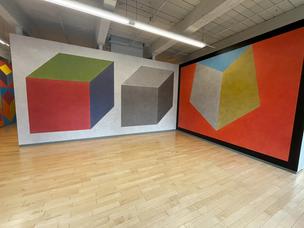
In the ‘sight’ of conceptual artworks—three floors of Sol LeWitt drawings, James Turrell’s colorful light shining from the holes in the walls, Spencer Finch’s ceiling lamp installation -- in the presence of all that, small, concrete, yet strikingly sincere stories emerged. Stories that seem to be more real than paint lumps on Anselm Kiefer’s embossed paintings. Stories that came out after asking casually “How’re you doing?”
“Hmm, so maybe this American courtesy is not that fake after all?” I pondered, “Maybe it is a rather versatile thing, a practical tool as well as something that can open people up. Just like those PVC pipes that we blew in the orchestra the other day.”
Indeed, this happened a few days before. The Orchestra of Original Instruments it was called, “conducted” by the Bang on A Can All-Stars guitarist Mark Stewart. “Conducted” is in quotes because it was not the type of conducting you would expect to experience.
It started when Mark, all excited, raised a white four-foot PVC pipe up like a spear.
“This instrument,” he yelled, “It is a very special one! You tape the reed on the saxophone mouthpiece—you plug the mouthpiece in the pipe—and you blow it! And you’re instantly a master of this One-Reed Horn! And there’s no way you can’t do it!”
Many of those standing in the room were professional musicians. It means they spent at least 15 of their lives to master their instrument—to produce a perfect, mellow, pleasing sound. So you don’t expect they would take seriously that blast of roaring, squeaking, croaking, and other simply indescribable sounds.
Instead, just like “‘How’re you doing?” opened up people to tell their stories, these crude sounds from PVC pipes opened all of us to create.
We came up with an almost unbelievable variety of ways to make a short 1-minute piece. One group made a “sacrificial dance”, blowing pipes just like ancestral horns. Others made short rhythmical pieces that could be easily developed to dance floor hits. Though my favorite was the one with a combat scene. Two piping “predators” dueled each other, with a flock of piping spectators cheering, and the “judge” with the longest pipe separating the quarrel.
Just like the purely functional “how’re you doing”, PVC pipe revealed people’s eagerness to share, to create, to tell and listen to stories.
Especially those that are not so easy to listen to.
Such was the one that opened the last day of the LOUD weekend at the Bang on a Can Summer Festival. Julius Eastman’s (1940-1990) “Gay Guerilla” starts with an emerging perfect fifth—an interval that is a skeleton for chords. An interval that is spacious, soothing, and considered to carry no distinct character at all.
In the serenity of this interval, played by a piano and saxophone, a single new pitch emerges. This sound, introduced softly by an electric guitar, transforms the perfect fifth into a minor chord—the one we associate with sadness.
“Everyone is a clear empty vessel, and it is the world that fills us with sorrow,”—that’s what Eastman’s opening, his musical “Hey, how’re you doing?” said to me. Written in 1980, “Gay Guerrilla” is a wordless story of a Black homosexual composer—too queer and political for the American new music stage, too vocal and idealistic to comply with any institution, and too unfortunate to witness his voice’s impact, which I saw in the audience.
I bet Eastman would be even more political these days if he heard what I heard from a colleague journalist.
They work in a classical radio, in one of the big cities on the West Coast. And when they play Black composer’s music, such as ragtimes by Scott Joplin or anything jazzy, they usually receive complaints from listeners.
That “it is not the right time and place for such music in a classical program”. In other words, that the word ‘classical’ must remain monopolized by those who glorify the Eurocentric classical music mausoleum.
“It seems it’s the worst time to be born a white male composer,” I told fellow students at the dinner table during the Bang on a Can Festival.
“No,” a very wise musician answered, “It is simply the time to take into account everyone else’s stories too.”
* * *
When I returned to Lithuania, I visited my dear friend—the one I dare to ask “how’re you doing?” I told him about the stories I encountered at the Bang on a Can Summer Festival: the PVC pipe horns, Eastman’s minor chord, about still ongoing racism in classical music, and sisters meeting each other only at the festival. And about my confusion regarding fakeness.
“You know,” he said to me, “Living in the States for a few months, I realized it doesn’t matter whether people’s smiles are sometimes fake. The kindness of the intention is what really matters. Kind intention to acknowledge other’s existence.”
I nodded in agreement.
”By casually saying ‘hey, how’re you doing’ to a stranger,” he continued, “We quit that survival mode our parents and grandparents unconsciously passed to us. The fear that each stranger can bring us threat, forcing us not to look in the eyes, not to engage in a casual talk.
“By asking “how are you doing?”—whether casually or for real—we quit ghosting people. We accept a stranger as an equal human being, with a right to smile, to choose, and to live as they please.”
This phrase “to live as they please” resonated in both of us. For we both knew the rumors that the Lithuanian businesses were told to prepare for a new stage of war at the end of this decade.
If the day comes—the day when the empire of evil returns to dehumanize our nation yet again—my friend and I know precisely what we would be fighting for.
That casual “Hey, how are you doing?” from a stranger, accompanied by a smile. That impulse from which benevolence and people’s stories emerge.
Jurgis Kubilius is a Lithuanian composer, music critic, and concert host. He currently studies composition at the Conservatorium van Amsterdam (The Netherlands).