Promoting Tidy Streets and Tidy Minds: The Junior Inspectors Club of the Air
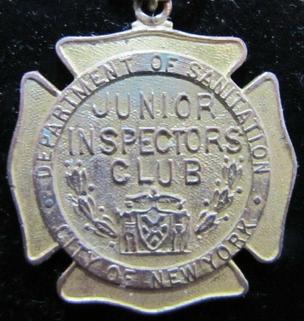
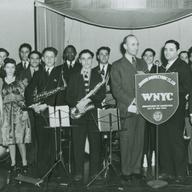
Imagine, for a moment, the Boy Scouts run by the New York City Department of Sanitation with a regular radio program, but no uniform. That's a nutshell description of The Junior Inspectors Club show on WNYC. For eight years (1934-1942), the city agency tasked with keeping the streets and parks clean hit the airwaves each week with a children's talent and variety program. Not long after the group's formation on September 26, 1934, the radio program was airing as frequently as three times a week. Over time it expanded to become a daily show and by the time it went off the air in 1942 it was airing just once a week. The broadcasts was designed to draw the city's children into the club and had three goals.
First, it establishes confidence, poise and self-reliance in the children who present who present the program, and gives the child a broader viewpoint which he or she might never otherwise attain. Second, such broadcasts inspire and encourage other children to emulate these children. The third advantage of these broadcasts is that they create among the members a more direct and active interest in the club, because they bring them into personal contact with each other.[1]
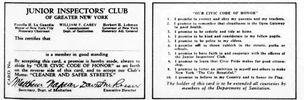
The program also aimed to engage children in the Sanitation Department's public relations agenda: the anti-litter campaign, volunteerism, 'character building' through an honor code in which members pledged to maintain good manners, advocacy of civic leadership, and obedience to parents and teachers. In brief, it was an effort to thwart juvenile delinquency and channel youthful energies in a constructive direction. The Public Engineers Yearbook for 1939 described the half-hour WNYC show.
Auditions are held under competent direction prior to these broadcasts, and in this way, these little singers, dancers, and musicians are taught poise, confidence in themselves, how to apply themselves to good hard work, and the difficult art of radio technique as it is practiced in modern radio studios. Hundreds of complimentary letters from our radio audiences are received weekly and testify to the genuine enjoyment these programs generate. In this way too we request our invisible audience to cooperate by adopting our club's slogan, 'Do Not Litter the Streets,' --and this repeated at least three times at each broadcast. [2]
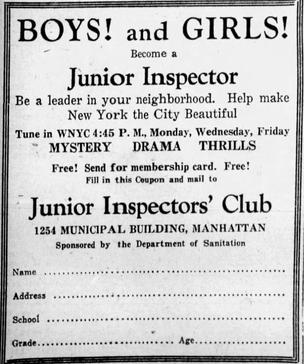
The Junior Inspector's Club was highlighted in a radio play as part of the opening of the station's new WPA-built studios in October 1937. In WNYC: Voice of the People, a boy complains to his father the station is boring, "They never have anything good. No movie stars or nothin." But his wise dad points out the exciting Missing Persons reports from the police department and the chance to be a member of The Junior Inspector's Club meeting regularly on WNYC. It's a slam dunk, the youngster is convinced.[3]
As part of the February 11, 1938 broadcast, ten club members were awarded medals for politeness by Sanitation Commissioner William F. Carey. The courteous kids had given the 'best' answers to an annual twenty-six-question politeness survey. Notable among survey results was that boys from the Bronx were less likely to express themselves with a 'Bronx cheer' to show disapproval while at the movies than boys from other boroughs.[4]
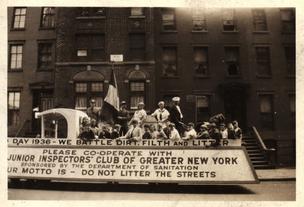
The Junior Inspectors Club was the 1934 brainchild of Sanitation Department official Matthew Napear, who came to the United States as an immigrant child from Poland and began his career in the wholesale underwear business. An ardent supporter of Fiorello H. La Guardia's first campaign for Mayor, Napear was rewarded with the post of 'Secretary' at the Sanitation Department.[5] Newspaper accounts and department literature name him as 'Commander-in-Chief' of the Junior Inspectors Club.
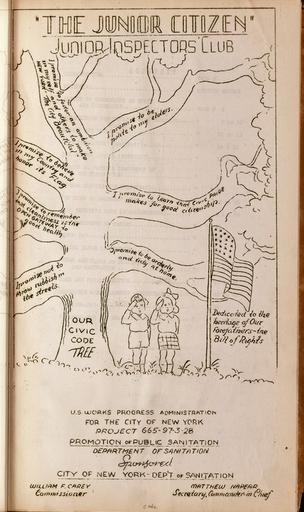
Funding for the club came from the federal Works Progress Administration (WPA) and, along with plays and performances on WNYC, the club published The Spic and Span News and The Junior Citizen. It sponsored regular field trips for members to museums, sports events, parks, and other kid-focused activities. Members also participated in the election of a Children's Congress, the group's ruling body. Within a month of the club's founding 500 children had enrolled. At its peak, the Junior Inspectors Club had a membership of some 155,000 New York kids between the ages of 6 and 18 on its rolls, with branches all over the city and a heirarchy of thousand of officers including, Squad Leaders, Platoon Chiefs, Lieutenants, Captains, Field Marshals and Majors.[6]
_____________________________________
[1] "Junior Inspectors Club Aid Anti-Litter Fight," The American City, January 1938, pg. 55-56.
[2] American Public Works Association, Public Works Engineers Yearbook 1939, including The Proceedings of the 1938 Public Works Congress, pg. 305.
[3] "WNYC Voice of the People," radio script, October 23, 1937.
[4] "Ten Polite Children Get Medals; Picked from 90,000 in Contest," The New York Times, February 12, 1938, pg. 17.
[5] "Matthew Napear, La Guardia Aide," The New York Times, April 16, 1968, pg. 47.
[6] ibid. "Junior Inspectors Club Aid Anti-Litter Fight"
The recording at the top of the page is composed of edited and signal-processed excerpts from a rare surviving broadcast of June 16, 1937. In brief, we have tried to make some very poor audio listenable again.
Special thanks to Alexandra Hilton at the New York City Municipal Archives.

WNYC is funded by sponsors and member donations