Earth Sounds: The Didgeridoo Stirs Controversy at the Bang on a Can Summer Festival
Earth Sounds: The Didgeridoo Stirs Controversy at the Bang on a Can Summer Festival
By Hannah Edgar and Elias Gross
When it comes to borrowing from other cultures, is music fair game?
The question isn't simple, and it's not new, with increased public discourse about the difference between musical borrowing and appropriation reaching out beyond academic discourse into mainstream debate. Last week, that question hit the Bang on a Can Summer Festival, sparking a cross-generational, multinational conversation between composers, performers, and festival faculty.
The piece at the center of the dialogue was Thousand Year Dreaming by Annea Lockwood, programmed by Bang on a Can co-founders Michael Gordon, Julia Wolfe, and David Lang as part of the festival’s inaugural LOUD Weekend. The New Zealand–born, U.S.–based Lockwood is known for her Fluxus-inspired works — like her Piano Transplants series, whose most provocative installment involved setting a piano aflame — but also for expansive sound experiments inspired by trance traditions.
Composed in 1990, Thousand Year Dreaming grew out of those trance studies but also out of a close musical collaboration: The year before, Lockwood created Nautilus, an improvisation for didgeridoo, conch shell, and percussion, for multi-instrumentalist Art Baron and percussionist N. Scott Robinson. She sought to expand the ensemble for a new work, ultimately creating Thousand Year Dreaming collaboratively with a nine-piece group that included Robinson and Baron, plus three American experimental musicians who would play didgeridoo: Jon Gibson, John Snyder, and Peter Zummo. (Snyder and Zummo both had some experience with the Aboriginal instrument, but Gibson — described by Lockwood as a “brilliant wind artist” who was also a pioneering member of the Philip Glass Ensemble — learned the didgeridoo just to play the piece.)
The conch shells return in Thousand Year Dreaming, part of an eclectic tapestry of sounds that includes English horn and oboe (the latter to be played “shenai style,” a reference to the Indian double reed instrument), waterphone, frame drum, pod rattles, and more. Stones and clapping sticks even join the fray, with accelerating and decelerating rhythmic patterns inspired by Japanese and Buddhist traditions.
But it’s the didgeridoo whose inclusion seems to have proved most contentious among some Fellows. Typically made from a eucalyptus trunk naturally hollowed out by termites, the didgeridoo is an Australian Aboriginal instrument with roots in the ceremonial practices of the Yolngu people in northern Australia, who call the instrument the yidaki. In those ceremonies — and, as the instrument spread, even in secular contexts — the instrument is played exclusively by men.
In recent years, the didgeridoo’s broader use has become controversial in Australia. In 2007, the Australian Government and the Australia Council for the Arts issued recommendations about the use of the didgeridoo — namely that women avoid publicly playing the instrument and that non-Indigenous musicians seek consent from “the original custodians” of the instrument before playing it. Last month, Christopher Sainsbury, an Indigenous composer, published an essay (summarized in this Music Australia article) urging non-Indigenous composers wishing to use Indigenous source material or instruments to collaborate with Indigenous musicians.
Early on in the rehearsal process, one Fellow — who requested anonymity — approached Bang on a Can All-Star guitarist Mark Stewart, the faculty member leading Thousand Year Dreaming, with concerns about material in the piece potentially belonging to Indigenous musicians who were not compensated, the inclusion of the didgeridoo itself, and the two female, non-Indigenous fellows performing on the instrument. Stewart then relayed those concerns to Lockwood via email.
“One of the players was concerned about appropriation, which I hadn’t really thought about in relation to this piece,” Lockwood later said about the email exchange, adding that in Thousand Year Dreaming the didgeridoo and contrabass clarinet broadly represent “earth sounds.”
“In the ’60s, many of us were looking at other musical traditions because our own seemed so stuck. We certainly frowned upon somebody directly taking material and replicating it, but we weren’t thinking of ourselves as colonialists in allowing ourselves to be influenced by ideas about music and so on from other cultures,” she said. “Ravi Shankar was only the tip of the iceberg.”
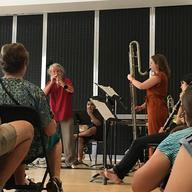
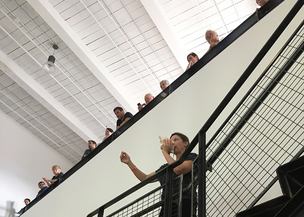
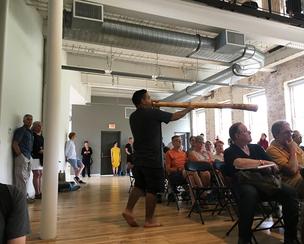
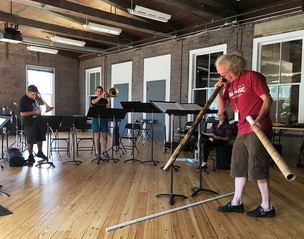
Over the 45 minutes of Thousand Years of Dreaming, a vast array of instruments realize Lockwood’s “earth sounds” across geographic and stylistic borders. The piece is inspired by the Lascaux cave paintings, and projections of the images often accompany performances. LOUD Weekend’s performance, which took place in a two-story gallery space, did not include those projections but incorporated numerous instrumental additions and amendments. Percussionist Reed Puleo dragged a superball mallet down the railing of a staircase in the space in lieu of a frame drum, commanding the audience’s attention with a long, clear tone. On the ground, Stewart added wind instruments of his own invention: a sliding PVC and cardboard “trombadoo” and a nine-foot long PVC “pole vault horn,” tuned to a thunderous low C, to support the didgeridoos and contrabass clarinet. The dualities of old and new, loud and soft, movement and stillness moved the audience a standing ovation.
In an interview, Lockwood emphasized that she was attempting to depict something elemental in Thousand Year Dreaming rather than imitating Aboriginal musical traditions or any specific ritual practice. In a set of notes explaining the piece’s origin, she wrote: “Hearing two Aboriginal musicians giving a concert in London — which they explicitly said was a performance, not in any way a ritual — showed me … that [the] didj need not be exclusively reserved and associated with ritual/sacred evocation.” Though she did not collaborate with Aboriginal musicians for Thousand Year Dreaming, she did seem to take inspiration from the fact that the London concerts presented the didgeridoo in a secular context.
Brisbane-based violinist and Bang on a Can Fellow Flora Wong did not perform in Thousand Year Dreaming, but she spoke about the potential controversy from her vantage point as an Australian. Wong said that the gender roles associated with the didgeridoo complicate its broader use more than most instruments: Because it’s considered taboo in some regions for women to play the instrument, women are typically discouraged from playing it publicly, and, in some cases, even touching it. In her capacity as the Queensland regional education coordinator at Musica Viva, a chamber music presenter, Wong learned about this issue firsthand.
“When we had [Indigenous] ensembles touring with Musica Viva doing school shows, women weren’t allowed to move the yidaki,” she recalled. “The lines weren’t clearly drawn, but it was definitely better that someone else carry it.”
Wong also noted that attitudes about didgeridoo performance are shifting in the instrument’s homeland, but that those changes may be slow to spread outside of an Australian context.
“It’s very much the climate that if you use Indigenous instruments, then you get an Indigenous performer. There are non-Indigenous didgeridoo players in Australia, but they don’t do a lot of big shows or have a big following,” she said. “Anyone who’s a little bit more considerate in their approach would not feel comfortable with that.”
Bang on a Can co-founder Gordon said that he was somewhat surprised by the controversy around Thousand Year Dreaming, in part because he finds the limits of acceptability difficult to parse. He noted that a didgeridoo briefly appears in Peter Maxwell Davies’s Eight Songs for a Mad King, also programmed for LOUD Weekend. (A male percussionist played the part.)
“I was trying to think, what piece of music played did not borrow cross-cultural ideas?” he said of the music programmed on LOUD Weekend. “I’m wondering if the didgeridoo is maybe just the most obvious of many souvenirs that Western civilization has picked up while being imperialistic, while we don’t ask how a marimba got here.”
Gordon’s view was echoed by other Fellows, especially those who were not from North America or Australia. Italian-born and Denmark-based percussionist Irene Bianco, who played gongs, clapsticks, and pod rattle in the Thousand Year Dreaming ensemble, said she also found conversations around musical appropriation confounding.
“I wouldn’t have thought about it otherwise, really,” Bianco said, noting that issues of appropriation aren’t discussed in Italy. “I’ve been thinking about it more, but it’s difficult as a percussionist because I have to play instruments from all over.”
Though opinions varied widely about the ethics of musical borrowing, interviewees affirmed that two steps are key in performance: engaging in equitable collaboration and providing context where needed. Gordon recounted his own experience working with the Steiger Butte Drum & Singers, a family group from the Native American Klamath Tribes, for his 2016 piece Natural History. The work was performed at Crater Lake, where it was accompanied by a Klamath ceremony and land acknowledgment.
A rehearsal at the tribal headquarters, about 30 minutes away, was particularly eye-opening. “I went with someone who asked, ‘So, how does a drum circle work?’” Gordon recalled. The musicians “went completely silent and stopped.”
“The eldest in the group turned to my friend and said, ‘This is a drum group. Drum circles are for hippies.’ And that was it.”
As for Thousand Year Dreaming, if the piece is primarily meant to be evocative rather than imitative, said Wong, so be it — but she believes listeners would benefit from knowing that off the bat so they weren’t left wondering about the piece’s musical roots.
“I don’t think you necessarily need to say, ‘This piece should never be performed without an indigenous didj player.’ Providing the context is important. Then at least you’re acknowledging what kind of cultural trinkets you’ve assimilated into your music.”
One thing is certain: As a festival known for challenging listeners and performers with experimental music, Bang on a Can succeeded in stirring a spirited conversation around Lockwood’s Thousand Years Dreaming. It even got the composer thinking more about what her nearly-30-year-old piece meant in 2019.
“It’s so interesting to look back, because for us, unless it was gross, it wasn’t appropriation — it was opening our minds and allowing other knowledges to come in,” Lockwood said. “Then, that became part of the way we trained ourselves as musicians, and then, gradually, it became appropriation.”
“It’s an interesting trajectory. But I still see it as cross-fertilization.”
Hannah Edgar is a Chicago-based editor, writer, and researcher. Recent bylines include Chicago magazine, The Classical Review, WFMT, and New York Philharmonic program books (2017/18 season).

Elias Gross is a PhD student in musicology and educator at UNC-Chapel Hill by day and a violist/ mandolinist by night.