Eat Less, Exercise More...and Plug your Arteries?
Tinesha Frasier has discovered the joy of salad. As someone who has been heavy her whole life, Frasier said recently she was making progress on her goal of losing more than 60 pounds, and credited an experimental new procedure with the change.
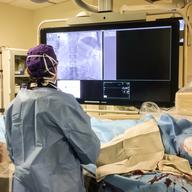
A month ago, Dr. Aaron Fischman, an interventional radiologist at Mount Sinai Hospital, injected gel beads into particular arteries in her stomach to reduce the ability of specialized cells to produce ghrelin, the substance sometimes referred to as the “hunger hormone.”
“It’s like clogging a pipe,” said Fischman of the procedure, formally known as bariatric embolization.
Frasier was one of the first patients participating in a pilot study Fischman is conducting together with colleagues at Johns Hopkins University Medical Center and from Piedmont Hospital in Atlanta. They hope to enroll 20 people who are severely obese — defined as those with a Body Mass Index above 40 — and then embolize the same arteries and follow them for a year to monitor their appetites, weight loss, hormone levels and various measures of health.

The study represents a new approach to understanding obesity, one that focuses on hunger and how to control it.
Researchers said they knew ghrelin, the hormone Frasier's procedure was supposed to suppress, played a key role in hunger but they did not know exactly how it worked and what impact it had on various body systems. As people diet, ghrelin levels frequently increase — perhaps the body's effort to thwart weight loss.
The hope is that decreasing the hormone will reverse the cycle of people getting hungrier as they reduce food intake.
“We have to see what they’re eating. Is their appetite really changing?” Fischman said. “Maybe the ghrelin goes down, but does that really correlate with their appetite? So far we’ve seen that it does, but we have to do that in a number of patients to make sure that’s what actually happens.”
There’s also a good chance that any effect could be temporary. The stomach, like many organs, is rich in blood vessels, and blockages in one area often lead to stronger blood flow elsewhere to compensate.
The researchers said they were still evaluating the safety of the procedure but they'll also determine whether results were robust enough to mount a more extensive randomized clinical trial. If all goes well, they said, embolizing vessels could become an alternative to stomach surgery, which can be effective at reducing weight and improving health, but also comes with potentially serious complications.
But even if ghrelin blocking turned out to be safer and cheaper than bariatric surgery in decreasing hunger — it is still a hospital-based procedure. During the trial, which is supported by the National Institute of Biomedical Imaging and Bioengineering and Merit Medical Systems, each embolization cost more than $10,000, according to a Mount Sinai spokesman.
Dr. Jeffrey Zigman, a ghrelin expert from Uinversity of Texas-Southwestern Medical Center in Dallas, said he was skeptical. Reducing ghrelin by physically manipulating blood flow struck him as too imprecise.
“Ghrelin cells have a great blood supply, and they’re scattered in the gastric mucosa [stomach wall],” he said. “I just don’t see that sending down an artificial embolus to cut off the blood supply to ghrelin cells is going to be specific enough.”
Zigman said he thought drug therapies under development to block ghrelin — or to influence multiple hormones and neuro-transmitters, too — held greater promise for curbing appetites and increasing self-control.
So far, study subject Tinesha Frasier said her drop in hunger was real.
"My stomach starts growling, but for some reason I’m not feeling hungry,” she said. “It’s almost like it’s apart from me, like when I was pregnant, and my stomach would move without my controlling it.”
Frasier said her lack of appetite extended to fried foods, sweets and almost all other common cravings. Her monthly need for chocolate translated into a single bite of a Snickers, not the whole candy bar, she said.
Whether this change was perceived or biochemical, long-term or short-term, was unclear, but Frasier said she hoped it would keep her devoted to eating salad, going to the gym and following the advice of the nutritionist she sees weekly as part of the study.
“Without my appetite suppressed, whatever the nutritionist tells me would go in one ear and out the other, because I’d be hungry and would want to eat,” Frasier said. “Now that I don’t feel as hungry, when she tells me, ‘Hey, you know you can eat some almonds, and some raisins, and be full,’ it really seems to work.”

WNYC is funded by sponsors and member donations