Joan Nathan Searches The World For Jewish Dishes
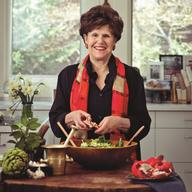
James Beard Award-winning author Joan Nathan joins us to discuss her cookbook King Solomon's Table: A Culinary Exploration of Jewish Cooking from Around the World. Nathan’s recipes are inspired by the biblical King Solomon, who was believed to have sent emissaries across the known world. In doing so, Solomon spread Jewish food and culture far beyond Israel. Nathan gathered over 170 recipes and histories including: Yemenite Chicken Soup with Dill, Cilantro, and Parsley; Slow-Cooked Brisket with Red Wine, Vinegar, and Mustard; and Apple Kuchen.
Author Joan Nathan will speak with Mark Russ Federman at the 92nd St. Y on April 4 at 7:00 p.m. The event features a 45 minute presentation/conversation followed by 15 minute Q&A.
Nathan will also appear in conversation with Gabriella Gershenson on April 19 at 6:30 p.m. at the Temple Emanu-El Streicker Center (One East 65th St.).
Check out some of Joan Nathan's recipes from King Solomon's Table below:
Flourless Chocolate Cake
Yield: 8 to 10 servings
8 ounces (226 grams) good bittersweet chocolate such as Caillebaut or Guittard
8 tablespoons (1 stick/ 113 grams) unsalted butter or coconut oil
6 large eggs, separated
¾ cup (150 grams) sugar
Pinch of salt
1 teaspoon vanilla
Unsweetened cocoa for dusting
Raspberries and blueberries for topping
Whipped cream or ice cream (optional)
I know many good cooks but none who entertains as joyously and effortlessly as Injy Farat-Lew. More often than not, when Injy and her husband, Jason, invite friends for lunch or dinner at their sprawling home on Martha’s Vineyard, she will serve this elegant flourless chocolate cake for dessert.
Injy was born into an Egyptian-Jewish family. Her grandfather Emmanuel Mizrahy Pasha was one of the few Jews to serve as Pasha, or financial counselor, to King Fuad I, the father of King Farouk. In 1961, when Injy was twelve and five years after Gamal Abdel Nasser’s 1956 revolution, the family fled to Paris from Cairo, leaving this regal life forever.
After studying medicine in Paris, Injy met Jason, also a doctor, on a trip cruising down the Nile. Cairo and Paris are far cries from Martha’s Vineyard where Jason is an obstetrician, but Injy has made this island her home and uses nearby farms as sources for ingredients. Because she likes to make food that is easy and delicious for her ever-appearing guests, this flourless chocolate cake—a cake that has been around since Europeans started using chocolate and has wandered as much as Injy’s family—is a favorite dessert. It was a big hit the year that Injy brought the cake to our Passover Seder. I like to serve it covered with colorful berries.
- Preheat the oven to 350 degrees and butter a 9- or 10-inch spring-form pan with spray or a little of the butter or coconut oil.
- Melt the chocolate and the butter or coconut oil in a double boiler or in a bowl in the microwave for a little more than a minute. Let cool.
- In the bowl of an electric stand mixer using the whip attachment, beat the egg whites with 1⁄2 cup (100 grams) of the sugar and the salt until soft peaks form. In a separate bowl, whip the yolks with the remaining 1⁄4 cup (50 grams) sugar and vanilla. Using a spatula, slowly stir the chocolate in with the egg yolk mixture. Then carefully fold in the egg whites. Don’t over-mix or it will deflate.
4. Bake for 28 to 35 minutes, or until the cake is fully set around the edges. You want it to be slightly gooey in the center.
5. Let cool in the pan for a few minutes, then remove from pan to cool completely, and dust with cocoa.
6. Serve topped with berries and, if you like, with whipped cream or ice cream.
Aharaimi, Arctic Char in a Spicy Tomato Sauce
There were wild fruits of various kinds, some of which our men, not very prudently, tasted; and upon only touching them with their tongues, their mouths and cheeks became swollen, and they suffered such a great heat and pain that they seemed by their actions as if they were crazy and felt obliged to resort to cooling applications to ease the pain and the discomfort.
—letter from Dr. Diego Álvarez Chanca, 1494, describing the Scotch bonnet chili peppers of Jamaica on the second voyage of Christopher Columbus to America
Yield: 8 servings as a first or 4 as a main course
1/3 cup (80 ml) extra-virgin olive oil
1 small onion, diced
7 to 8 cloves garlic, diced
3 heaping tablespoons tomato paste
1 tablespoon diced small hot red pepper like habanero, Scotch bonnet, or cayenne
1 teaspoon ground cumin
1 teaspoon ground caraway
1 teaspoon sea salt
2 pounds (907 grams) arctic char, grouper, tuna, whiting, yellowtail, or bonito, cut into 8 pieces
1 roasted red pepper, sliced into lengths
2 tablespoons diced cilantro or parsley
Juice of 1 lemon
Aharaimi is a traditional post–Columbian Exchange Libyan dish popular among the Mediterranean seafood restaurants, especially in Tripoli but also throughout the Maghreb. It is a kind of fish tagine or casserole (the sauce is always thick), fragrant, hot, and spicy.
For the Jews of Libya, who are now mostly in Israel and Italy, aharaimi begins the Sabbath meal. The secret is the spice kick, called in Israel pilpel tsuma, a mixture of garlic and red pepper once ground by every Libyan home cook and today available from the Israeli-Libyan spice company called Pereg Gourmet.
Abraham Pereg started the company in a small stall with no electricity in the marketplace of Tripoli, where he sold hot peppers, cumin, ginger, and cloves. When the family immigrated to Israel after 1948, his son Victor soon opened a spice market in Lod, about twenty-five minutes from Tel Aviv.
“Immigrants came from all over the world asking for spice combinations,” said Chaim Pereg, Victor’s son and the owner of the certified kosher company. “The Moroccans asked for sweet paprika with oil, so we started growing peppers here. Yemenites wanted zhug, and showed us how many grams of cumin, cardamom, caraway, cilantro, pepper, and coriander went into this hot sauce. That is the way we learned how to make everything.” The Peregs added pilpel tsuma, a blend of pepper and garlic that they used in Tripoli. As Israeli appetites for peppers and other spices grew, so did Pereg Gourmet, which now has boutiques all over Israel and even ships abroad to the United States and other countries.
According to Nawal Nasrallah, a specialist in Arabic cooking and the author of Delights from the Garden of Eden, some say that the dish was originally called harr ya’mmi (“Mom, it’s hot!”). Others say that when the delicious aroma of this dish spread throughout the neighborhood, Muslim Libyans would visit their Jewish neighbors in hopes that it would be shared. To discourage them, the Jews would say it was haraimi (from haram), i.e., that Muslims were forbidden from eating it.
Until the twentieth century, chili peppers, like the hot Scotch bonnets from Jamaica first described by Christopher Columbus’s doctor above, were dried on a cloth outside in the sun, often laid on flat roofs. Then they were ground with garlic and mixed with salt, caraway, and sometimes cumin. Serve this spicy fish as a first or main course, with saffron rice (see page 169) or a colorful salad, like matbucha (page 101), carrot (page 99), and beet (page 112).
- Heat the olive oil in a heavy frying pan with a cover. Sauté the onion until golden, then add the garlic, tomato paste, and hot pepper and stir, sautéing for about a minute.
- Add 1 ½ cups (355ml) of water, stirring until the paste is dissolved. Then add the cumin, caraway, and salt. Simmer for several minutes, until the sauce is very thick. Taste and add a little pilpel tsuma or harissa if not hot enough.
- The traditional way to prepare this is to slip the fish pieces into the sauce and spoon the liquid over them, adding a little water if necessary to create more sauce. Simmer slowly, covered, until the fish is just cooked through, or for no more than 12 minutes. You can also transfer the sauce to a baking dish and put the fish on top of the sauce, skin side up, and bake in a 450-degree oven for 10 minutes and switch to a broiler for an additional 2 minutes.
- Using two spatulas, gently transfer each piece of fish with the sauce to a serving platter. Adjust the seasonings to taste, lay the red pepper slices over the fish, sprinkle with cilantro or parsley, and sprinkle the lemon juice over all. Serve either hot or at room temperature.
Excerpted from KING SOLOMON’S TABLE by Joan Nathan. Copyright © 2017 by Random House. Excerpted by permission of Alfred A. Knopf, a division of Random House LLC. All rights reserved. No part of this excerpt may be reproduced or reprinted without permission in writing from the publisher.