Einstein Listened
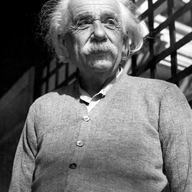
Former WNYC director Seymour N. Siegel suggested that WNYC once received fan mail from Einstein. As I continue to look far and wide for evidence of this alleged bit of praise, I can’t help but wonder, what broadcast prompted the great man to write? Alas, so far, the document has eluded me. But, we do know that the father of the theory of relativity was a subscriber to both the WNYC and WQXR program guides. And we have no less than Erwin Panofsky, the noted German-American art historian and friend of Einstein's, to thank for that.
It all began when the distinguished gang at the Institute for Advanced Study in Princeton, New Jersey decided to chip in and build the Nobel laureate a "high-fidelity" radio for his 70th birthday. The 1949 gift included subscriptions to the WNYC, WQXR, and WABF program guides.[1]
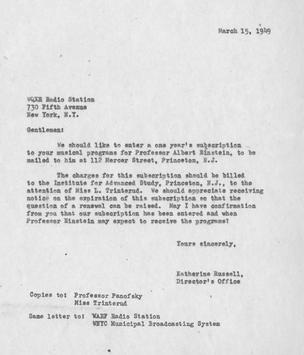
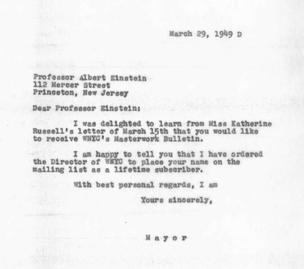
When told of Einstein's subscription to WNYC's Masterwork Bulletin, New York City Mayor William O'Dwyer wrote to inform the professor that it would never expire.
While we don't know which station he was listening to when writing his 'thank you' note to the radio's principal fabricators[2], Einstein was quite moved by what he heard from the sophisticated receiver.[3] Translated from German, he wrote of the radio's "blissful sounds" and "here I am sitting enrapturedly listening to a flute concert by Mozart and I gratefully remember that I owe this delight to your competent workmanship..."[4]
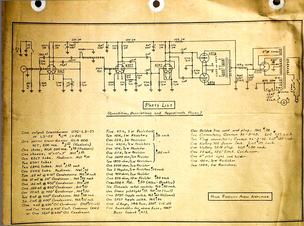
That workmanship was primarily due to electrical engineer and audiophile Jack Rosenberg. His unpublished memoirs provide a detailed account of the equipment installation, accompanied by J. Robert Oppenheimer, at Einstein's home on 112 Mercer Street, Princeton, New Jersey. The antenna had been surreptitiously erected days earlier when Einstein was out, so Rosenberg just had to connect the sound system wires, plug in power, flip the switches and tune the receiver.
The radio was playing a classical composition. The look of pleasure in his face was a sight I will never forget. There were genuine tears in his eyes. I have never witnessed a more authentic surprise. I showed him how to operate all the controls, and invited him to turn it on, choose the station, and control the volume himself. He asked me why had I taken the trouble to build it, and how could he thank me enough. When I told him I had been honored to have the privilege of doing the work, he did not understand. His expression brought tears to my eyes. I have never seen a face with such sincerity.[5]
It should be no surprise that the gift of the high-fidelity FM radio unit so moved Einstein. He reportedly said that if he had not been a scientist, he would have had a career as a classical musician. As a skilled violinist and pianist, he found music both relaxing and an aid to his scientific thinking.[6] In 1949, WQXR was New York's leading commercial classical music station, and WNYC, the primary non-commercial outlet for the classics, so the accompanying program guide subscriptions were, no doubt, put to good use.
Einstein was also a serious radio listener who advocated for the technology from a political and humanitarian perspective. Speaking in 1930 at the 7th German Radio and Audio Show in Berlin, he told the attendees and those listening to the broadcast of his remarks that the medium held out the promise of being a powerful tool in the service of world peace and democracy.
The radio has to fulfill a special and unique function for international reconciliation. Up till now, peoples got to know each other almost only with the help of the distorting mirror of their own daily press. Radio shows them to listen to each other in their most vivid form and mainly from the amicable side. Thus it will continue to end the feeling of bilateral strangeness which so easily turns to mistrust and hostility.[7]
_______________________________________
[1] Erwin Panofsky letter to J. Robert Oppenheimer, March 14, 1949 from the Institute for Advanced Study in Princeton, NJ. Note: WABF later took the call letters WBAI.
[2] The speaker, amplifier, and FM receiver were made by Herman H. Goldstine, Peter Panagos, Milton Rosenberg, and electrical engineer Jack Rosenberg, who designed and installed the components in Einstein's study. Rosenberg's perspective on the project can be found in Knowing Einstein, in the September 9, 2004 edition of the Palisadian-Post.
[3] The parts alone for the unit cost $320 in 1949 dollars. So, it must have been a fantastic set of components. The reader should remember that FM radio was still relatively new. At the time WQXR-FM was only ten years old and WNYC-FM had been on the air only six years. Low fidelity AM radio remained the dominant electronic media of the day.
[4] Albert Einstein letter to H. Goldstine, P. Panagos, J. Rosenberg, and M. Rosenberg, March 15, 1949 (translation by E. Panofsky) from the Institute for Advanced Study in Princeton, NJ.
[5] Rosenberg, Jack, unpublished memoir excerpts courtesy of George Dyson.
[6] Foster, Brian, "Einstein and His Love of Music," Physics World, January, 2005, pg. 1.
[7] Einstein, Albert, speech to the 7th German Radio and Audio Show, Berlin, August 22, 1930. See: https://www.einstein-website.de/z_biography/speechfunkausstellung.html
Special thanks to archivists Caitlin Rizzo and Erica Mosner at the Shelby White and Leon Levy Archives Center, Institute for Advanced Study, Princeton, New Jersey. Thanks also to Chip Calhoun at the Niels Bohr Library and Archives at the American Institute of Physics, Sherly Postnikov and Bill Swersey at HIAS, Alexandra Hilton at the New York City Municipal Archives, Tyler Rourke, and George Dyson.
And one final note. Einstein had one other potential classical station to tune in as Philadelphia's classical station, WFLN (95.7 FM) coincidentally first hit the airwaves on March 14, 1949, his 70th birthday. However, the station, modeled after WQXR, only broadcast in the evening hours in its early years.

WNYC is funded by sponsors and member donations