Mary McLeod Bethune : Great Women of America
This episode is from the WNYC archives. It may contain language which is no longer politically or socially appropriate.
Interview with Mary McLeod Bethune of the National Council of Negro Women
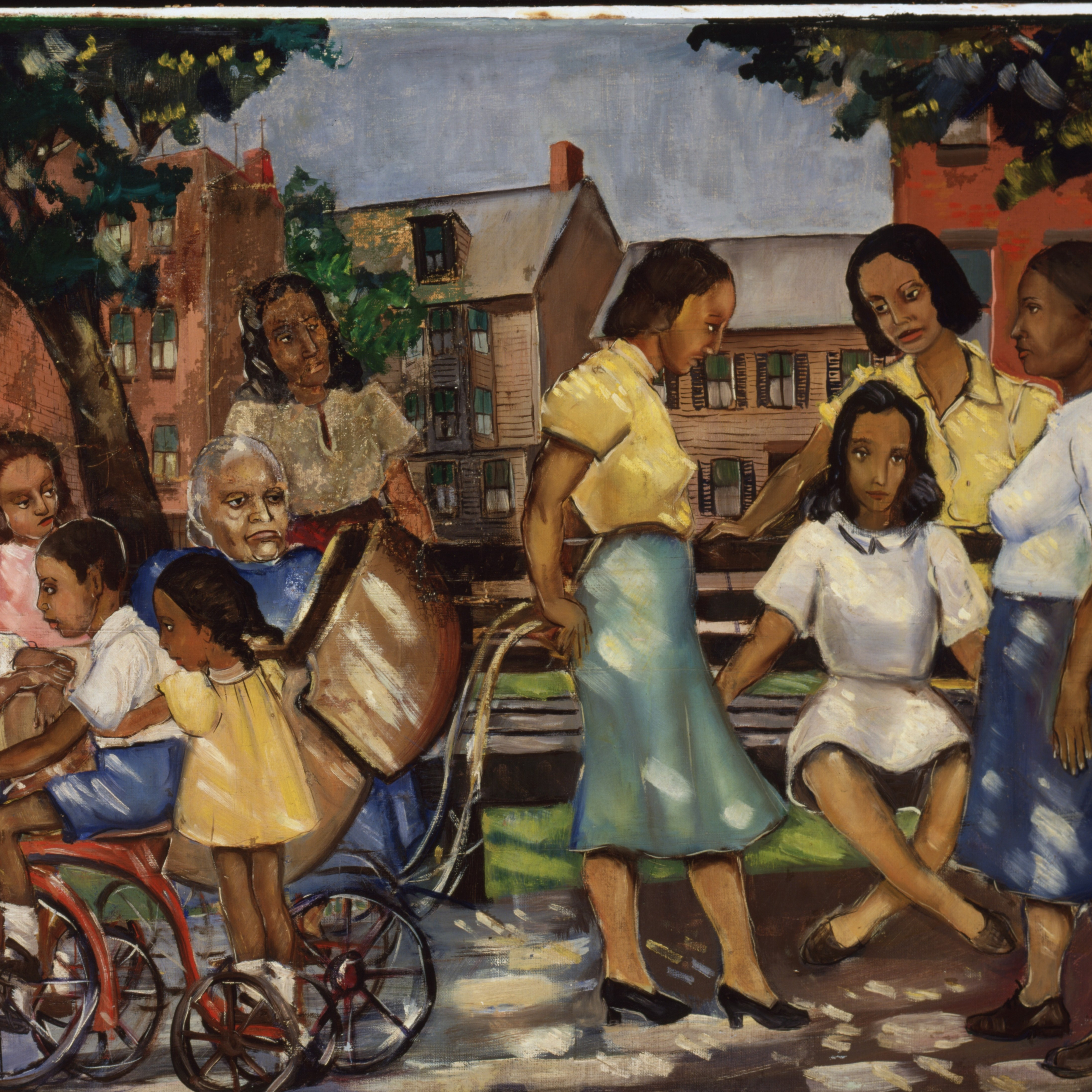
The day before Lincoln's birthday, Eleanor Roosevelt interviews Mary McLeod Bethune, the daughter of former slaves who formed schools for African-American children, about her work with the National Council of Negro Women. For the first time, the Council is inviting women of any race to join the fight for civil rights. "In these times, Mrs. Roosevelt, we feel that in order to achieve the goal of civil and human rights for all, it is necessary for women of all races and creeds to know and understand each other."
After the interview, Mrs. Roosevelt throws it back to her daughter in Hollywood.
Audio courtesy of the NYC Municipal Archives WNYC Collection
WNYC archives id: 69657
Municipal archives id: LT852
WNYC is funded by sponsors and member donations
Top Stories From Gothamist
State audit finds gaps in NYC schools' oversight of tech and student data
New York City’s public schools system struggles to track which technology its schools use, report breaches on time and notify families when student data is compromised, the state comptroller’s office found in a recent report.
Comptroller Thomas DiNapoli released the audit late last month, about a week before the start of a widespread ransomware breach that ultimately left school districts and colleges around the country without access to the online education platform Canvas. New York City schools, Columbia University, Rutgers University and Princeton University were all among the institutions facing outages this week.
In a statement on Friday, Schools Chancellor Kamar Samuels said the department had recently learned of two data privacy issues. One was “globalized,” affecting up to seven schools, an apparent reference to the Canvas breach. The other, he said, was localized to one campus. Bloomberg cited a memo saying malware had been found on computers at one school community’s shared lab.
DiNapoli’s audit doesn’t address those incidents. It was based on a longer review of the period from March 2020 through September 2025. It found the city’s public schools system — which serves roughly 900,000 students across 1,600 schools — does not maintain a comprehensive list of the various applications each school uses and, as a result, does not have a “clear understanding of its environment, the type of information being stored in these applications, and the various risks associated with the data.”
Auditors reviewed 141 data breaches between January 2023 and February 2025 and found the department delayed reporting nearly half of those breaches to the state, in some cases by more than a year.
“One of the things that we noted in the report is a lack of a centralized inventory,” said Tina Kim, the deputy comptroller for state government accountability. “So, the district is not aware of what specific applications all of the schools are actually using.”
“And if you think about it, that creates a delay because you don’t have a centralized inventory,” Kim continued. “And the reason why inventories are also important is because it allows you to basically do a risk assessment and know if you’re using certain applications that are higher risk, you have to put in certain controls.”
They also found that school district policy didn’t address some areas related to data security and privacy, or publish related materials on the school system’s website. Auditors also said they found “weaknesses in technical controls” used to safeguard student data. And they said a quarter of the department’s roughly 161,000 employees did not complete required annual data privacy training in 2024.
“Historically, when you got a phishing email, there were red flags, there were misspellings,” Kim said. “But artificial intelligence can take away those red flags, and with new technology, you can actually do phishing emails at scale.”
“That’s why training is so important, because artificial intelligence lowers the barrier,” Kim continued. “It basically increases the number of people who have access to these tools and makes it a lot easier to actually do.”
New York City Public Schools didn’t immediately reply to a message from Gothamist seeking comment on Saturday. In a written response to the audit, however, Deputy Chancellor of School Operations Kevin Moran said protecting student data “is of the utmost importance” to the department.
Moran also pointed to a new student privacy webpage and a working group of parents, advocates and school leaders convened in the past year. And while Moran pushed back on some of the survey’s methodology, the department accepted most of the comptroller's recommendations, including developing a way to account for all student information systems and drafting a written data classification policy.
The comptroller's office said it would follow up in a year to check on the district’s progress in implementing its recommendations.
Is learning to read in NYC schools getting in the way of reading whole books?
When Bronx teacher Jessica Beck began teaching two decades ago, middle schoolers in her English class often read 20 books a year. Under the city’s new, mandated literacy curriculum, however, she’s hoping to get through four books in class by the end of June.
She said that’s because much of the kids’ class time is dedicated to reading excerpts and supplementary activities.
“They come to me and they're like, ‘Miss, this is so boring. I miss talking about books,’” Beck said.
With literacy rates at crisis levels among students throughout the five boroughs, the education department has recently implemented major reforms to reading instruction as part of an effort called NYC Reads. The city began with an overhaul of the early grades. By fall 2027 all middle schools must adopt one of two reading curricula, from EL Education or Wit & Wisdom. Officials said the two programs were selected because they align with the latest science on reading, focusing on phonics, vocabulary, knowledge building and comprehension.
But teachers and parents said they’re worried kids are now being forced to slog through mind-numbing exercises in workbooks, rather than nurturing the joy that comes from reading whole books.
The critique reflects concerns across the country about a decline in whole books taught at school. A national survey out this week found teachers assign four whole books on average.
“I have a firm belief that following characters for 300 or 400 pages builds a muscle that there's no other way of building,” said Jonathan Goldman, a parent at Manhattan School for Children.
Lists of the books included in the two city-approved curricula show middle school students are expected to read four to seven books in a school year, depending on the grade.
[object Object]Goldman, an English professor, said his daughter has been coming home with reading assignments that look more like test prep with short excerpts followed by comprehension questions.
“We keep being told that our kids don't have the attention span anymore that previous generations did, and I think that they don't have the attention span because they haven't been given enough opportunities to stretch out their attention span, frankly,” Goldman said.
New York City’s literacy overhaul reflects a nationwide course correction from teaching methods that experts said have now been disproven. Critics said popular strategies created bad habits by encouraging students to guess words by using pictures, while glossing over important lessons on letter sounds.
[object Object]As soon as the new curriculum was introduced at the elementary level, parents started raising alarms about fewer whole books. Now, as the effort expands to middle schools, those worries have spread. Parents fear the shift exacerbates the attention-span crisis for kids surrounded by screens.
But education department officials insisted that whole books are still at the core of the city’s reading program. They said the new curriculum creates more consistency and ensures kids have the skills they need.
And they said it’s working: Reading scores on state exams spiked last year. New York City students’ reading scores went up 7.2 points in grades three through eight, with 56.3% of those students testing proficient on the state reading exams.
Danielle Giunta, deputy chancellor for teaching and learning for the public schools, said the gains show the literacy overhaul has been a “game changer” for students.
She said the new curricula still centers whole books, with middle schoolers assigned popular titles including “The Lightning Thief,” “The Boy Who Harnessed The Wind,” “Hidden Figures,” “Farewell To Manzanar,” “Maus,” “A Midsummer Night’s Dream” and “Animal Farm.”
She also noted that kids have been borrowing digital library books in record numbers.
But she acknowledged that the new coursework “balances” whole texts with excerpts and activities. “New York City Reads is really centered on this concept of a literacy ecosystem, making sure there’s a breadth of exposure on a topic to different authors, to different perspectives,” she said.
“We often refer to literacy in [grades] K-2 as learning to read, and then from grade three on shifting to reading to learn,” she said.
Giunta encouraged parents to use a new tool that offers more insight into what kids are reading about in school.
Representatives from the two curriculum companies, EL Education and Wit & Wisdom, both said whole books are central to the curriculum and serve as anchors to related content meant to deepen students’ knowledge and skills.
“We believe whole books matter,” said Abbas Manjee, co-founder and chief academic officer at the company Kiddom, which includes EL Education. “Books are sacred.”
In EL Education, Rick Riordan’s “Percy Jackson and the Olympians: The Lightning Thief” is paired with a unit on Greek mythology where students research a Greek god, and each rewrites a scene with a character they invent, among other tasks. “Hidden Figures” is paired with a speech with historical documents and debates about space exploration.
The curriculum says teachers should have students read excerpts in class so they have time to reflect and respond, and “invite” them to read the rest for homework. There are assessments — like quizzes and tests — that accompany the units.
Evan Stone, CEO of Educators for Excellence, said the advocacy group made up of thousands of New York City teachers is very supportive of NYC Reads. He said teachers appreciate the new approach and “see real value in going very deep on a smaller number of texts.”
But many teachers and parents are frustrated with the changes. In addition to decrying a decrease in whole books, some have criticized the new “boxed curriculum” as too rigid and lacking diversity.
“The students you have and what’s happening in the world should determine what you’re reading in the classroom,” Beck said.
Susan Neuman, a professor of childhood literacy and education at NYU, said, overall, she’s “very impressed” with the curriculum changes, which have been effective in teaching kids the basics of literacy. But she said there’s room for improvement, including more time spent on whole books.
“We now have a systematic program that focuses on helping children connect sounds and letters and helps children learn how to blend these sounds into words,” she said. “ I really think that one of the things we need to do, and we may be neglecting to some extent, is time spent reading.”
NYC doubles Legionnaires' inspectors, triples testing frequency ahead of summer
New York City has more than doubled the number of cooling tower inspectors on its payroll since last summer’s deadly outbreak of Legionnaires’ disease in Central Harlem, according to new staffing levels announced by the Department of Health and Mental Hygiene.
Rooftop cooling towers function as part of a structure’s air conditioning system, but can spread deadly Legionella bacteria if they are not maintained properly. In August last year, health officials traced the source of the outbreak to two cooling towers, one on Harlem Hospital and another on a city-run health lab on the same block.
The health department will also begin enforcing more frequent testing of cooling towers for Legionella bacteria. A law passed by the City Council in October requires building owners to now test the water in their systems every 31 days, up from once every three months under previous requirements.
“As the summer approaches, we are working collaboratively to ensure that the city is utilizing every tool in the toolbox to monitor for this bacteria and help keep our residents safe,” Yume Kitasei, the commissioner for the Department of Citywide Administrative Services, said in a joint statement with the health department.
This new regulation, which took effect Friday, comes nine months after the Central Harlem outbreak sickened 118, hospitalized 92 and killed seven people.
City Councilmember Lynn Schulman, who chairs the health committee, said the Council will closely monitor whether the health department enforces the new law and pre-existing regulations around cooling towers.
“Legionnaire's disease is not a one-size-fits all problem,” she said. “Even with the stringent regulations that the NYC Council has passed over the years, there is no guarantee that an outbreak won't occur.”
A Gothamist analysis of city data last year found that the health department inspected a nearly record-low number of cooling towers in the lead-up to last summer’s outbreak.
At the time, a spokesperson for the agency attributed the drop in inspections to short staffing resulting from budget cuts. The total number of inspectors stood at just 24, down from 37 in 2022.
The health department hired six new cooling tower inspectors in the immediate aftermath of last year’s outbreak. It announced on Friday that the team has expanded to 54.
The city’s preliminary budget for 2027 allocates $13 million in additional funding for the additional staff. The health department said the money would also go to establishing a community outreach team in the event of another outbreak.
As the outbreak spread through Central Harlem last year, the health department said it collected eight samples of the bacteria from infected patients. Those matched the genetic material taken from two cooling towers located atop city-owned buildings.
The first was a construction site for a public health lab. The site was being managed by the construction company Skanska. Health officials said in August that the company had failed to register the tower with the city and conduct any required testing and monitoring of the cooling tower.
The second was located atop Harlem Hospital. A Gothamist investigation found that hospital staff failed to conduct weekly rapid testing required by its cooling tower management plan in the months leading up to the outbreak.
Cooling towers can be breeding grounds for dangerous Legionella bacteria.
Water is often circulated through pipes in larger buildings to absorb heat. That warmed water is then pumped into cooling tower basins on the roof, where it is evaporated by big fans.
But if the water is not regularly tested and disinfected, Legionella can not only thrive, it can be blown out in vapor and inhaled by passersby. The bacteria can cause a type of pneumonia. Older adults and immunocompromised individuals are especially susceptible. But even healthy people can suffer long-lasting effects from the disease.
April McIver, the executive director of the Plumbing Foundation, an advocacy group for water and gas professionals, said that while more testing is needed to prevent deadly outbreaks, the city should also broaden its efforts beyond cooling towers.
In January, the health department advised residents in a Harlem housing complex to use buckets and hoses to bathe after two residents contracted Legionnaires from the buildings’ internal water system.
McIver said plumbing systems must also be more strictly regulated.
“Any expert will say that this is the only way to better protect New Yorkers, and until that happens, we can expect to see another tragedy related to this dangerous disease,” she said.


How to Avoid Sneaky Phishing Scams


Justice for Epstein Victims Through NYS


New Doc Celebrates NYC's Weird and Wild Public Access TV Experiment
WNYC is funded by sponsors and member donations