Generation without Farewell
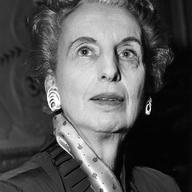
Modern Germany is the subject of Kay Boyle's talk at this 1960 meeting of the Book and Author Luncheon. Although ostensibly here to promote her new novel, Generation Without Farewell, Boyle rather refreshingly lauds another writer, the little-known Theodor Plievier, calling him "Germany's greatest post-war writer," as well as offering quotes on the current state of German society from Otto Frank (father of Anne Frank) and Carlo Schmid of the Social Democratic Party. The title of Boyle's book comes from a play by Wolfgang Borchert, an anti-war writer Boyle was deeply influenced by.
As this list reveals, Boyle had an intimate and complex relationship with German culture and a strong personal interest in the country's fate. That is what she dwells on, speaking of Germans who were under twenty when the war began and who are now in positions of authority. They have great feelings of condemnation, resentment, and betrayal for those who came before. She frankly admits that the protagonist of her novel is based on a real German and talks about his current job and opinions. "The past is acknowledged by the writing of books," she proclaims, going on to lament that "we have not heard enough from the creative artists of Germany." Again quoting, this time George Steiner, she complains of "a terrible stillness at the heart…the death of the German language." It is unclear if she is out of touch with the literary generation about to make its mark not just on German but world literature or if her personal connection to works of the immediate post-war period blind her to the burgeoning talents of those authors who will shatter the abovementioned silence. This is, after all, one year after the publication of both Gunter Grass's The Tin Drum and Heinrich Boll's Billiards at Half Past Nine. However her lack of self-promotion, at this blatantly commercial event, is refreshing.
Closely identified with the expatriate world of the Twenties and Thirties, Kay Boyle (1902-1992) was a prolific and, for many years, popular novelist, short story writer, and poet. By the time of this performance, however, her literary career was in decline. Her emphasis on social justice and professed left-wing views did not play well in Cold War America. Neither did her flamboyant personal life. William Pritchard, reviewing her biography in the New York Times, notes:
"…she acted on the un-Socratic premise that first impressions were the only ones of value. She never hesitated to follow the dictates of impulse, leaving her first husband to bear a child with the consumptive and dying poet Ernest Walsh and leaving her children in the care of others as her convenience dictated. Something similarly headlong may be observed in her literary productions, as she used, in her biographer's terms, 'her fiction to tell the truth about her life, to rationalize it, to mirror it.' Ms. Mellen is more than once moved to wonder how this woman so full of "sensitivity" could perceive so little about her own daughters, three of whom at one time or another attempted suicide. The fact that Boyle preferred to live her life rather than examine it, eventually, her biographer says, 'diminished her as an artist" and always "diminished her as a mother.' Yet except for her championing of Huey Newton and the Black Panthers, Boyle had few regrets about her decisions. The writer Grace Paley, who got to know her late in her life, observed that people with full sex lives don't have regrets."
Boyle experienced something of a renaissance in the 1960's, when her concerns once again were in sympathy with the spirit of the times. The Independent newspaper, in its obituary, tells how:
"In 1963, during her husband's last illness, she became English Professor at San Francisco State University, a post which she held until 1979. In her late sixties she was imprisoned for demonstrating against the Vietnam war, an experience she described in a memorable essay published in the collection Words That Must Somehow Be Said (1985). She was also active in the civil-rights movement, and worked indefatigably against censorship and torture through PEN and Amnesty International."
But fairly or not, most of the writing she is remembered for today centers on that glamorous between-the-wars period. The Los Angeles Times neatly captured her two public sides in its remembrance:
"Kay Boyle, the elegant novelist and expatriate who chatted and sipped coffee in Paris with such titans as James Joyce, Gertrude Stein and William Carlos Williams, is dead at 90….'I probably write to express a feeling of guilt,' Miss Boyle said in a 1949 interview. 'I feel guilty for every act of oppression that has been committed in our time.'"
Audio courtesy of the NYC Municipal Archives WNYC Collection.
WNYC archives id: 150253
Municipal archives id: LT9000

WNYC is funded by sponsors and member donations