George Meany
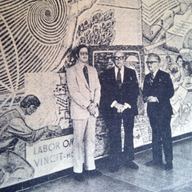
Douglas Cooper and George O'Brien interview AFL-CIO President George Meany at his Washington D.C. office, overlooking the White House.
The interviewers first drill down on Meany's title, Labor Union Leader, and his role as President. He implies he's not big on titles and still considers himself a part of the trade union movement, which has gone after mostly economic and social objectives that benefit the whole populous, union or not.
The AFL (for short) is a coordinating association for all the unions, attempting to tie them all together to pursue legislation, for example. He says they're strong on consumerism and civil rights. He thinks the black worker never had a better instrumentality for better wages and civil rights than the unions.
Unlike unions abroad, he says, we don't have an affiliation with a political party. No 'political Godfather.' We're completely independent and its analogous to the fifty states. Each has autonomous rights and the federal government organizes, as we do; we coordinate the member unions to get work done. We've got 120 unions today, and 60,000 local unions, similar to the federal, state and metro area breakdown in government.
Cooper asks about the narrow areas where the AFL Constitution calls for interference in the autonomy of the unions. He's emphatic on this point: We'll step in if there's corruption. With money--when the officers won't give answers under oath. We threw out 10% of the membership for corruption in 1957.
And we don't allow Communist participation and advocacy of government overthrow. We fight for freedom abroad too, where Communists put constraints on decent wages. And we feel this buttresses our freedoms at home. We'll go in, like we did in Kenya, where there are no unions, and provide educational and vocational training. That's how we helped start the garment industry there.
Mr. Meany then recounts the history of strikes just for the right to organize, culminating in The Wagner Act (1935), insuring that right as a matter of law. Meany recites his tri-part axiom on legislation: don't beg, don't threaten, honesty. He reiterates, the unions and the country have parallel needs; the most deplorable situation today is affordable housing, and we're working with Congress and the President. If we can't get it today, then it's gradualism--Medicare, Education--with Johnson; using our insights abroad to build an adequate national defense.
O'Brien lightens it up, likening Meany to Churchill: love of cigars and painting. He downplays his own art.
Cooper concludes with a question about the press. "I won't take any question I don't like for any reason. And I don't like an activist press. But I get along great with them. I like press conferences.”
_______________________________________________________________________________________________________________
The Douglas P. Cooper Distinguished Contemporaries Collection (1967-1974) contains rare interviews with influential writers, statesmen, artists, songwriters, journalists and others who have left their mark on our culture.
The Origins of The Cooper Collection
WNYC archives id: 92050