Go Do This: 'Three Tall Women' Finally Makes it to Broadway
The current production of “Three Tall Women” on Broadway is a bracingly honest examination of the life of a difficult person. Yet despite the strained, real-world relationship the author Edward Albee had with the play’s central subject, his play is also a deeply sensitive portrayal of a woman he intensely disliked.
Inspired by Frances Cotter, Albee’s adoptive mother from whom he was estranged, the three tall women in the title actually refer to the same person, but at different points in her life. Through this device, Albee’s explores the stories we tell ourselves when we first start off in the world; the compromises we make along the way; and finally, the acceptance about who we are when we come to the end.
This might sound depressing, but this assured production, directed by Joe Mantello, is deeply satisfying. That's due in no small part to the stellar performance of Glenda Jackson who returns to acting after a 23-year break (during which she served in the British Parliament).
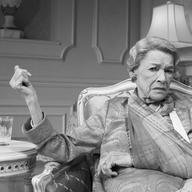
In the first half of this intermission-less play, Jackson — a 92-year-old woman only referred to in the program as “A” — vainly insists she’s 91 as she struggles with senility and the ravages of time. With her broken arm in a sling and a marcel wave in her silver hair, “A” carries herself with the air of the grand dame: She’s imperious and used to being listened to, but with decrepitude, she’s become an openly angry and difficult woman who's comfortable making racist and anti-Semitic remarks.
Tending to her moods is her patient caregiver “B” (Laurie Metcalf who makes Albee’s words sing like real dialogue) and an increasingly frustrated, and at times, sarcastic lawyer “C” (Alison Pill) who is trying to sort through “A’s” financials.
At the end of the first half of the play, "A" suffers a stroke and via a “through-the-looking-glass” twist (set designed by Miriam Buether), the three women become versions of Jackson’s character at various points in her life: 26, 52 and 92 years of age. These "three tall women” look upon the comatose body of “A” and reflect on her life. As they wait for her die, her (their) estranged son arrives to visit his ailing mother and that in turn sets off each woman who reacts to his presence based on what they know (or don’t yet know) about him.
Albee’s play is about how people change. By separating his protagonist into parts, we see, and perhaps even understand, how she ends up the embittered woman we encounter in the first half of the play: her philandering husband, the despised mother who comes to live with her, the alcoholic sister and a gay son who rebukes her after she has affair and then walks out. But Albee is not looking to excuse his protagonist, and part of the thrill of this production is watching the actors embrace the character’s complicated life, with all her hopes for the future, as well as her cruelty.
Describing this play which earned him his third Pulitzer Prize in 1994, Albee wrote, “What I wanted to do was write as objective a play as I could about a fictional character who resembled in every way, in every event, someone I had known very, very well.”
Towards the end, the younger woman pleads with her two older selves to know if there is more happiness to come. Jackson’s character, looking back on her long life, tells her audience onstage and in the theater, “The happiest moment? Coming to the end of it.”
After seeing this production, the audience might disagree.
Editor's note: This story has been updated. Albee was estranged "from" his adoptive mother.

WNYC is funded by sponsors and member donations