Got Potholes? Don't Just Blame the Weather
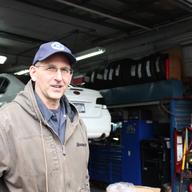
Drivers on the streets of New York have discovered massive car-gobbling potholes that seem to be everywhere this spring. Many have ended up at the garage of David Goldsmith, host of the radio show Auto Lab on WMCA and proprietor of Urban Classics Auto in Brooklyn.
"We’ve just seen a really big increase in damage done," Goldsmith said. "We’ve been doing a lot of blown-out tires and bent rims and blown struts."
His tiny lot, packed with cars like a jigsaw puzzle sits right at the foot of the Brooklyn Bridge with a view of the Manhattan skyline. He has even seen a special breed of New York vehicles come in, the top-dollar, heavy-duty vehicles provided to diplomats.
"When you’ve got a bullet proof tire that’s got a bubble in it that means you’ve hit a crater not a pothole," he said," and we’ve had a number of those this winter."
Since the start of January, New York City has filled 225,000 potholes and New Jersey says it has filled 179,000 this season.
"The Staten Island Expressway’s got more holes than Swiss cheese,” said Rudy Hartill, a mechanic at Urban Classics Auto.
Goldsmith blames the potholes on a bad winter with a lot of snow and a lot of ice. But not so, says former New York City transportation commissioner, Lucius Riccio.
“Everybody thinks that, well, potholes are natural consequences of the spring just like the daffodils and the other flowers that crop up,” Riccio said. “It’s the road resurfacing that’s the dominant factor in the creation of potholes.”
And he's got the math to prove it.
Riccio now teaches at Columbia University where he’s developed a formula confirming his theory based on decades of observations working in city government. He has found that regardless of the weather during the winter, roughly the same number of potholes open up. What matters, Riccio said, is how much the city resurfaces aging streets.
When he was transportation commissioner under Ed Koch, Riccio said the city got the percentage of roads in good condition to about 85 percent. (As proof you can never make everyone happy, The New York Times reported in 1990 that road repairs were producing an epidemic of traffic jams.)
However, since the mid-90s, New York City has cut back, beginning a period of decline in road conditions. In the last five years, the city has bumped up funding a little, to where they have roughly stabilized at 70 percent, but not enough to catch up on repairs. Today the backlog, according to Riccio's calculations, could form a one-lane road all the way to California.
“It’s not the winter, it’s not an act of God. God’s not punishing us. It’s under-repairing the streets. It’s underfunding of road repair work, chronically, consistently over a long period of time,”said Riccio, who believes the lowly pothole is a metaphor for the underfunding of American infrastructure writ large.
The American Society of Civil Engineers estimated in 2013 that motorists spend an estimated $500 dollars in extra costs driving on rough roads – in repairs, wear and tear and extra fuel.
In New Jersey, a state much more devoted to the car, the potholes have been just as bad. Earlier this month, Fernando Serrano invited a reporter to drive around his area of Essex County, east of his home in Bloomfield, to see the pothole he had hit on New Jersey Route 21.
“I literally had to pull over to make sure like I didn’t blow a suspension piece or something and was in a Jeep. And all you heard, the thud was insane.” His mother got a flat tire on the same stretch in January. “The potholes, you could fit a Smart car inside.”
As Serrano scanned the road, he spotted new patches of asphalt that had appeared in the last week, since he’d begun berating state agencies on Twitter about the conditions. Finally, he discovered the pothole he’d done battle with had been filled.
“Well good for me, good for everybody,” he said. But, based on his past experience, these crumbling, patched streets will be full of potholes again next year.
Correction:

WNYC is funded by sponsors and member donations