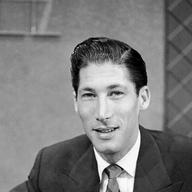
Barry Gray
Douglas Cooper and George O’Brien met "The Father of Talk Radio,” Barry Gray, for an interview recorded in his WMCA radio studio.
-
The Interview
George asked the late night host about his freedom to cover any topic. Barry says he was the first to talk about venereal disease in the early 60's, right to life vs. abortion. He never got criticism unless he or a guest were wrong. Since he started at WMCA in 1945, no on has told him who to have (or not have) as a guest.
Then we asked him about the afternoon show, 4-6, he had hosted, and hated it. The call-ins were different. People calling to argue or complain. That show did a lot for my bartender but not for me.
The calls we get at night are a completely different demographic. I say they're many cuts above the afternoon caller. Calls about energy, legal issues, the Middle East. Our demographics show it.
Cooper reminds Gray that he once said he had the equivalent of a PhD. Right, he answered. You can't interview 40,000 guests without having a certain amount of it rub off.
Cooper asked if it was the longest running program. We've been second to Martha Deane who died recently. And your most momentous show must have been when Al Jolson brought his pianist? Oh, no question. And I interviewed Harry Truman, all the Kennedys, John, Ted and Bob. And Martin Luther King was on on many occasions. I didn't agree with Malcolm X, but we became friends.
Doug asks if Barry ever wants to "hang it up," just like everyone else? Yes, no one has something new to say five days a week. George has heard that Barry's working on a book. Yes, but none of the stories has been on the air; it's all behind the scenes. Some people will be happy; others will leave town.
_______________________________________________________________________________________________________________
The Douglas P. Cooper Distinguished Contemporaries Collection (1967-1974) contains rare interviews with influential writers, statesmen, artists, songwriters, journalists and others who have left their mark on our culture.

WNYC is funded by sponsors and member donations