
A Haitian Immigrant Tests the Trump Crackdown
Augustin Sajous had just finished a hearing on fare evasion and low-level drug possession last fall when federal ICE agents snatched him off the sidewalk in front of criminal court in downtown Brooklyn. The 60-year-old Haitian man is a lawful permanent resident of the U.S. who spent the next nine months in custody in a New Jersey detention center, as officials sought his deportation to a country where he no longer has family or friends.
"Every day, people were getting deported, and every day, more people were coming in,” said Sajous, who came to the U.S. when he was 14. “I was a little anxious to get out.”
His case was the first to be considered in New York since the U.S. Supreme Court ruled in March that there is no requirement to provide bond hearings for detained immigrants if the government can justify continued detention. Despite the ruling, Sajous won release on $3,000 bond last month following a prolonged court battle.
“He needed help. He needed support,” said Sajous’s immigration attorney, Jesse Rockoff. “The manifestations of his difficulties in the criminal justice system certainly have never justified locking him up and throwing away the key, which is what the government tried to do in this case.”
Sajous’s fight to remain in the U.S. is the latest legal chapter in the battle by civil-liberties lawyers and public defenders to push back against the Trump administration in New York courts. Under Trump, immigration authorities have stepped up efforts to detain and deport non-citizens, even those like Sajous who are legal residents with minor convictions on their record.
Afflicted with mental problems, Sajous has cycled between homelessness and jail for years. But Sajous’s violations have been interpreted by federal ICE officials as crimes of “moral turpitude” – which are grounds for deportation. Such crimes can range from low level offenses such as marijuana possession to violent felonies including murder.
Sajous was released at the end of June with the help of attorneys from the New York Civil Liberties Union and Brooklyn Defenders who helped him raise the bond funds.
Based on numbers from the first year of the Trump administration, the NYCLU estimates that there are around 200 people in similar situations – held longer than six months with no right to bond -- in New York state alone.
Since there is currently no maximum in effect on how long they can be held without a bond hearing, detainees like Sajous are forced to appeal their cases individually.
Last month, Judge Thomas Mulligan of the federal immigration court on Varick Street ruled that Sajous could be released from detention for a $3,000 cash bond. The bond hearing and subsequent ruling came after the NYCLU and the Brooklyn Defenders prevailed on some aspects of a federal class-action lawsuit they filed in federal court against ICE.
"The government agrees that at some point detention becomes unconstitutionally prolonged when there’s no judge looking into whether that detention is necessary,” said Jordan Wells, the lead attorney on Sajous’s case from the NYCLU. “They’re saying we agree, but you basically have to sue us to enforce the rights.”
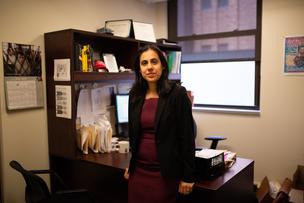
Andrea Sáenz, supervising attorney for the Brooklyn Defenders immigration practice, said it was clear that Judge Mulligan had carefully read the top court’s decision.
“He’s been ordered to hold the government to a high burden of proof and they didn’t meet it,” said Sáenz about Judge Mulligan’s decision at the bond hearing.
ICE has yet to say whether it intends to appeal Mulligan’s bond ruling. An agency spokesperson did not reply to a request for comment. The underlying case will continue in immigration court.
Sajous, who suffers from chronic homelessness and sporadically treated mental illness, was granted bond with the understanding that the Brooklyn Defenders will connect him with services and get steady care for his mental illness, his lawyers said. He’s now back in Jamaica, Queens, in the room he was living at the time the ICE agents picked him up in Brooklyn.
His home there, provided through a city program called LINC, is a dramatic change from the detention center where he spent most of the last year. In New Jersey, he shared a dorm with more than 60 other men, and while he received the medications he needed, that was the extent of his medical care. In Queens, he has access to mental health care and help for his drug problem, and he has his own bedroom, he said.
Having done prior short stints in places like Rikers Island, Sajous said that while they call it immigration detention, it really was no different than jail.
When he was dropped off for detention at Hudson County Correctional Center in New Jersey, all of his belongings and clothing were taken away and he was issued three jump suits that he wore throughout his stay, he said.
For the first few weeks he was kept in a cell with a cellmate. He only had five dollars on his person when ICE picked him up so that was all he had to pay for phone calls. Eventually they moved him into a dorm where he slept on a bunkbed and used a shared side table and cubby to store the few belongings he was allowed. He passed the time talking with other detainees, watching TV, cooking, and playing chess he said.
Now that he’s out, Sajous said he understands how tenuous his status is, so he plans to stay out of trouble. He said the last nine months were particularly difficult because he knew he could be deported back to Haiti.
“Supposed that, you know, I get deported,” he said. “The scary part for me was that, you know, not having nobody over there in Haiti because all my family is here.”
Donna Lieberman, the executive director of the NYCLU, says that Sajous’s plight is the same as many non-citizens who have paid fines for minor offenses such as jumping a turnstile .
“You're told five years later or 10 years later that you're going to be deported for it,” said Lieberman. “It's unthinkable. That's the situation that's been created."
In response to the Trump crackdown, Brooklyn District Attorney Eric Gonzalez last year instituted a new program to adjust charges during plea bargaining to protect immigrants from possible deportation.
It is unclear whether Sajous’s most recent arrest would have qualified him for the program, given his lengthy rap sheet that includes another 2015 fare-evasion conviction that cost him 30 days in jail. But Sáenz of the Brooklyn Defenders said that on the whole, defense attorneys throughout the city are actively advocating for immigration-safe pleas for their clients.
“In general these kinds of offenses are exactly the kinds of crimes that district attorneys should be working with public defenders on,” she said.