Measured Breath: How Best to Monitor Pollution
You get what you pay for.
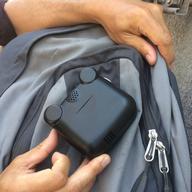
Columbia University researchers Darby Jack and Steve Chillrud have developed a new way to measure air pollution, using state-of-the-art air monitors, combined with special respiration and heart rate monitors.
Together, these gadgets, made by a North Carolina-based scientific instruments powerhouse called Research Triangle Institute, cost about $10,000.
“The expensive sensors are engineered to really be reliable,” Jack said. “If it tells you your exposure is 30 micrograms per meter cubed, you can be pretty sure it’s 30 micrograms per meter cubed.”
Jack and Chillrud have given these setups to bicycle commuters recruited by WNYC.
Want to see an estimate of air pollution on your route? Click here to learn more.
Riders carry the monitors for two weeks, capturing fine particles, roughly one-thirtieth the width of a human hair. Calculating the riders' lung and heart rate, and then plotting their movements across the city using their smartphones, scientists are building an accurate measure of how much pollution they're breathing, and where it's better or worse.
But the high-price monitors have limited researchers because they can afford to use only a handful of them at a time, limiting the project's sample size and data collection.
That's why this summer, in addition to continuing the high-end data gathering, researchers are launching a side experiment to see what they can do with $200 air monitors called AirBeams, produced by a Brooklyn-based non-profit.
"It could be a game-changer," Chillrud said.
The catch: AirBeams are built around what Jack called "cheap, off-the-rack commodity sensors," and their readings are not precise enough for rigorous science.
At least not by themselves.
Michael Heimbinder, co-founder of Habitat Maps, the parent company of AirBeam, recently said what the monitors lack in hardware, they make up for with software — software that pools readings from multiple AirBeams and compares them with readings from government pollution monitors posted on utility polls, lamp posts and roof tops. These are very expensive monitors often costing tens of thousands of dollars, but there aren't many of them, they only stay in one place at a time, and they're not measuring what's in the air at street level.
So the government monitors, while great for producing city-wide and region-wide maps, are imprecise in a different way.
Heimbinder said that by combining the two sets of data with the right algorithms, scientists just might be able to get the best of both worlds.
"It’s less important to necessarily say, ‘What’s the performance of this specific instrument?’ and more important to look at it in the aggregate and say, ‘How can we combine low-cost, citizen-science-collected data with high-end-instrumentation data to improve the accuracy of both?’" he said.
If the results impress Chillrud and Jack, they will go back to the National Institutes of Health, which is funding their main project, and ask for more money to incorporate many more cheaper monitors into their work — so they can expand the Bicycle Brigade and more quickly get answers to the impact of pollution on exercisers' health.
The video below, made by our friends at Science Friday, tells you more about Chillrud and Jack's study.

WNYC is funded by sponsors and member donations