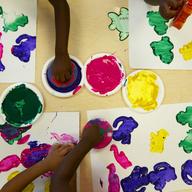
How Important Is an Art Room Anyway?
It's called "art on a cart."
Or the subject could be music, science, technology or other classes taught by specialized teachers who must travel from room to room with their materials because of a lack of space for classrooms of their own.
This week, New York City education officials affirmed that elementary schools with small enrollments, of 250 students or fewer, should have a minimum of two so-called "cluster" rooms for specialized subjects. It's an effort by the city to refine its formula for calculating how much space should be allocated to each school, and how to keep track of space needs.
For larger elementary schools, these rules existed: based on enrollment, they were allocated three, four or five specialty rooms.
Still, despite being allocated these rooms, schools don't necessarily have them. Many overcrowded schools have to convert specialty classrooms for general instruction.
WNYC reviewed the most recent data, covering the 2013-2014 school year, submitted by principals to the Department of Education on their classrooms, cluster rooms and common areas. According to principals' reports, 60 elementary schools did not have a single cluster room, including 21 schools with at least 500 students. Another 104 elementary schools reported having only one cluster room.
P.S. 107 John W. Kimball in Brooklyn was one of those schools that had to use every room available for general instruction. In the 2013-14 year, the school had an enrollment of 578 students in a space meant to hold 369 students, according to the city's annual report.
Eve Litwack, the school's principal, said students still received instruction in subjects like art and music, with those teachers traveling from room to room. A designated space for these subjects, she said, creates a better experience for both the teacher and the students.
"I really do think art is one of the areas that could be most difficult to adapt to a cart, because you want to give the kids an opportunity to work with different media," said Litwack.
A creative teacher can make do in any space, but teachers do their best work when they are not limited to the materials they can carry with them, Litwack said. Plus, classroom teachers have to designate space in their rooms for paintings to dry, or to store sculptures that students may work on over the course of several weeks.
Anthony Inzerillo, principal of P.S. 199 Maurice A. Fitzgerald in Queens, said besides convenience, specialty rooms set up for specialty subjects — like science — can enhance instruction.
"Science cluster rooms should really have tables in cooperative groups and not necessarily all traditional desks," he said, "because you want students to be talking to each other, working with each other."
Inzerillo confirmed that P.S. 199 did not have any cluster rooms in the 2013-2014 school year, when his school had an enrollment of 968 students in facilities, including trailers, meant for a total of 722 students.
Next school year, he said the school is expanding to two annexes and will be able to provide multiple cluster rooms for students.

WNYC is funded by sponsors and member donations


