I Am Twenty: Soviet New Wave Filmmaking in the Khrushchev Thaw
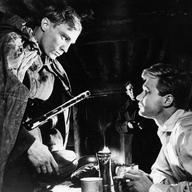
The film I Am Twenty (Mne dvadtsat' let), directed by Marlen Khutsiev, follows Sergei, a young man recently returned home from serving in the military. He reconnects with his friends only to find that they are drifting apart into their own versions of adulthood. He meets Anya during a May Day parade, and as their relationship becomes more serious, they struggle to find common ground between his modest, working class world, and her urban intellectual world. This production of Radio Moscow dramatizes a selection of scenes from the film in English.
Though the film began production in 1959 during the Khrushchev Thaw, a nationwide movement of creative freedom, the final release in 1965 was censored to half the original three hour run time and given the title I Am Twenty. The original title Ilyich's Gate (Zastava Il'icha), meaning "Lenin's Gate" or "Lenin's Guard," is taken from an industrial neighborhood in Moscow where the film takes place.
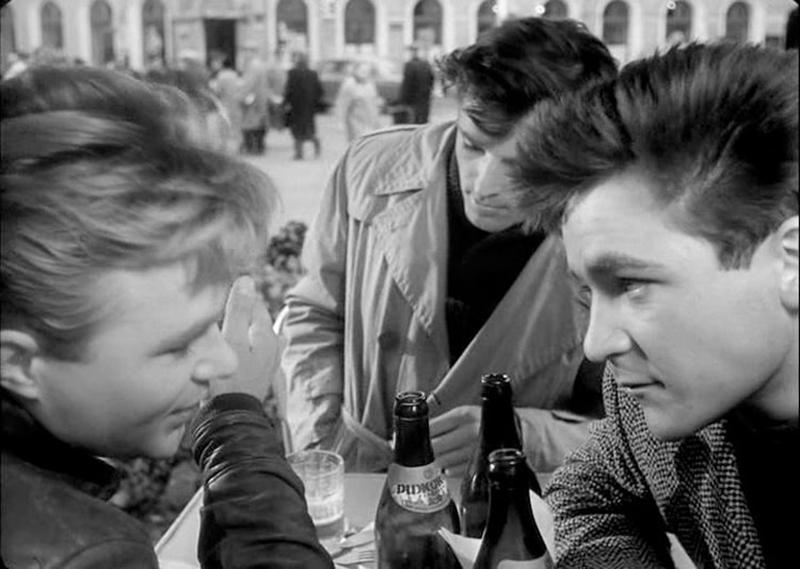
Khutsiev's version was interpreted by the government as too critical of Stalinism and portrayed Soviet youth as pessimistic, westernized and disrespectful of elders. In 1963, Khrushchev singled out the film in a public lecture to roughly 600 artists and writers:
Even the best of the characters - the three young workers - do not personify our wonderful youth. They are shown as not knowing how to live or what to live for. And this at a time of all-round building of communism, a time illuminated by the ideas of the Communist Party Program!
These are not the sort of people society can rely upon. They are not fighters, not remakers of the world. They are morally sick people, who have grown old while still young, who have no high aims or vocation in life...
The idea is to impress upon the children that their fathers cannot be their teachers in life, and that there is no point in turning to them for advice. The film-makers think that young people ought to decide for themselves how to live, without asking their elders for counsel and help.[1]
Given this vilification from the highest office, it is curious that Radio Moscow would distribute a segment about this film to western audiences. The host in this recording applauds the filmmaker:
There are film directors who turn out movies as quickly as they are forgotten by the audiences. There are others, however, who work long and painstakingly on a picture. Their films can rightly be considered works of art. This is true of the young Soviet director Marlen Khutsiev, who has only three films to his credit, but all of them have had a great impact on our audiences.
I Am Twenty shares many stylistic and thematic similarities to French New Wave, Italian neorealist and German rubble films made in Europe in the wake of WWII. For example, Khutsiev uses long tracking shots, non-professional actors and documentary style footage taken at public locations. The young characters amble through day-to-day life pondering existential questions. I Am Twenty follows a disillusioned soldier returning home from military service, still reconciling his family's experience during the war with modern comforts and opportunities. The film opens with three men in WWII uniforms walking down an empty cobblestone street. As they march into the distance, three figures take their place, this time casually approaching the camera in modern attire. Next we follow Sergei in his modern military uniform returning home through eerily quiet streets.
Historian Joan Neuberger notes,
...the twenty-somethings we’ve been hanging out with were members of the first generation to come of age after the war. Their search for purpose suddenly no longer seems purely ideological, materialistic, or individual. They are, in fact, each shadowed by the devastation of war-time loss even as the richness of their everyday experiences seems to have put the war behind them. [2]
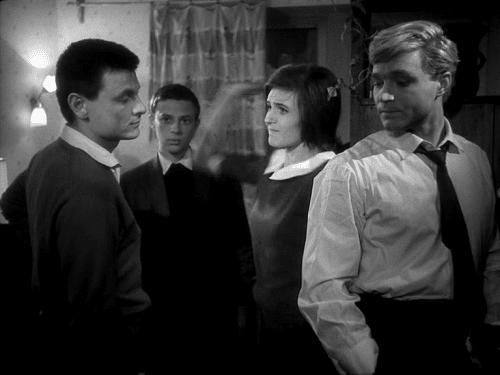
Though liberally rewritten to fit with nationalist doctrine, the scenes dramatized by Radio Moscow illustrate Sergei's post-war existential crisis. In the first scene Sergei and Anya reject the bourgeois lifestyle of her parents. This contrasts with the next scene in which Sergei's mother describes digging for potatoes on the front lines to feed her hungry family during WWII after misplacing food rations. This causes Sergei to explode with anger in the following scene, at Anya's birthday party, when one of her friends dismissively steps on a potato. In the final scene, Sergei confronts a vision of his father, a soldier who died during WWII. Sergei begs him for guidance on how to live his life, "...I was only 21, so how can I advise you," he responds.
The radio adaptation attempts to bring a resolution to the film. As his father disappears, Sergei proclaims, "...the most important thing in life is not to be alone. Alone one is helpless. I must live for Mother, for Vera, for Anya. I must live for all people and only then I will be a real person." This film, however, is purposefully vague. The audience does not see what becomes of Anya and Sergei. Like these characters, we are left to decide for ourselves.
I Am Twenty is available to rent or purchase on Amazon.
[1] Woll, Josephine, Real Images: Soviet Cinemas and the Thaw, 2000, pg. 146-147
[2] Neuberger Joan, "I am Twenty (1961, released 1964)", Not Even Past, 2011
Audio courtesy of the NYC Municipal Archives WNYC Collection.
WNYC archives id: 150292
Municipal archives id: T4062

WNYC is funded by sponsors and member donations