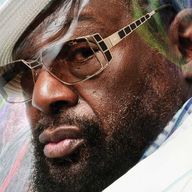
George Clinton on his Life Aboard the Mothership
Kendrick Lamar, D'Angelo, Bruno Mars...with so much of George Clinton's sonic footprint in the air, Soundcheck thought it was time to revisit our recent career-spanning interview with Dr. Funkenstein himself.
"If it wasn't for flashbacks, I wouldn't have any memory at all," says George.
Over his 50-plus years in the music industry, the funk pioneer best known as the founder and driving creative force of Parliament-Funkadelic, and later, the P-Funk All-Stars, has seen -- and done -- a lot. Clinton started out as a doo-wop singer and and a songwriter in the Brill Building in the 1960s. But his sound quickly evolved into something much more rock -- and, eventually, funk -- oriented. Clinton describes that funky sound as "psychedelic versions of the songs that my mother would listen to."
"Music from way back up in the woods," he says. "Matter of fact, all the way in the jungle. We wasn't even going back to slavery -- we was going back primal."
With his '70s and '80s bands -- Parliament and Funkadelic — Clinton achieved four No. 1 R&B hits, including the anthem "One Nation Under A Groove" and "Atomic Dog," which topped the R&B charts for four weeks in 1982. Other songs like "Flash Light," "Give Up The Funk (Tear The Roof Off The Sucker)," "Maggot Brain," and "Mothership Connection," remain indelible, and frequently-sampled classics. And with his exuberant marathon concerts, Clinton and his sprawling, colorful band earned a reputation as one of the most memorable and unpredictable live acts around.
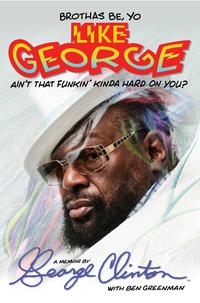
Clinton's winding musical journey -- and his longtime struggles with a crippling crack addiction -- is chronicled in his new memoir, Brothas Be, Yo Like George, Ain't That Funkin' Kinda Hard On You?
In a conversation with Soundcheck host John Schaefer, Clinton reflects on his early years bridging divided black and white audiences, his musical highs and career lows, and the invention of famous The Mothership.
Interview Highlights
George Clinton, on the title of his book Brothas Be, Yo Like George, Ain’t That Funkin’ Kinda Hard On You?: A Memoir:
I say I was hard when I started, I’ll be hard when I get through. In the meantime it’s been a challenge. But without humps, there’d be no getting over. I feel good, 73. I got something to fight for. I enjoy and welcome all that we’re going through because I think we found a way of getting the problems out to the people in the book.
On finding an audience within the black and white communities:
Funkadelic strived hard to become underground. We made records that we didn’t want to be played on the radio. We were too white for the black audience and too black for the white audience. And that’s how we wanted it. Because the fans that are going to like us no matter what stayed. They were smaller but they grew over time. I realized I can actually start a movement like this. Frank Zappa was like that. You have your fans who liked you for you, no matter what you did.
On the creation of Dr. Funkenstein:
Neil Bogart, owner of Casablanca Records, I had wanted to be with him for years because he was a good promotion man. But he would only do it if I would be the center of attraction. And I was reluctant to do that because that wasn’t our style. I had heard that once before by Dave Kapralik, manager of Sly and the Family Stone. He thought it was too dark, you couldn’t distinguish the focal point of the band. And I would trust me more than anyone else doing that. So I reluctantly said yes and that became Dr. Funkenstein.
On the inception of The Mothership and landing in Times Square:
When I told him [Dave Kapralik] after we got the hit record, you don’t get paid for records in the tail end anyway but you can get help with promotion. I said, “buy me this spaceship,” and I didn’t have to finish the sentence. He went and got me a loan from the bank for a million dollars. Jules Fisher built the spaceship, did all the costuming. I told him we wanted to be able to land it on the stage...It was a funk opera.
We landed the spaceship at five o’clock in the morning right in Times Square, right in front of the Coca Cola sign. With no permit in ‘77. The only person who came out was Murray the K, the DJ. He was ripped, he was drunk. He said, “Dr. Funkenstein, welcome to planet Earth. I am Murray the K, the fifth Beatle.” It transported us for 10 years all the way up to "Atomic Dog."
On his drug use and struggles with addiction:
I think we were sanctioned by the mission, the Vietnam War. It was the kind of thing that would allow you to be silly. Peace and love, people meant that. You had to have some kind of blessing from that to have all the fun we did, taking acid. But that ended at Woodstock. I see that now. We stopped doing acid in ‘70. It just wasn’t acid anymore. It was commercial whatever they would sell you to hallucinate. We started cocaine, basically a rich person drug so we didn’t get very deep. Then we ended up in the late ‘70s and ‘80s when crack came around. We were looking for acid again -- tried everything once or twice…but this, all it takes is one time. And I stayed there until four years ago. And that slowed me down from being able to take care of the business.
On adopting a hip-hop-influenced direction in 1982 "Atomic Dog":
We were intentionally trying to sound like a hip-hop record when we did “Atomic Dog.” We had already begun to hear a little bit of the sampling and how songs were loose and disjointed form connecting grooves together, overlapping samples with each other. We very early tried to catch on to that. The song that sounded electronic, we knew how to synthesize sounds. If you listen to the old versions, the B-side of it was us trying to rap. It sounded more like Sugarhill Gang, but we actually did that as part of the remix of that song.
This interview originally aired on October 29, 2014.