Explainer: Is the Jones Act Hurting Puerto Rico?
Updated: Thursday, 8:35 A.M.
At @ricardorossello request, @POTUS has authorized the Jones Act be waived for Puerto Rico. It will go into effect immediately.
— Sarah Sanders (@PressSec) September 28, 2017
This week, seven House Democrats, led by Rep. Nydia Velázquez, called for a waiver of the Jones Act. Locally, City Council Speaker Melissa Mark-Viverito said the Jones Act was leading to "insanity."
"We can't have hospitals running indefinitely on generators! I mean how do you, how can you even imagine that? People in ICU, people in need, people on ventilators!" she said at a press conference Wednesday.
People in large sections of the territory don't have enough food, water and fuel after Hurricane Maria. Communications are spotty and roads are clogged with debris. Officials said electrical power may not be fully restored for more than a month.
On Thursday, the Trump Administration said it would give a temporary waiver to Puerto Rico of the Jones Act. But now, people are calling for a repeal.
But what is the Jones Act? And is it really what's currently hurting Puerto Rico's infrastructure?
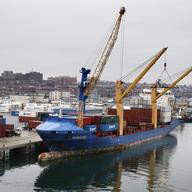
The 1920 Jones Act was designed to protect the U.S. shipbuilding industry for military and economic reasons. To do that, it mandates that only U.S. flagged ships staffed by all-U.S. crews on U.S.-built ships can go between U.S. ports without financial penalties. So, ships with, say, Chinese crews can't go between California and Alaska, or New York and Puerto Rico. (But they CAN go from Mexico to Puerto Rico. That's fine.) This means that ships from nearby countries can't bring Puerto Rico aid supplies from the U.S. mainland unless they pay tariffs.
The shipping industry, which is a very powerful lobby, says that the Jones Act protects 500,000 jobs —and it told Congress that hundreds of those jobs are actually in Puerto Rico.
But the Jones Act doesn't just protect jobs. It also raises prices in places like Hawaii....and Puerto Rico.
How much does this hurt? Even before the storm hit, shipping household and commercial goods to Puerto Rico cost roughly double what it did to nearby Jamaica and the Dominican Republic, because those islands don't have a Jones Act. Here are some numbers from an opinion piece in The New York Times:
"A 2012 report by two University of Puerto Rico economists found that the Jones Act caused a $17 billion loss to the island’s economy from 1990 through 2010. Other studies have estimated the Jones Act’s damage to Puerto Rico, Hawaii and Alaska to be $2.8 billion to $9.8 billion per year. According to all these reports, if the Jones Act did not exist, then neither would the public debt of Puerto Rico."
Ouch.
This is especially a problem now, because post-Hurricane Maria, people who have lost everything won't be able to afford these higher prices due to the Jones Act.
But shipping industry operators say, 'Sure, goods shipped on a boat made in South Korea with a Russian crew would be cheaper. But at what cost to American jobs and manufacturing?'
Wait. Wasn't the Jones Act waived for Florida and Texas?
Only in a limited way, to prevent widespread fuel shortages in the wake of Hurricanes Irma and Harvey. Not-so-incidentally, at the same time it was also waived for Puerto Rico to help it avoid a fuel shortage, as well. But that waiver expired last week.
But....the Jones Act has been permanently waived for other territories by Congress in the past, including the U.S. Virgin Islands.
Will waiving the Jones Act help Puerto Rico?
This is complicated. To provide immediate, humanitarian relief and the rebuilding of crucial infrastructure — probably not. But for long-term recovery of a bankrupt nation, the answer could be yes.
The Trump administration has said a waiver is not needed, because there are enough U.S. flagged ships available to ferry goods to Puerto Rico. Officials at the Department of Homeland Security, speaking anonymously because they were not authorized to discuss the issue by name, said the bottleneck is with unloading cargo at the island's damaged ports and then getting the supplies inland.
That echoes what two major shipping firms told The Wall Street Journal: goods are stranded because there's not enough diesel fuel for trucks and roads are often impassable. One shipping operator told WSJ that "The cargo is here" in Puerto Rico. That includes 6,000 shipping containers with "medicine, food, water, construction materials, tarps for temporary shelters, generators and fuel."
But without a long-term waiver of the Jones Act, food, fuel and building materials will continue to be more expensive in Puerto Rico than they would be in the nearby Dominican Republic, for example. And many political leaders worry that those are costs that the bankrupt commonwealth likely won't be able to afford, even after the current humanitarian emergency has passed.
With reporting from the Associated Press.

WNYC is funded by sponsors and member donations