Medical Students Learn More Than Anatomy From Donated Bodies
When Haig Manoukian died in 2014, after a six-year struggle with prostate cancer, his wife Michele Piso Manoukian lay down next to him to say good-bye. Then she got up, anointed his body with oil in the tradition of her Syrian ancestors, and handed him over to the New York University School of Medicine.
“Haig was a teacher,” she said, so donating his body to educate medical students added both physical and metaphysical meaning to his death. “Being taken into their learning, their intelligence, their awareness — that’s the best thing we could imagine.”
****
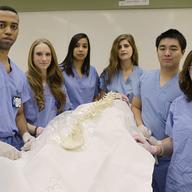
About 18 months later, Haig was a cadaver on Table 4 in the NYU anatomy lab. He caught the students off guard. For weeks, they had been dissecting another cadaver – a woman – but student Bianca Kapoor came in one evening to do some work, unzipped the body bag and found Haig.
“I immediately just closed the bag,” she said. “I needed to prepare myself, because it caught me by surprise.”
“It was weird,” said her table-mate Samantha Ayoub. “But then we got back to work.”
It turned out the previous donor’s colon cancer had devastated her lower digestive system, making her undissectable. So the anatomy supervisors had replaced her with Haig.
The group never found out much about either body donor during anatomy class. Although medical school instructors often say cadavers are the students’ “first patient,” the bodies came with no background information and the students could only stitch together bits about their life and medical condition.
In their first year, the doctors in training spent one concentrated month on gross anatomy. With so much information to master, learning it well enough to pass their final exam was foremost on their mind.
Much of medical school is about memorizing – memorizing facts about how the body works, facts about the cause and effect of illness, facts — and techniques — about caring for patients. In one sense, gross anatomy puts the ultimate memorizing tool and 3D puzzle into the hands of students.
“Seeing something on the cadaver is ways easier than seeing it on a diagram on a page of text,” said Oliver Stewart.
But as much as anatomy is an exercise in memorizing, it is also about selectively forgetting. There is immense respect and gratitude for the donors who gave their bodies, but forgetting about their humanity, at least temporarily, is part of the drill.
It helps that the cadavers are embalmed. Drained of blood and preserved with formaldehyde, they take on a non-human quality. It also helps that much of the body is wrapped, including the head and limbs, so the first-year students are working on the chest and abdominal cavities in isolation.
“The instructors tell us to view things as structures, not as people, and I think you need a little bit of that,” said Michael Nguyen. “Learning in the anatomy lab, a lot of the time you need to think not necessarily that ‘This knee belonged to someone,’ but rather ‘That’s a knee in front of me, and I need to learn about all the surrounding muscles and tendons and ligaments.’”
The NYU students tended to go back and forth between the parts and the whole, between immersing themselves so deeply in vessels, nerves, organs and tissues that they forgot they were working on a former person, and then catching sight of something that reminded them.
“It’s hard, I think, sometimes to imagine it was a living, breathing person,” said Kapoor.
****
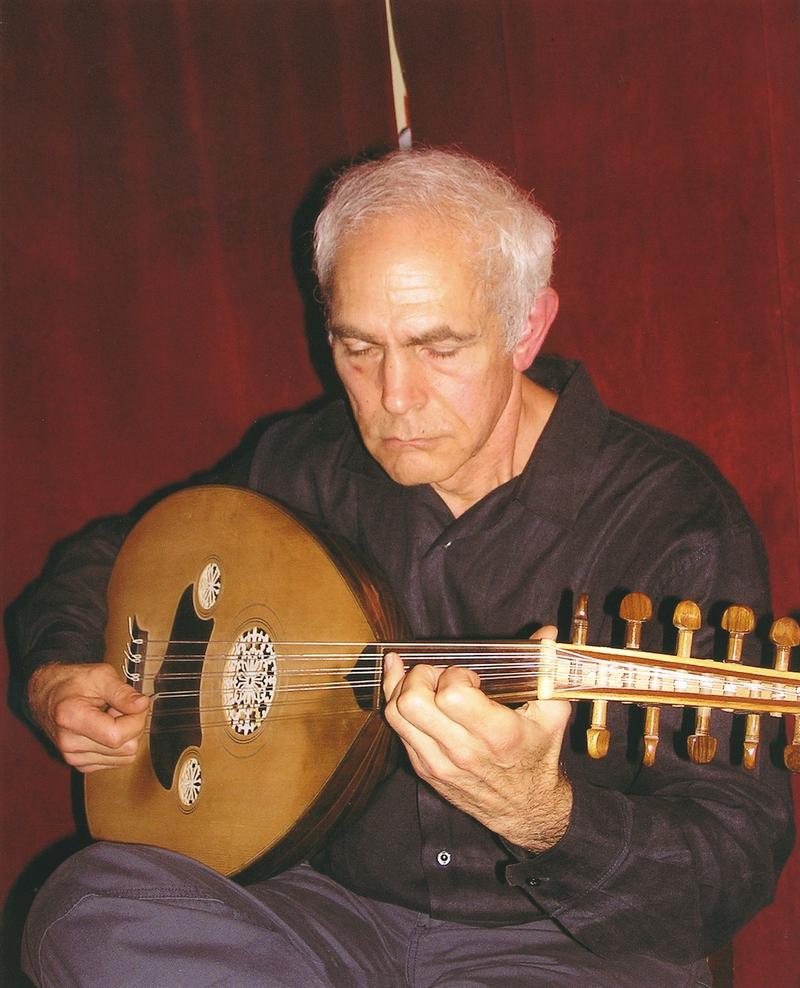
When Haig Manoukian was a living, breathing person, he spent his life making music. The son of a survivor of the Armenian genocide, he was master of the oud and a fixture in the Middle Eastern cultural scene in New York City, dating back to the 1960s. Back then, he wore his hair long and belly dancers at the clubs on Eighth Avenue dubbed him “Haig the Handsome,” while one friend called him “the Jimi Hendrix of the oud.”
Even into his cancer-ridden years, Manoukian performed around the world, and players from all over came to learn from him and get help restoring their instruments.
“He could raise an instrument from the dead,” said Ara Dinkjian, who once brought Manoukian a valuable oud to repair.
Donating Haig’s body to medical education suited his personality, according to his wife Michele.
“He was so scientific, so methodical, so practical,” she said. “I thought he of all people would appreciate being used. He was the sort of person who if he ate an apple, he ate the whole thing – the stem, the seed, everything.”
Haig also had a wicked sense of humor. Friends talked about all the pranks he pulled – loading a band member’s luggage with their host’s fine silverware or a piece of firewood, or diverting an accordion-hating friend to an accordion festival. The body-bag swap was something he would have appreciated, even orchestrated.
Michele asked about the the anatomy lab, trying to picture it.
“I wouldn’t want to think that people are all somber,” she said. “They should be laughing, too. If they’re smart people, they’re going to be making jokes, and Haig would appreciate that. And I also hope they’re making lots of mistakes, too, you want that – good mistakes you can learn from.”
****
After the students completed this year’s anatomy class and final exam, I told them about Haig’s life and death. They were excited to learn about him but said they're glad they didn’t know earlier.
“If you went into it knowing this patient had prostate cancer, you’d have preconceived notions about what’s going to be in there,” Steuer said, “as opposed to just letting it surface, as it would if we were doctors.”
“I’m glad that anatomy was just focused on the biology,” Kapoor said. “I like that I get the rest later, but I don’t think I would’ve been ready for it, going into dissection.”
But she expressed some regret for not considering his individuality more.
“I feel bad that I didn’t really ask,” she said. “When we’re in the weeds, you’re just focused on ‘this vein goes to what vein’ and ‘where does this come from?’”
****
As luck would have it, Michele held a long-awaited memorial tribute for Haig the same week I told the students about him. She invited us all to attend.
In a packed sixth-floor dance studio near Union Square, friends, family and collaborators recalled Haig's relentless energy, musicianship, generosity and humor.
The three medical school students who attended met Michele briefly. They expressed gratitude to each other. While the ceremony was informal, Michele announced to the room that the NYU students who worked on Haig’s body were there. In addition to living on in his music, Haig lived on in them, she said.
“I thought that was very beautiful,” Ayoub said afterwards. “I hope I’ll always do him justice and honor his life and be a good doctor.”
(Music: Oud Taksim, Haig Manoukian, from Near East Far West, courtesy of AgaRhythm)

WNYC is funded by sponsors and member donations