Why 160 Immigrant Teens Call an Old Bus Depot 'School'
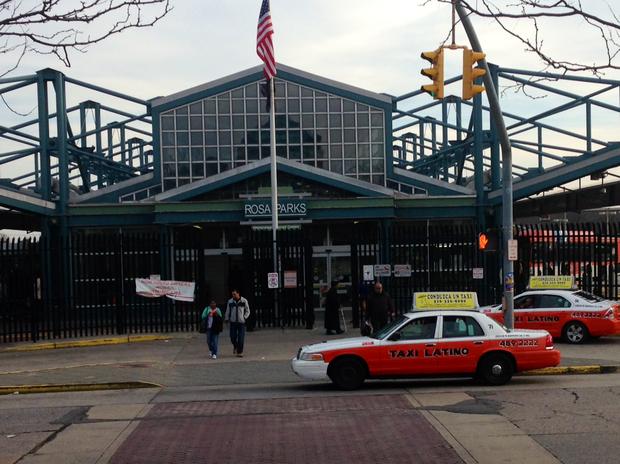
At the heart of Hempstead, there are two bus depots. The bustling Rosa Parks Transit Center gives the Nassau village its nickname: the hub of Long Island. But the old terminal building across the street, sandwiched between a McDonald's and a gold exchange store, now holds hollow storefronts, stories of foreclosure, and as of this fall, something new: a school for English Language Learners who've had a break in their formal education.
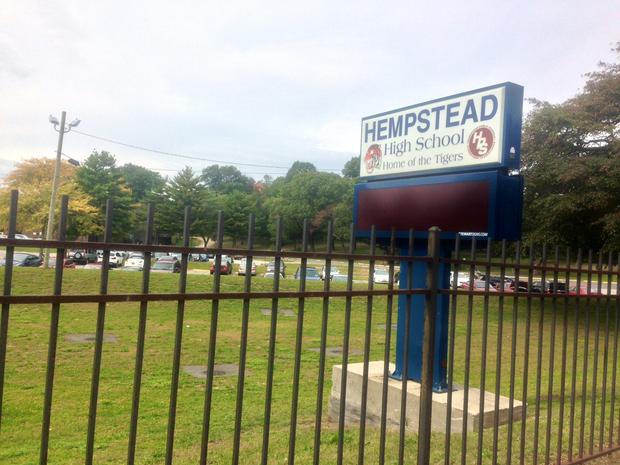
In late October, over a month into the school year, about 160 kids who couldn't fit in an allegedly overcrowded Hempstead High were sent to school in the upstairs office spaces instead.
Waiting for a ride outside after class was Miguel Maravilla, 18, who'd fled gang violence in El Salvador earlier this year. He said he didn't know why he'd been sent here from the high school, where he'd attended class since September on a suburban, tree-lined street.
But Carmen Gutierrez, 17, said she was just happy to be starting classes. She left her mom in El Salvador earlier this year to live with cousins in Hempstead, hoping to study computer science in the United States. When Hempstead High opened in September, she was told the place was full; she'd have to come back later.
A state investigation
After word of Hempstead Union Free School District's dysfunction reached Albany, an initial state probe couldn't make sense of the district's placement decisions. At least a dozen students like Gutierrez were technically enrolled but denied instruction since September. When the transitional school for newcomers opened at the old bus terminal, some of the wrong kids were transferred from the high school and promptly sent back. The state also found some administrators didn't read new students' transcripts from their previous schools if the transcripts were in Spanish, resulting in questionable class placements. In a classroom upstairs at the converted terminal, a teacher had teens cut out letters with scissors to learn their ABCs. The students, the state report said, "appeared insulted at the level of the instructional material."
Merryl Tisch, Chancellor of the New York State Board of Regents, visited the annex the week it opened. She said she was "pleasantly pleased" by the calm atmosphere in classes. "That does not mean I think a transitional facility is where these students belong," she said. The state gave the district less than a month to come up with a corrective action plan to address problematic placement and enrollment practices — the deadline is today, Dec. 3.
The superintendent of Hempstead Schools refused repeated requests for comment since early September. As of Dec. 2, the school system would not explain how they planned to respond to the state. Hempstead will have to come up with a timeline detailing milestones and district budget support to meet a laundry list of state demands. Among these, the district must create a new step-by-step procedure to review foreign language transcripts, loosen registration requirements, and make sure all students have access to extracurricular activities. In its Monitoring Report, the state does not require the district to move the students out of the annex.
"Our biggest concern is that some of the students are not being educated at the appropriate level," said state board of education spokesman Dennis Tompkins. "Some of them are being given instruction well below their potential. so that's one of the things that should be addressed in the corrective action plan."
A long history of dysfunction
English Language Learner placement has long been an issue in Hempstead, a village now almost evenly split between African Americans and Latinos. The official population is around 54,000 — but Mayor Wayne Hall said he thought the actual population is more like 70,000 because many residents skip the census. Among those who skip may be recently arrived immigrants without legal documents. Latin Americans have been arriving in the village for at least 30 years.
Thirty-one-year Hempstead schools veteran Dawn Sherwood, a retired teacher and former teachers union president, said she watched as school rosters swelled with Hispanic-sounding last names. She said some English-proficient kids were placed in ELL classes just because their last name was Rodriguez.
Sherwood said new arrivals are just one stress on the school district, long plagued by under-performance, sloppy records, and poor planning. "There's always been threats made by the state: clean up your act," she said. "But that doesn't really seem to happen."
But this year was unusual, even for this district. School officials said an overwhelming influx of over a thousand new students, compared with a normal flow of 400 new students in an average year, became too much for the already overburdened district to handle. At a community forum, Superintendent Susan Johnson said 330 of these new arrivals are "unaccompanied students," or kids who crossed the border without a guardian.
"There's nothing racist, we're not mad at Hispanic children," said Leonard Myers, a former school board member who runs a charity in the converted bus depot building. "It's just this place is getting overcrowded, and it's not helping the children."
But Jason Starr, a lawyer with the New York Civil Liberties Union, said, "Regardless of the challenges, if their solution was, 'Well we'll just send these kids home until we can figure it out,' that was completely inappropriate and against the law."
The adults in the room
School and state officials said high turnover in school leadership makes it hard to hold anyone responsible. Board of Regents member Roger Tilles, a policymaker for all Long Island districts, said the dysfunction is rooted in mismanagement at the school board level. He said if the board would ask for help, the district could form partnerships with higher education institutions, as Westbury Schools did, or maybe be assigned a distinguished educator to oversee the district, as the state did in Buffalo.
Current school board president Lamont Johnson said that moving forward, he'd like to spread the new kids across Long Island, to other districts with more room and resources for help with the influx.
But retired teacher Sherwood said that "not in my backyard," is a way of life on Long Island and "people aren't willing to pool resources because resources are limited."
State education commissioner John King said he's pushing for state and federal emergency aid for districts that have seen an influx of unaccompanied children this year, but the state budget won't be updated to reflect the new students until February.
Sherwood said money's important, but it's not the only thing the district will need. "They gonna need some tough love and they gonna need some truth being told about what's really happening," she said.

WNYC is funded by sponsors and member donations