The Long, Winding Path of Same-Sex Marriage
In the last couple years same-sex marriage swept across the country with such extraordinary force and speed that at some point its passage, nationally, assumed an air of inevitability. Opponents, for the most part, resigned themselves to it, even before Thursday's expected decision from the Supreme Court.
Which is why it's instructive to revisit an earlier era: when same-sex marriage wasn't a priority of the LGBT movement, and something most Americans couldn't have imagined.
In 1983, the U.S. Secretary of Health and Human Services Margaret Heckler stepped into the Cabrini Medical Center on East 19th street and shook hands with Peter Justice, a 40-year-old AIDS patient.
"As you can see, I've taken no precautions, because the very best scientific evidence has clearly demonstrated that one cannot contract AIDS through shaking hands," she said, as the media looked on.
"The recent reaction of concern, not by patients, but by the public, that was so irrational, that isolates the AIDS victim -- this has become a fairly recent phenomenon and so serious that I felt it was important to be seen publicly with an AIDS patient."
Just months before this strange spectacle and photo-op, Larry Kramer published his now-legendary column in the New York Native: "1,112 and Counting." in which he wrote "Our continued existence as gay men upon the face of this earth is at stake. Unless we fight for our lives, we shall die."
"I mean, Larry went out to Fire Island literally with a tin can and collected 60 bucks for his effort," recalled Andy Humm, a longtime activist and host of the Gay USA show. "It was ridiculous. Now it's like, go to a dinner and it's a thousand dollars a plate, right? That's where we were in those days, there were no resources. The government wasn't helping."
"The president was Ronald Reagan, who was totally anti-gay. Wouldn't say the word until 1987," he recalled. "Nineteen eighty-seven! I mean, [with] Ebola, everybody jumped into action and did something. Legionnaires' disease, everybody got involved. But this was like, 'Well, this was just faggots, junkies. It's doing a good job. Let 'em go!'"
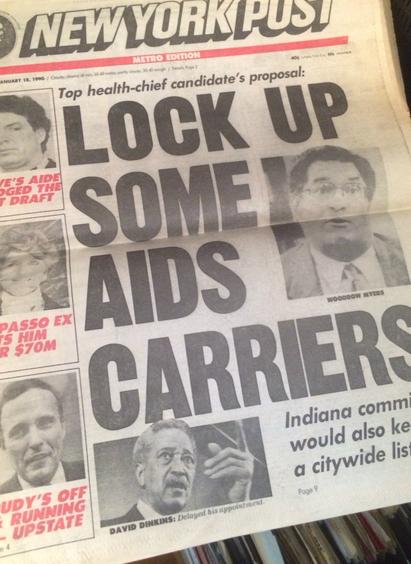
By the early 1990s, AIDS had claimed 10,000 lives in New York alone and groups like ACT UP were engaging in mass demonstrations in hopes of seizing attention.
Humm recounted a story about Bill Lynch, the political operative who led David Dinkins' successful campaign for mayor, and who was black.
"Bill had a radio show called Illuminations on WBAI and he had one of the first people with AIDS on a radio show," Humm said. "And his first question to the guy was, you know, white gay guy, "How's it feel to be a n-gga?"
"That's what he said to him," Humm continued. "It was like 'Woah!' And it summarized all these privileged white guys, right? Who acted like, 'Well, I can move in society and no one's going to bother me.' And you were now the lowest of the low, and you were going to feel real prejudice. And people with AIDS obviously did! People with AIDS were outcasts."
It was against this backdrop, activists say, that the marriage equality movement began to take root. Evan Wolfson heads Freedom to Marry and is widely considered the leader of the marriage equality movement. He wrote his law school thesis on same sex marriage, in 1983, and says the AIDS crisis, as terrible as it was, allowed the country to see gay people caring for one another, and grieving.
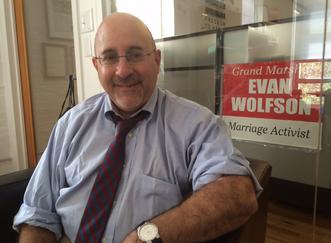
"And it also prompted gay people to understand how vulnerable we were in being excluded from marriage and family protections and the basic respect the law owes us," Wolfson recalled. "And that really transformed our movement from a movement seeking just to be let alone — 'Don't arrest us. Don't persecute us. Don't harass us.' — into a movement about being let in. 'Let us have what you have.'"
But not everyone saw it that way, at least not early on.
"A lot of people, myself included, kind of just thought 'He's just nuts. That isn't going to happen for decades. We've got so much other stuff to do,'" recalled Cathy Renna, the onetime spokesperson for the Gay and Lesbian Alliance Against Defamation (GLAAD) who now runs her own PR firm.
Many at the forefront of the LGBT movement, said Renna, saw themselves as sexual revolutionaries, hardly the marrying kind. But activist Bill Dobbs says that slowly changed, to an extent that worries him.
"In the 1970s and 80s, the early decades of this movement, there were a lot of words flying around. Gay rights, lesbian rights, power, liberation. All kinds of things," Dobbs said. "Equality was just one among many. But then in the 1990s, it got very tight. It was as if everybody had to salute equality, or get out of the house."
In 2004, Massachusetts became the first state to legalize same-sex marriage. In 2011, New York became the sixth. And then in 2013, the Supreme Court struck down the Defense of Marriage Act in a case brought by New Yorker Edie Windsor. That day in late June she stood outside the Stonewall Inn in Greenwich Village and addressed her fans.
"Because of today's Supreme Court ruling, the federal government can no longer discriminate against the marriages of gay and lesbian Americans," she proclaimed, to cheers.
For people on the other side, like the Rev. Ruben Diaz, Sr., a state Senator from the Bronx, there's a certain sense of disbelief.
"Marriage equality?" he asks, with a laugh. "Marriage equality. What is that?"
Diaz heads a Pentecostal church in the Bronx and organized large demonstrations against same-sex marriage. He thinks opinion surveys are misleading, and that the American public is less supportive of it than the data indicates. What he wants is a national referendum on this issue. But he doesn't expect one. At this point, he sounds somewhat resigned.
"I think that I have done what I have done," said Diaz. "And now the Supreme Court will decide. And if they say that it's legal, I'll have to live with that."
Evan Wolfson said that if the court does make same-sex marriage the law of the land, the group he founded, Freedom to Marry, would help its employees find new jobs, before shutting down. That process, he thinks, will take a few months.

WNYC is funded by sponsors and member donations