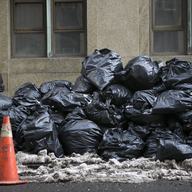
Massive Waste: New York City Fails to Get a Handle on Trash
New York City produces millions of tons of trash every year. And despite repeated promises by elected officials, the city has failed to stem the tide. Politico New York has published a series looking into the decisions that got us here, and City Hall Bureau Chief Sally Goldenberg spoke with WNYC's Richard Hake.
WNYC transcripts are created on a rush deadline and the text may be updated or revised in the future. Accuracy and availability may vary. The authoritative record is the audio record.
Richard Hake [host]: It's Morning Edition on WNYC, I'm Richard Hake. New York City produces millions of tons of trash every year, and dealing with it has serious consequences both for the environment and for some of the smaller communities outside of New York City where much of it ends up in landfills and incinerators. But despite repeated promises by elected officials, the amount of garbage produced by residents and businesses continues to go up. Politico New York has been publishing a series all this week, and we've been talking with our reporter this week from City Hall, the City Hall Bureau Chief Sally Goldenberg. Sally, good morning.
Sally Goldenberg [guest]: Good morning. Thank you for having me.
Richard Hake [host]: So your series highlights just how poorly on New York City performs in terms of recycling rates and sheer volume of garbage versus other other cities? Why is that? Why is New York falling behind other cities?
Sally Goldenberg [guest]: There are a few reasons for that, I think prominent one is that New York City doesn't have a program to recycle organic waste, which is food waste in yard scraps. There was a pilot program put in place by Mayor Bloomberg as he was leaving office and 2013 and it you know, it's expanded in possibility but not an actual take up. In other words, like only 1% of organic waste is recycled, it could be much more. There are people including the city sanitation Commissioner Kathryn Garcia who believe it should be mandatory and unless you mandate it people are really not inclined to go through what might seem to be a rigorous process of you know, separating out your food waste
Richard Hake [host]: Yeah what happened. I mean, basically, we have Mayor de Blasio, Mayor Bloomberg are all touting this program on
Sally Goldenberg [guest]: a presidential trail ...
Richard Hake [host]: yeah, here in the city and on the presidential trail. So like what happened?
Sally Goldenberg [guest]: Yeah, I should say they're talking about climate change on the presidential trail and this, you know, ties to that. I think Mayor Bloomberg, you know, started it. He probably could have started it sooner. It has started in other cities, in Seattle, it started before 2010, I think somewhere between '05 and '09 it went from pilot to mandatory or something like that. But he put a pilot in place and I think de Blasio originally intended to make it a citywide mandate, he said that when he campaigned in 2013, and he sort of fell off of his promise, I'm told because budget officials in the city said it's too expensive. You know, that's sort of the role of the budget office to say, this is too much money. This isn't getting enough participation. And there was just a lack of political will and motivation, it would appear to be, from city leaders to actually go through the trouble of making it a mandate and making it a more robust program.
Richard Hake [host]: Here's another interesting point that you focus in on in your series, um, the lack of recycling and public housing. I mean, now, though nearly half a million people live in public housing, recycling bins weren't even installed until there was a lawsuit. I mean, why can't the agency fix recycling and just put in the bin?
Sally Goldenberg [guest]: And now you know, they they put in bins and they're touting that and they touted that to us but really, it wasn't until, as you said the National Resources Defense Council and residents threatened to sue. And that was I think in 2016 they were put in and in 2019, the City Housing Authority put out a report saying recycling rates are less than 2% at NYCHA. And I think that's a lot of reasons, you know, people live on a high floor and trash shoots don't enable recycling. The bins themselves, I'm told by residents are like inconvenient. They're in dark areas, they're farther away from the entrance. And there's no—I don't know how well the signage is. And there's no organics recycling program to speak of at NYCHA either so that as you said, it's almost half a million people who basically functionally don't recycle.
Richard Hake [host]: Now, you also report that more than 3 million tons of garbage come from businesses, and city officials estimate that some two thirds of that is recyclable, but even when those businesses carefully separate out the recycling, private commercial haulers just throw it all in with the trash right?
Sally Goldenberg [guest]: And we watched that, you know, we did a midnight ride with the Teamsters and we drove around Brooklyn. We watched them, these workers, take all of these recyclable materials and commingle them in the back of their trucks, which they're not supposed to do.
Richard Hake [host]: And we actually have some tape right now you spoke with former hauler, Allan Henry, who said workers face intense pressure from their bosses to get their routes finished quickly.
Allan Henry: It's not like the the people on the truck is just throwing cardboard in and recyclables and because they want to throw it and they thrown it in because that's pretty much what they was told to do.
Richard Hake [host]: So Sally, why doesn't New York penalize the companies for putting recycling in with the land in the landfills?
Sally Goldenberg [guest]: Well, the New York City agency that's tasked with doing that, the Business Integrity Commission, is pretty small and understaffed. So I think that's part of the problem. And, you know, it goes back to not having a lot of motivation to make this a central focus of City Hall. I mean, you have to actively do something or else it doesn't get done in government. There's so many fires to put out every day real and metaphorical and I think this just isn't one of them.
Richard Hake [host]: And the city is kind of working on this because there was a law that was passed last year, aiming to cut down on the number of private haulers in the city. Could this make a difference?
Sally Goldenberg [guest]: Yes. And the sanitation commissioner said that she told us you know, she now has control—her agency, which is much larger than BIC—has control over this and they will be going after carter's who commingle recyclables and trash.
Richard Hake [host]: Now, Seattle has managed to bring recycling rates up to 60% by charging residents for garbage pickup, while providing recycling pickup for free. But New York City Council Speaker Corey Johnson calls that idea a non-starter for New York, what should New York City do to bring up the rate here?
Sally Goldenberg [guest]: I think organics recycling would be a huge contributor, making it mandatory or at least making it such that it is a citywide program. And there are people who believe that Save-As-You-Throw or Pay-As-You-Throw is a way to incentivize people to produce less trash in the first place. But that is a political lift.
Richard Hake [host]: And reducing consumption as well.
Sally Goldenberg [guest]: Right. I mean, we talked to people who said you know, if you—I think it was actually the commissioner, said that if you line up all your plastic bottles for a month, just look at how many plastic bottles you buy. You know there are things you can do that just produce less, carrying a S'well bottle, bringing your lunch in a Tupperware, a glass container, whatever. So you're not constantly buying and producing, you know, the salad or the sandwich wrapper.
Richard Hake [host]: Sally, such a great series this week. Where do we find it?
Sally Goldenberg [guest]: Oh, politico.com/NewYork.
Richard Hake [host]: All right, Sally Goldenberg, City Hall, bureau chief of political New York. Thanks so much.
Sally Goldenberg [guest]: Thank you.


