Nixon's Turn to 'Expand the Electorate'
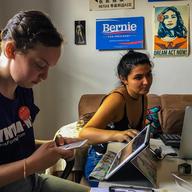
It’s time for a pregame pep talk, at Corinne Greene’s apartment in Flatbush.
“When you’re on the phone, people can hear if you sound nervous — they can smell your fear,” Greene says. “But if you just smile – they have it written here: ‘Smile while you dial’ — you’ll sound natural and confident.”
Greene, a Brooklyn College senior and paid campaign organizer, is leading a phone bank for Cynthia Nixon, the Democrat challenging Governor Cuomo from the left in next week's primary.
A half-dozen other students from as far away as Queens and Rockland County have come here to call voters, trying to interest them in Nixon’s campaign.
For Greene, campaigning for Nixon — and against Cuomo — is personal. She wanted to take advantage of the governor’s new free-tuition program for middle-class families, to reduce her student loans. But she took a semester off when she transferred schools, and that disqualified her.
“I was so disheartened," she said. “And then I found out I wasn’t alone — most people aren’t getting these packages, even when their family incomes qualify them.”
Anger at Cuomo over educational funding and false promises are just a small part of what’s leading Greene and the other students to dial for dollars. Mostly, they support Nixon’s left-leaning agenda, which includes higher taxes on the wealthy and single-payer health care that would eliminate insurance companies.
With 10 days to go before the party primaries, Nixon remains the underdog in the polls. But the upset win by Congressional candidate Alexandria Ocasio-Cortez earlier this summer, and Andrew Gillum’s surprising gubernatorial primary victory in Florida, has given many Nixon supporters hope and cemented a strategy: attracting new voters to the polls, or “expanding the electorate.”
Strategist Rebecca Katz says the surveys that show Nixon trailing Cuomo by 30 points don’t capture people who never or rarely vote, who are overlooked by the establishment and are getting off the sidelines because they’re outraged by President Trump.
“We’ve knocked on doors this cycle where people have said, ‘I’ve lived in this house for 10 years, and no one’s ever knocked on my door and asked for my vote,’” Katz said.
With the polls suggesting Nixon has made few inroads among traditional Democratic primary voters, Nixon has little choice but to try to find new voters. But Democratic strategist Bruce Gyory is skeptical she can take Ocasio-Cortez’s strategy for a single Congressional district and make it work state-wide.
“The governor is running very strong amongst minorities, well among those who identify as liberals. He’s absolutely clobbering her in the suburbs," said Gyory, who’s working for neither candidate. “And in New York, if you can carry black voters, Jewish voters, Hispanic voters and suburban white Catholics, you do not lose a Democratic primary.”
Nixon supporters downplay her deficit in the polls, noting surveys projected Ocasio-Cortez losing by 36 points, and she won by 15. Gyory says district-level polling “can often get it wrong,” because Congressional primaries occur in a vacuum, with no other primaries, and turnout is invariably low — in contrast with gubernatorial polls, which are state-wide and much larger.
Assuming the polling margin in early September is similar to what it has been from March through August, he says, a Nixon triumph would represent “the greatest mistake in statewide polling probably in the history of the nation.”
Cuomo, meanwhile, has a formidable war chest. At $24 million, in the most recent disclosure, it’s roughly 60 times larger than Nixon’s. That includes multi-million-dollar backing of all the state’s major labor unions, but doesn’t include the thousands of volunteers they are mobilizing for his campaign.
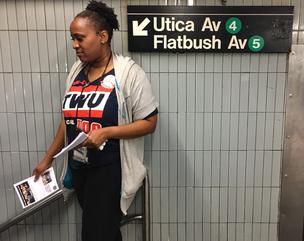
On a recent morning, three Transport Workers Union members were handing out leaflets to straphangers, trying to make the pitch that Cuomo is “fixing our stations.” They’re on temporary leave from their jobs with the MTA, and the TWU is paying their salaries for a month or more, both to do campaign work and other jobs around union headquarters.
“We’re able to interact with the people, hands on, one-on-one, so if they have questions about what’s going on with Cuomo [and the subways], we’re able to answer those questions,” said Natashia Letman, a conductor on the A, C, L and J lines.
Many city residents have been frustrated with increasing subway problems, including delays, breakdowns and crumbling stations. Critics, including Nixon, have pinned the blame on the governor, tweeting #CuomosMTA with each new problem. The TWU flyers highlight his efforts to fix the ailing system and lash out against his detractors.
“That’s right, Cynthia. It is #CuomosMTA,” reads one flyer.
As she handed them out the other day, most commuters simply rushed by without looking up. A few made dismissive sounds and refused to take the flyer.
“I understand their complaints,” Letman said. “But their complaints are being heard, and he’s doing something about it, and that’s what counts.”
The TWU and other unions — including 32-BJ, 1199-SEIU, the AFL-CIO, hotel workers, retail workers and more -- have tens of thousands of members doing volunteer calling and canvassing, too.
The Nixon campaign says it’s supplementing phone banks like the one Corrinne Greene hosted and traditional door-knocking and leafleting with social and digital media, relentlessly texting prospective voters and creating content for Instagram and Facebook.
“What we're seeing in primaries across the country is that those voters are skewing younger,” Katz said. ”We've been really going after that younger voter — and when I say younger I don't just mean under 30, I mean under 50.”
The Cuomo campaign and its allies are also spending millions of dollars on new media. Alison Hirsh, political director for 32-BJ — which largely represents building workers — says they too rely heavily on electronic communications, both with their 85,000 members and with the general public.
But she says she still puts more stock in 20th-century campaigning.
“Call me old-fashioned, but I think there is absolutely nothing that replaces the one-on-one conversation at the door or when you're handing someone a leaflet the day before they go to vote,” Hirsh said. “I tend to be skeptical of the idea that technology can replace that.”
Clarisa Diaz contributed reporting on Alexandria Ocasio-Cortez.

WNYC is funded by sponsors and member donations