For a Guatemalan Teen in Brooklyn, the Path to Asylum Has Narrowed
As a boy living in a mountain village in Guatemala, Melvin knew he was a prime target for gangs looking to expand their drug business. He said they’d approach students on their way home from school and try to get them to join by acting friendly.
But one day last fall, when he was 17, a group of young men surrounded him and some friends. When he refused to join their gang, he said, they got violent.
"My friends managed to escape," he said in Spanish. "But they caught me and they started to beat me up and they cut me."
Melvin said they slowly cut his arm in several places with a knife and slashed his hand, as a form of punishment for refusing to join. Afraid for his life, Melvin and his parents decided he had to leave Guatemala and join relatives in Brooklyn. Now living in Bushwick, he's in an agonizing form of limbo.
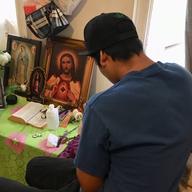
Like thousands of other unaccompanied minors who come to the U.S. without their parents each year, Melvin is seeking asylum and has no legal status — which is why WNYC agreed not to reveal his real name. Now 18, he's slim with thick black hair. He's shy and talks softly, often looking away, and can point to the fading scars where he said he was cut. But he arrived in the U.S. at a difficult time for immigrants. President Trump's Attorney General, Jeff Sessions, has narrowed the standards immigration judges use when deciding whether to grant or deny it. As a result, odds that were long before are now even longer.
The Journey from Guatemala to Brooklyn
When Melvin left Guatemala last fall, he took the same route thousands of other migrants use. He crossed into Mexico and worked some odd jobs for a couple of months to make money. Then he climbed onto a notorious cargo train known as The Beast. This 2015 video by the U.K.'s Channel 4 News shows how it's a dangerous ride. Migrants jump on a network of trains while they're still moving and ride on top for a journey that covers almost 1500 miles over several days.

Melvin said he enjoyed watching the landscape during the day, but it was very cold at night. In January, after getting off the last train at Nogales, he crossed into Arizona and asked border agents for asylum. He said he was was handcuffed and taken to an office where he answered questions about his age and family. He was then detained at a shelter for unaccompanied minors. He recalled what it was like when he was given a toothbrush, clothing and a bed in a shared room.
"I couldn’t barely sleep that night thinking that I had made it," he said, in Spanish. "I felt protected."
Melvin said he and the other kids took English classes during the day and played baseball. During his stay in detention, he also passed what's called the credible fear test. This is an interview with an asylum officer to establish whether there's a significant possibility that a person is eligible for asylum because of his or her fear of persecution. By making it through this first round, Melvin was allowed to stay in the U.S. while waiting for his asylum case to be decided by an immigration judge. He was released about a month after crossing the border to his uncle in Bushwick.
When WNYC first met him in the spring at the immigration court in Lower Manhattan's Federal Plaza, he was among dozens of unaccompanied minors. They were all attending a master calendar hearing, which is preliminary hearing before a judge. Those without a lawyer were given more time to find one.
Thanks to a coalition of nonprofits, about 80 percent of unaccompanied minors at New York's immigration court used to have lawyers, according to data analyzed by TRAC at Syracuse University. But in fiscal year 2017, only 58 percent of unaccompanied minors in New York were represented. Immigration lawyers said that's partly because the Trump administration's immigration policy changes have kept them busier than ever, unable to take as many new cases.
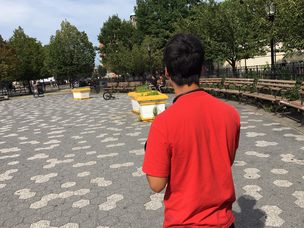
Melvin was handed a list of free legal service providers when he attended that first court hearing. But over the summer, he said he had no luck finding a lawyer. "I went to different places but they said they had too many cases and they couldn’t help me," he explained, in Spanish. It wasn't clear if he had called every agency on the list.
Melvin's aunt Jessie — his uncle's sister — also lives in Brooklyn and tried to help, by referring him to her lawyer. She did not want to reveal her full name because her own asylum case is still pending. She claims she was raped by a gang member and that another one killed a relative. But the nonprofit legal service provider that represents her wasn't able to take Melvin's case.
Jessie works cleaning houses and her husband has a construction job. Their apartment is a just a small room they've divided with a shelving unit to create a mini bedroom for their ten year-old son. They share a kitchen and bathroom with other tenants in the building. Melvin comes over on most Saturdays.
"When he got here he looked like a different person," Jessie said in Spanish, describing how Melvin was very skinny when he arrived in New York over the winter.
Jessie said she has no doubt her nephew needed to flee Guatemala. She knew from her own experience there was no way Melvin could ask the police for help.
"In Guatemala if you are poor you are helpless," she said. "And if you have no money the police are not going to pay attention to you. But on the other hand, if you do something wrong and you can pay, you will be able to get away with it."
Why Asylum is Such a Hard Case to Make
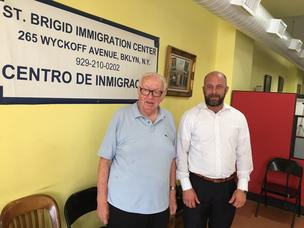
Over the summer, Melvin went to the St. Brigid Immigration Center. The storefront office in Bushwick is a neighborhood fixture led by Father John Kelly — an 80 year-old Irish immigrant who came to the U.S. in 1960. Kelly is a lawyer and St. Brigid's offers free legal services for immigrants seeking visas and citizenship assistance. But Kelly said asylum cases are more complicated and many immigrants can't find free lawyers to take their cases.
"What’s happening is a lot of these people are paying lawyers," he said. "They’re retaining lawyers themselves."
When Melvin went to St. Brigid's, Kelly referred him to Thomas Wright, a private lawyer who specializes in asylum cases.
Although the Trump Administration argues it’s been too easy for impoverished young people to come to the U.S. claiming they’re victims, Wright said it’s actually quite tough for unaccompanied minors like Melvin to get asylum.
"When they say someone or a group wants to murder me in my country, my question that I then have to ask them is 'why?'"
Under asylum law, the threatened immigrant must be a member of a group that’s persecuted or someone whose political opinions have made them a government target.
But with gang violence in Central American countries, Wright said, everyone is a victim.
"They target everyone, they’re indiscriminate," he explained. "Because they’re indiscriminate, unfortunately the policies of the United States are 'we can’t help you.'"
Before President Trump took office, immigration judges had some flexibility to interpret asylum law. Victims of domestic violence could argue that women were a persecuted social group the police ignored. Those fleeing gangs could try to claim the government took no action to help. But this year, Attorney General Jeff Sessions said gangs and men who assault women are private criminals, with no connection to the government. That's a direct instruction to immigration judges, who work for Sessions as a part of the Department of Justice. They're not independent.
"I would say certainly that there’s now a strong presumption that a judge should deny" asylum, said Wright.
In the waiting room at St. Brigid’s last month, Wright and Father Kelly met Karen Rivera, a businesswoman from Honduras who claimed she’s a victim of extortion. She had a stack of papers about four inches high and described how gang members collaborated with the police.
"She actually went to the police and she told them the crimes that had been committed and the police are communicating and sharing information with the gangs," Wright said, after conversing with her in Spanish.
He said this appeared to be the type of case that could win asylum. "She didn’t say that her fear was due to the gangs," Wright noted. "She said her fear was due to the police, the governmental actor who was acting on behalf of the gangs."
But that connection isn't as clear in Melvin's case. Because he has no police report, all he's got is his personal story and the fading scars from where he said he was cut. He doesn't even have medical records for the injuries because he said there's no hospital in his town.
As his lawyer, Wright said he’ll look for anything to show the gang in Melvin’s town is somehow supporting government officials, because the teen said he believes they're paid to ignore certain crimes.
"This may not be successful for asylum," Wright acknowledged. "However we do have convention against torture, where if we could demonstrate that if he were to be returned to Guatemala there’s a probability that he would be tortured there" by the gang.
Wright said there are other potential tools in his legal arsenal. He's challenging Melvin's original notice to appear in court because it didn't contain a date or time. Some immigration lawyers are using a recent U.S. Supreme Court ruling to try to throw out cases with these errors. And if he fails to win asylum for Melvin in the immigration court system, he said, he could appeal to a federal judge. The attorney general's strict definition of asylum doesn't apply in the federal courts.
There's also the possibility that Melvin's case could drag on for a couple of years, since the immigration court in New York City has a backlog of nearly 100,000 cases. By then, there could be a new president and new directions to the immigration judges about asylum law.
Living in Limbo
Melvin's life in Brooklyn is extremely busy. He spends six days a week working at a pizzeria under an elevated train line. He said he prepares pizza and makes deliveries for about $500 a week in cash. He'd like to take English classes but said he doesn't have time.
Technically, Melvin isn't supposed to get a job until he receives work authorization. But that can't happen until he formally applies for asylum, which could take several more months. Melvin said he had no choice but to work because he has to pay his share of the rent at the apartment he shares with his uncle and two other undocumented immigrants.
"My uncle has his relatives in Guatemala that he has to send the money to," he explained. "and he can't always be giving me food and clothes."
Melvin also has to save money for his lawyer. Wright is charging him $4500. Melvin's aunt Jessie paid half the fee.
Melvin said he had no idea winning asylum would be so hard and he's nervous about being sent back to Guatemala. His mother ran into a gang member who inquired about him. But he said he has no regrets about his journey.
"I feel safer here than in Guatemala."
With Spanish translation by Lidia Hernández Tapia

WNYC is funded by sponsors and member donations