Out of Power
What do the conservative former governors Bobby Jindal and Nikki Haley have in common with progressives Sen. Kamala Harris and Rep. Pramila Jaypal?
They're all politicians of Indian descent, but also, people who rose to power outside of New York. No one of Indian descent, no South Asian American for that matter, has been elected from New York to the City Council, the state legislature, or Congress.
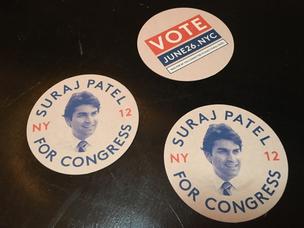
Suraj Patel is hoping to change that with a primary challenge to Congresswoman Carolyn Maloney.
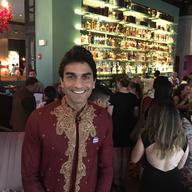
Patel was an Obama aide and teaches business ethics at New York University. He's a relatively unknown 30-something hotelier, but he's raised well over a million dollars and at an East Village fundraiser, filled with men in suits and women in saris and cocktail dresses, he had a special guest and ally.
"We had to ship an Indian-American across the river to speak here," said Patel to his supporters, "because we don't have any elected officials in this state."
He brought out the mayor of Hoboken and one of the most prominent Sikh officials in America, Ravi Bhalla.
"We need more representation in Washington, we need progressive leadership," Bhalla told the crowd. "We have a current Congress member who is representative of the past. Everyone in this room is representative of the future."
By "the past," Bhalla meant Maloney, who's represented the Upper East Side, Long Island City and Greenpoint for more than 25 years. In fact, Maloney was primaried by another well-funded Indian-American candidate in 2010, Reshma Saujani. Saujani won just 19 percent of the vote.
So why can't Indian-Americans win in New York? After all, they have the highest median income of any ethnic group in America, and the highest levels of education. But at least in New York, Indians and more broadly South Asian Americans have no political power — aside from a couple judgeships. (One tantalizing question: Will former U.S. Attorney Preet Bharara run for New York attorney general or another high-profile office?)
"They're not concentrated in one area like Dominicans were in Washington Heights, or Chinese are in Sunset Park and Flushing," said Jerry Skurnik, the co-founder of political consulting firm Prime New York. "They're more dispersed."
In socioeconomic terms, New York state's South Asian community is diverse, according to the Asian American Federation. The median income for Americans of Indian descent is $83,044, compared to $41,318 for Bangladeshis and $54,569 for Pakistanis, based on the 2015 American Community Survey. The state's overall median income was $59,269.
Also, a sizable portion of those communities are wealthy: 12 percent of New York City's Indian-American households and 14 percent of Sri Lankans have a median income above $200,000. In general, Skurnik posited that members of wealthier ethnic groups are reluctant to dwell in the trenches of the political world when other, more lucrative careers beckon.
The prevailing attitude, he said, is one of, "I don't want to bang my head against a wall for five years when I can get a job on Wall Street."
When South Asian-Americans do run for the first time, it's often for a high-profile office, according to Sayu Bhojwani, New York's first Commissioner of Immigrant Affairs.
"One of the biggest trends nationwide for the last several election cycles is Indian-Americans running for Congress without having a local base," said Bhojwani. "So they've never served in political office and they aim immediately for Congress."
Bhojwani now runs New American Leaders, a nonprofit that tries to get first and second-generation Americans of all backgrounds into office. Last year, she said the organization received twice the number of applicants as it had the year before.
She said it takes time for immigrant groups to come of age politically, but it's especially hard in New York.
"New York City has a very, very powerful Democratic machine," she said. "So you have predominately white men making choices of other predominately white men to run."
It will largely be up to these men, the people who run the machine, to determine whether South Asians have a seat at the table in the years to come.
Ali Najmi, a Democrat who lost a City Council race in Southeastern Queens in 2015, said South Asians are fragmented along lines of religion, nationality and language. But he argued they could elect one of their own if the political districts are redrawn.
"I think we could have legislative districts that encompass the community and don't break it up as much," he said.
"And that's going to probably lead to a higher likelihood that we're going to have an elected official from the community."
In Queens, that would require the support of Congressman Joe Crowley and the Democratic organization, he said, and could only happen after the next Census. Which means the South Asian community would have to wait until about 2022 for its first taste of political power.

WNYC is funded by sponsors and member donations