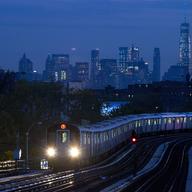
Overnight Subway Service Is Enormously Popular — Except When it Isn’t
Only a small fraction of straphangers ride the subway late at night. That’s why an urban planning think tank called for a nightly shut down of the subway last month. The proposal from the Regional Plan Association (RPA) took up just a single paragraph of nearly 400 pages of recommendations for improving the tri-state region’s infrastructure, but it led to a massive outcry from city officials, transit experts, and subway riders like Lizaida Sosa.
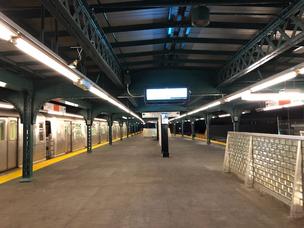
Sosa said she rides the subway home late at night a few days a week. At nearly 3 a.m. on a recent Tuesday, she waited 20 minutes to take the L-train home from a family reunion. The mention of the proposed closure made her think immediately of her sister, who commutes from Park Slope to Penn Station every weekday.
“My sister, she takes the train at 4 a.m. to go to work,” Sosa said, her words piercing the silence at a nearly empty Myrtle-Wyckoff station in Queens. “So if they’re going to close it around that time, she wouldn’t have a way to commute to work. How’s she going to get to work?”
Mayor Bill de Blasio was also aghast by the proposal to shut down the subway at night. He called 24/7 subway service a “birthright” for New Yorkers. City Councilman Rafael Espinal said he’s considering proposing a bill to keep the system running around the clock.
Richard Barone, vice-president for transportation at the RPA, says he understands the emotional backlash. But he said the proposal makes practical sense.
“It’s not like everything is running really well and we’re suggesting, ‘Ok, we’re going to shut it down during these times and everybody’s going to lose a service they’re really flocking to. That’s not what’s happening now. We’re seeing people leave it because it’s gotten so bad.”
The average weekly riders on the subway fell by 100,000 between September 2016 and September 2017, according to a recent MTA report. The biggest drop came from off-peak times when ridership is already thin. Only about 85,000 people — or 1.5 percent — of the subway’s average daily riders rode the subway between 12:30 a.m. and 5:00 a.m. last year.
As an alternative to the subway, the RPA suggested ramping up bus service at night. Buses might inch along during the day, but Barone said that won’t be the case when the streets are relatively clear of traffic. “We can build a bus system that will be able to move people quickly, and mimic the subway system or even do a better job than the subway system.”
New York would still have a 24/7 transit system, he added, it just wouldn’t be a 24/7 subway system.
Running Around the Clock
Keeping a subway system running — especially one that never stops — is no easy task. There’s only one other system that operates around the clock: the Copenhagen Metro, in Denmark.
“You have the conflicting demand of running trains and needing to put staff on the track while trains are running. Clearly these two are incompatible,” said Christopher Cox, who manages systems and operations for the Copenhagen Metro.
It would be cheaper to shut the system down at night for maintenance work, but luckily, he said the Copenhagen Metro doesn’t need extensive repairs: “We are fortunate that the system is new and it’s extremely reliable.”
The New York City subway is more than a century older than Copenhagen, and has a long list of maintenance needs that range from updating a 1930s-era signaling system to repairing crumbling stations. But the nightly closure proposed by the RPA may not go very far to fixing those issues, says John Samuelson, international president of the Transport Workers Union.
“The four-hour window would be appropriate for track reconstruction work because it’s steady work on one track,” said Samuelson. “But track maintenance work bounces from track to track even from different line to different line.”
The MTA already uses late-night shut downs to schedule track work through its Fast Track program. Earlier this year, MTA Chairman Joe Lhota told radio host John Catsimatidis he’d rely heavily on that program to do repair work.
“We’re seeing more and more shut downs late at night from eleven o’clock at night to five o’clock in the morning so we can get a lot of intense work done,” Lhota said. “You’re going to see more of that going on.”
He said the RPA plan for a nightly closure of the subway was “inappropriate for ‘the city that never sleeps.’ ”
New York City got its insomniac nickname more than a hundred years ago. It teemed with activity late into the night even then, according to transit historian Andrew Sparberg. “New York, at the turn of the 20th Century, was already the biggest seaport and manufacturing center in the United States so you needed workers at all hours of the day and night.”
The subway helped get people to and from work — and everywhere else people needed to go. It’s been doing exactly that — all day, every day — ever since it opened in 1904.

WNYC is funded by sponsors and member donations