A Radio Legacy Continues: Processing the Bob Sherman Collection
Bob Sherman was a legendary producer at New York’s classical music radio station WQXR. For almost 70 years, he hosted seminal programs like Woody’s Children, The Listening Room, and Young Artists Showcase. He also produced documentaries, hosted concerts, co-wrote books on classical music, and lent his voice to narrated recordings. His indefatigable energy, extensive knowledge of classical and folk music, gift for connecting with artists and listeners, and belief in building and supporting the community around music defined his brilliant legacy on the airwaves.
Such a long and active career resulted in a substantial personal collection of recordings, both as finished broadcast products and source materials. Sherman started saving many of these in the late 1990s, when the New York Times started considering selling WQXR (it would sell its AM license to Disney in 2006). Fearing that the radio programs he’d been involved in might get lost in the shuffle during that transfer of power, Bob began amassing a small but mighty collection of a wide variety of music and radio content, mostly on audio cassette and Digital Audio Tape (DAT). Over the years, Sherman began to donate these items to a variety of repositories, including the University of Maryland in College Park, the Oral History of American Music Collection at Yale, and a small Florida-based music archive. Following New York Public Radio’s acquisition of WQXR from the Times in 2009, NYPR Archives Director Andy Lanset started an ambitious program of repatriation, acquiring Sherman-related recordings from these repositories; simultaneously, Sherman began to give material from his personal collection to the NYPR Archives. The Archives usually digitized these items for Bob, giving him CDs of the material while holding onto the originals.
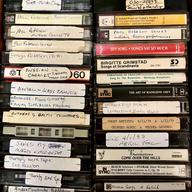
Our internship at the New York Public Radio Archives began in January of 2024, when we were confronted with a wheeled metal cart stacked with boxes of audio cassettes and DATs — the last bit of the Bob Sherman deliveries from his personal collection. Our job, as part of the University of Alabama’s School of Library and Information Studies EBSCO Scholars program, was to process and direct the fate of this motley collection of audio recordings, with the understanding that the NYPR Archives would get the pick of the items, keeping digital copies of WQXR material and passing the whole collection on to the University of Maryland when the job was done. With Bob’s passing in 2023, it became more pressing to finish this task and consolidate Bob’s collection at its final home in College Park. What we found in the materials and in our work and research revealed new perspectives on this committed radio maker, avid music fan, and relatable personality, whose lifelong curiosity about the world was only matched by his enthusiasm for sharing what he learned with listeners. That unique combination — along with his sense of humor and ease with artists — grew into a radio philosophy we heard Bob share in a recording of The Listening Room 15th Anniversary Concert in 1985, when he was joined onstage by pianist Emanuel “Manny” Ax.
In total, this final batch of the Bob Sherman Collection included 462 items: 270 audio cassettes, 191 DATs and one Hi8 video. Our initial expectation was that processing this portion of Bob’s collection would involve learning the New York Public Radio Archives’ reformatting procedures and transfering all of the materials into digital audio files for ingest into our digital asset management system. While that training was part of our process, we soon realized that, given the time limits, the reformatting work would be best handled by an external vendor, while we focused on prioritizing which materials needed reformatting. The goal then became to generate a complete collection inventory that set priority levels for transfer. Previous NYPR Archives intern Sam Seliger had started processing this batch of recordings in the summer of 2023, so our work built on that foundation and also (gratefully) involved Sam as we merged inventories and evaluated prioritization factors.
Sorting through Bob Sherman’s collection revealed who he was in life: a multi-hyphenate Renaissance man who contributed his time and intellect tirelessly to the worlds of music, public radio, and the arts broadly. First, our work required determining which materials were directly connected to New York Public Radio and WQXR. As expected, there was plenty of radio content to evaluate (which we categorized as “Broadcast Recordings”), but the range of recordings was relatively narrow. The three programs most represented in the collection were The Listening Room, which ran from 1970 to 1993; Woody’s Children, which ran from 1969 to 1999, subsequently moving to WFUV; and Young Artists Showcase, hosted by Bob from 1978 up until his retirement in 2023, and which continues on today with rotating guest hosts.
Within the “Broadcast Recordings” category we broadly divided the material into source elements and final broadcasts. Source elements included original live performances, raw interviews and thematic song compilations; final broadcasts were the produced episodes as heard over the airwaves. Source material sometimes ended up being used in more than one final broadcast, which presented an interesting cataloging challenge.
Bob’s collection also contained what we defined as “Personal Recordings,” which led us on a journey through nearly a hundred years of New York radio history. Sherman was a radio fan and a “lifer” in the business: he not only collected audio “memorabilia” from his own stations, but across the gamut of New York radio history, like recordings of Toscanini’s infamous, vitriolic rehearsals with the NBC Orchestra, or a radio interview with the Beatles. Bob was also a voracious music collector, keeping dubbed copies of a wide range of out-of-print vinyls and shellac discs, commercial recordings from small international folk imprints, and his own compilations of folk and world music – like a mixtape of “Anthems of Baltic Countries,” kept on a Scotch personal computing cassette.
As a teacher, Sherman followed in the footsteps of his mother, noted concert pianist Nadia Reisenberg, to become a professor at Juilliard, where he taught The Business of Music for 20 years; recordings of his lectures and lectures by guest speakers found their way into his personal archive as well. Bob was also a prolific writer, working as a music critic for the New York Times for 40 years; his collection includes recordings of phone interviews and other material never intended for broadcast but rather used as a constituent part of his writing process. A performer in his own right, Sherman frequently joked that his mother had given up on him being a great pianist at an early age, but he could nonetheless be cajoled to play a bit of accompaniment from time to time; he also appeared as host and narrator of a variety of spoken word parts in performance, most frequently as The Narrator in performances of Prokofiev’s Peter and the Wolf in his later years, recordings of which appear in his collection as well.
Finally, but perhaps most importantly (and a revealing insight into the trajectory of Bob’s career), Sherman was a devoted family historian, collecting performance highlights from across the careers of both his mother and his aunt, the virtuoso thereminist Clara Rockmore. Bob’s musical upbringing became the basis for much of what he did, and he never failed to credit Reisenberg and Rockmore as crucial parts of his outlook on the value of music, which hinged on listening widely, deeply, and with a keen sense of curiosity about the lives of the performers we love. For Sherman, a deep connection between music and family led to a deep connection to his listeners and the music community in the New York metro area.
As our goals shifted away from diving fully into the reformatting process, we recognized the importance of getting this assessment to a more complete state for the eventual hand-off of materials to the University of Maryland, and the potential to use this project as a model for processing future collections from New York Public Radio hosts and producers. Our prioritization process evolved across a few rounds, moving away from relying on label information and towards reviewing audio, and shifting towards an assessment of all items, rather than broadly segregating the materials.
Fortunately, we had access to Sam Seliger’s original spreadsheet from 2023, so we were able to merge and align our inventories. That process clarified the need to establish Priority Levels for reformatting as well as Categories of Prioritization — to make the inventory documentation more functional, to evaluate problem entries, and to help with quantifying materials. While this prioritization eventually took spreadsheet form, the process followed this decision-making structure:
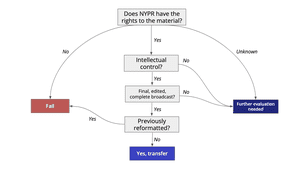
Determining whether New York Public Radio has the rights to the material might seem straightforward, but it often required quite a bit of research. Evaluating the intellectual control considered information from the material, the inventory and the NYPR Archives’ collection management system, Cavafy, to determine what was known about a given item. Broadcast source material was generally considered less usable, and also less clear in how the material was intended to be used, or not. Finally, the “Previously reformatted?” question allowed us to mark whether a copy of the item has already been transferred. The outcome of these decisions was the assignment of an overall Priority Level to each item: “Yes, transfer,” “Fail, do not transfer,” and “Maybe, Further evaluation needed.” After further evaluation was completed by Archives staff, approximately 43% of the collection was a “Yes, transfer” and 57% was a “Fail, do not transfer.”
On April 16 2024, joined by Sam Seliger and Archives Project Cataloger Martha Ball, we shared our rationale, workflows and results in a presentation for the Archivists Round Table of Metropolitan New York (ART), “Sticky Notes: Finding the Music in WQXR Archival Recordings through the Bob Sherman Collection.” As is often the case, preparing the presentation and receiving excellent feedback from our colleagues helped us refine our methods and guide our final steps.
Even with the many changes across this project, the main goal is still to advance the reformatting of New York Public Radio materials in the Bob Sherman Collection. We hope that by implementing this process we have established a foundation for more efficient workflows when time and funding allow. While “embrace the iterative'' was one lesson for us, another was to center our decision-making mindset on NYPR Archives users and the mission of the NYPR Archives Collection and Preservation Policy: “preserving [NYPR’s] organizational and programming legacy for future generations of producers, researchers and listeners.” Other lessons came from Bob Sherman himself, as we learned more about his life, work, and incredible contributions to the music communities around him. It’s fitting that Bob is still sharing knowledge after his passing, and it’s an honor to have helped ensure that future listeners will be able to learn from him in the New York Public Radio Archives.

WNYC is funded by sponsors and member donations