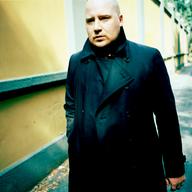
Remembering Jóhann Jóhannsson
Icelandic composer Jóhann Jóhannsson, who died on Friday, Feb. 9, at 48, was the rare experimental musician whose work crossed over to the general public. I remember tuning into the 2015 Golden Globe Awards and seeing Jóhann's face filling my TV screen... an odd feeling, since up to that point he seemed like one of "my" composers - you know, a really interesting musical outlier who would occasionally come to the New Sounds studio to share his work but who would probably remain a cult figure among a small circle of musical friends.
In retrospect, though, Jóhann's success in the film and TV industry seemed inevitable. From his first album, 2002's Englaborn, it was clear that Jóhann was a composer with a distinctive voice - his blend of classical instrumentation (string quartet, brass ensemble, and later full orchestra) with electronics had a spaciousness and serenity that seemed both effortless and elegant. I remember thinking, this would make a great score to a film. (In fact, Englaborn was a soundtrack - to a theater piece.) This turned out not be an original thought on my part; it seems that almost everyone who heard Jóhann's music thought it was dramatic and cinematic.
One of those people was the NY film maker Bill Morrison, who creates contemporary silent films out of found footage. In 2010, he put together a beautiful movie about the mining culture of northern England and asked Jóhann to do the music. The resulting piece, Miners' Hymns, contains some of Jóhann's grandest and most affecting music. In 2012, we presented the film with a live performance of the soundtrack at my annual concert series at Brookfield Place. "It's a really stunning version," he wrote in an email later, "much slower than on the record (I remember the music lasted a good minute longer than the film!) and with string quartet instead of organ, so it's really unique." He asked if his record label at the time, Fat Cat/130701, could have a track to release on a compilation they were doing, and we were happy to oblige. He signed off by breezily referring to "some other film projects" that he was working on.
We now know that those other film projects would include the scores to Denis Villeneuve's films Prisoners, Sicario, and Arrival. And of course, the award-winning music for James Marsh's The Theory of Everything. And it seemed Jóhann was being catapulted to the very top of the film industry when he was named the composer for Blade Runner 2049. That didn't work out, for whatever reason, but Jóhann's career was certainly in the ascendant; he moved from Fat Cat to the world's most prestigious classical music label, Deutsche Grammophon, and wrote music for the much-hyped Netflix TV series The OA.
His death yesterday in his Berlin home is a shock. At this time of writing there is no word on a cause, although an autopsy is pending. But while his death is now being widely covered by news organizations pointing to his film and TV work, I'd like to put in a word for the music Jóhann wrote for his own projects. Because even as his public music career took off, he continued to make his own records, and they are, I believe, his best work.
Hollywood makes very specific sorts of demands on a composer, and while Jóhann's Arrival score has some wonderfully oddball moments and sonic surprises, most of the soundtracks serve a different master. Left to his own devices, Jóhann often came up with startlingly original ideas. Check out, for example, his album IBM 1401: A User's Manual, inspired by Iceland's first mainframe computer, which was maintained by Jóhann's dad. His father programmed the computer to "sing," and a decades-old tape recording of that becomes the basis of a haunting and strangely moving piece called The Sun's Gone Dim and the Sky's Gone Black. And of course there's The Miners' Hymns, which is nominally a film score but is in essence an electroacoustic symphony to which the film is edited.
Jóhann Jóhannsson was obviously more than a cult figure among a small circle of friends. But he managed to travel in two very different musical circles - one much bigger than the other; and while you'll be able to hear his last film score when the movie Mary Magdalene comes out next month, you don't have to wait to hear the works that first made people take notice of his musical gifts.
Listen to this 2015 New Sounds interview with Jóhannsson which includes musical selections from Jóhannsson's Golden Globe-winning score to The Theory of Everything, his very first record, Englabörn, and music from his album, IBM 1401: A User’s Manual.
Listen to this 2012 New Sounds Live concert from Arts Brookfield of Jóhannsson's score to the Bill Morrison silent film The Miners Hymns performed live by the Wordless Music Orchestra:
Also, Jóhannsson had just finished a string of North American tour dates with ACME, and brought the chamber group into the studio for this Soundcheck session in 2016:
There's also this 2012 Soundcheck interview about The Miners Hymns:
Watch below the Bang on a Can All-Stars perform Jóhannsson's Hz from their 2015 album Field Recordings, live in The Greene Space at WNYC/WQXR.

WNYC is funded by sponsors and member donations