Report: School Choice Makes NYC Schools More Segregated
A new study released Wednesday challenges the argument that public school segregation in New York City results exclusively from segregated housing patterns, pointing to school choice as another, perhaps unexpected, factor.
“That can’t be true if almost half our students are choosing, and they’re choosing based on race, and class, and language class and their choices are contributing to a division of different racial and ethnic groups across the city,” said Nicole Mader, a senior fellow at The New School's Center for New York City Affairs.
By studying enrollment data for about 715,000 kindergarten students across a 10-year period, Mader, with co-authors Clara Hemphill and Qasim Abbas, found that schools would be more diverse if all students attended the schools in their neighborhood zones instead of choosing to enroll in other public schools or charter schools.
“Even if it’s beneficial to some individuals,” Mader said, school choice is “having a detrimental effect on some schools and communities.”
The issue was especially stark for schools in gentrifying school districts where about 60 percent of parents send their children to non-zoned kindergartens. At some schools in the historically black neighborhoods of Harlem, Bedford-Stuyvesant, Fort Greene, and Crown Heights less than 25 percent of children attended their zoned school.
"White parents are typically leaving schools that are much more concentrated with poverty and English language learners and black and Hispanic students and they're going to schools that have lower concentrations,” Mader said.
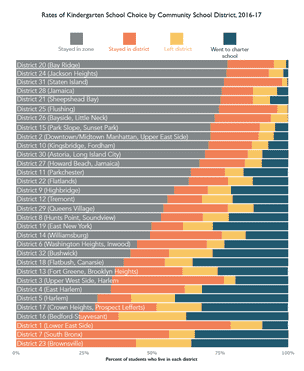
But the issue of school choice extended across racial lines during the years 2007-2017. Black students were the most likely to exercise school choice, often leaving for charter schools which opened up in many predominantly black neighborhoods.
The low enrollment left neighborhood schools with lower funding which meant lower performance metrics — a trend Mader said created a “vicious cycle” that exacerbated segregation.
Mayor Bill de Blasio has referred to housing segregation as “the root of the situation” when it comes to school segregation. “If we can create more diversity through housing and development, that is another way to get at the schools issue,” he told WNYC’s Brian Lehrer in 2016.
Schools Chancellor Richard Carranza delved into the debate on segregated schools with a late-night tweet that referred to “angry white parents” facing a policy shift that could serve to integrate schools on Manhattan's Upper West Side. Since taking office last month, he’s openly referred to racial demographics in schools as “segregation,” a word de Blasio notably avoids.
New York City schools are some of the most racially segregated in the country, according to a 2014 study by the UCLA Civil Rights Project. Analysis by WNYC found that half of the city's schools had student bodies that were more than 90 percent black and Latino during the 2015-2016 school year.

WNYC is funded by sponsors and member donations