An Exclusive Unearthed Track by Blues Legend Reverend Gary Davis
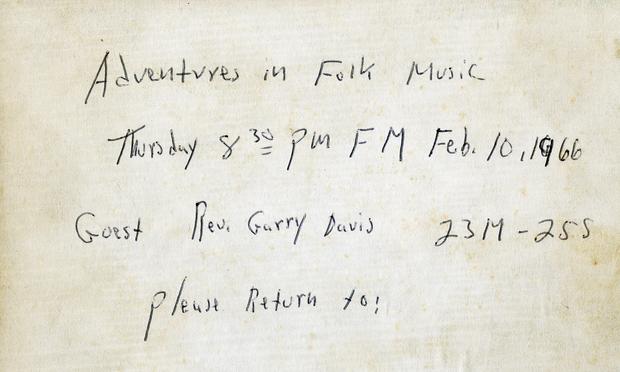
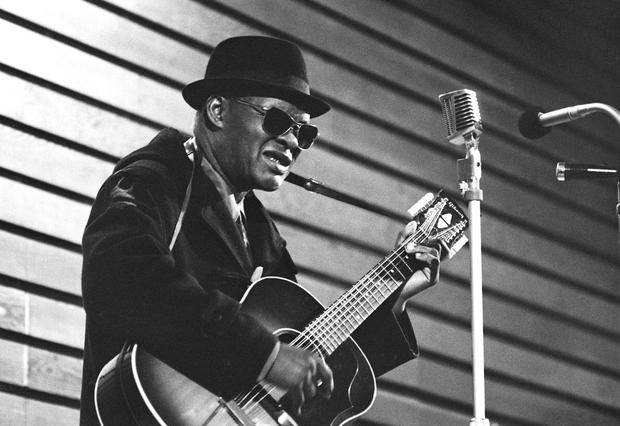
In 1966, in the midst of the blues revival, Reverend Gary Davis was arguably at the height of his fame. “Height” being a relative word here – the average American music fan, then or now, probably wouldn’t recognize his name. But Davis was a hugely influential figure, as evidenced by his effect on the pop and rock music of the 60s: Bob Dylan recorded one of his songs, so did Peter Paul & Mary. The Grateful Dead were big fans, and Jorma Kaukonen of Jefferson Airplane still plays a lot of Davis’s songs to this day. So the discovery in the WNYC archives of this 1966 studio visit is definitely one to take a closer look at.
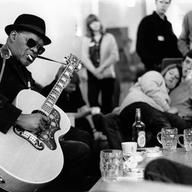
Reverend Gary Davis, who also recorded as Blind Gary Davis, was in fact an ordained Baptist minister (and blind), from the Piedmont region of South Carolina. He grew up playing the distinctive style of Piedmont blues and taught one of that style’s best-known figures, Blind Boy Fuller. But he moved to New York in the 50s, and for the next two decades, a series of (mostly white) guitarists beat a path to his door, to study the blues and to occasionally hear a little sermon. Dave Van Ronk, David Bromberg, Stefan Grossman… the list of his students is long and littered with well-known folk and blues musicians. At least one of whom confided that it was Mrs. Davis who was the more likely one to lay a little ol’ fashioned religion on you. The good reverend seems to have preferred sharing a drink and a song.
Anyway, this 1966 in-studio performance is notable for several reasons: first, the hosts. Henrietta Yurchenco will be a familiar name to fans of the WNYC Archives; she helped bring Lead Belly, Woody Guthrie, and others to a larger audience through WNYC in the early 1940s. And the folk musician Dave Sear, who would later go on to host the long-running Folk Music Almanac on WNYC, appears here as her co-host.
And second, there are the songs. Of the five tunes played here, two are hits; two more will be known to Davis fans; but the opener is a song that for the life of me I cannot identify, even after a Google search.
There is very little chat – the session sounds like it has been edited with a heavy hand. Davis launches into one of those moralizing, early gospel-tinged numbers where the different verses are actually mostly the same; usually a different first line in each verse leads to a repeat of the first verse’s conclusion. The Carter Family did a lot of this kind of singing – a song like “Sow ‘Em On the Mountain,” for example.
The second song is “There’s Destruction In This Land,” also known as “There’s Destruction On That Land.” Davis had a large repertoire, and this is one of a fairly large number of tunes from the country-ragtime tradition. Davis’s two-fingered picking technique is especially impressive in these songs.
After that comes one of the hits, though perhaps not one associated with Rev. Gary Davis. “You Got To Move” is a traditional blues that was popularized by Mississippi Fred McDowell, and then made famous by the Rolling Stones.
Next is “Children of Zion.” While the song moves along at a good clip, there’s a dark, almost ominous quality to the chord sequence. One of the things I’ve always loved about Davis’s songs is the elliptical but ecstatic imagery he often uses. In “The Light Of This World,” for example, he sings: “got fiery fingers/got fiery hands/when I get to heaven I’m gonna/play in the fiery band.” Here, after wondering in the first verse where his mama went, he sings: “she’s somewhere sitting in glory” (or in this performance, it sounds like he’s saying “she’s somewhere around in glory,” which is even more unusual and ecstatic.)
His grand finale is “Samson and Delilah” – also known as “If I Had My Way.” Originally associated with Blind Willie Johnson, Rev. Gary Davis’s version reached a much wider audience when it was covered by Peter, Paul & Mary in 1962.
Listening to the rough-hewn sound of Davis’s voice and his surprisingly intricate guitar technique is, for me, something that never gets old. I learned a couple of Davis’s songs, including “The Light Of This World” and “Death Don’t Have No Mercy,” from the playing of Jorma Kaukonen on one of my New Sounds Live concerts some years ago. The former took a bit of time to work out, and I was pretty damn pleased with myself for eventually getting it. I later told Jorma I’d figured out how to play his arrangement and he immediately said “oh, I’m almost embarrassed at how easy that one is.”
Oh well. We can’t all be guitar geniuses. But listen here to a man who truly was.

WNYC is funded by sponsors and member donations